

Marvel Super Heroes: Best Commander Cards Two Weeks In

Marvel Super Heroes Commander Format: Two Weeks Post-Release
Magic: The Gathering | Marvel Super Heroes released on June 26, 2026. Two weeks later, the Commander metagame has crystallized enough to identify the real power players. The set brought an explosion of options—there are 356 commanders in Magic: The Gathering's new Marvel set—but most of them are noise. The signal is clear: a small cluster of cards has proven itself across dozens of decks, and the rest are either theme-locked or mediocre. This is a Spike's breakdown: raw power, consistency, and win rate. No flavor hype. No "cool character" pushes that don't cash. Only cards that move game clocks or protect your plans.
The Tier 1 Non-Land Powerhouses for Commander
Two cards have emerged as the undisputed workhorses across every color and archetype: Cosmic Cube and Vision Quest.
Cosmic Cube reads, "Whenever you attack, look at the top six cards of your library. You may cast a spell from among them with mana value less than or equal to the greatest power among attacking creatures you control without paying its mana cost. Put the rest on the bottom of your library in a random order." This thing is going to be absurdly strong in basically any big creature deck you play. At five mana with a ward cost, it's repeatable tutoring on a stick. That's not a card advantage engine—it's a deck acceleration engine. Creatures matter? Cosmic Cube turns your threat into a spell-slinger. Control your board size, control your access to your deck.
Vision Quest is an X, one blue, and one red sorcery that allows you to fetch up an artifact creature with a mana value of X or less from your graveyard or library and put it into play with X +1/+1 counters on it. The mana cost is steep, but it doesn't matter in Commander. You're fetching from two zones—library and graveyard. If X is four or more, haste lands immediately. Artifact synergy decks, reanimator strategies, and pure value builds have all adopted this instantly.


Why the New Dual-Lands Are Standard-Beating Utility
Dark Fortress, Gleaming Bastion, Gathering Place, Training Compound, and Hidden Lair are all excellent. They come in untapped and can tap for colorless mana, but can also tap for one of two colors if they entered that turn, or if you control a basic land. You can't fetch these up using fetchlands, but they're still exceptionally strong, and are sure to find a place in most Commander decks. This is the real land cycle of the set. They're not flashy, but they solve mana constraints in ways that traditional dual lands don't. In three-color and four-color decks, these fill gaps without demanding fetches or sacrificing early plays. They're boring. They're also correct.


Focused Legends: The Cream Actually Rose
Among the 356 commanders in Magic: The Gathering's new Marvel set, only a handful merit building around. Most are narrow tribal payoffs or limited-format signposts. Here are the actual threats:
The Unbeatable Squirrel Girl: The Unbeatable Squirrel Girl is a four-mana mono-green Commander who creates a 1/1 Squirrel creature token whenever she enters or attacks. She also has a mana ability that costs the same as her casting cost, which creates X 1/1 Squirrel creature tokens where X is the number of Squirrels you control. Token decks thrive on exponential growth. This is exponential growth on a stick. Pair it with any doubling effect and you have a win condition by turn five or six. She's not flashy, but she's efficient.
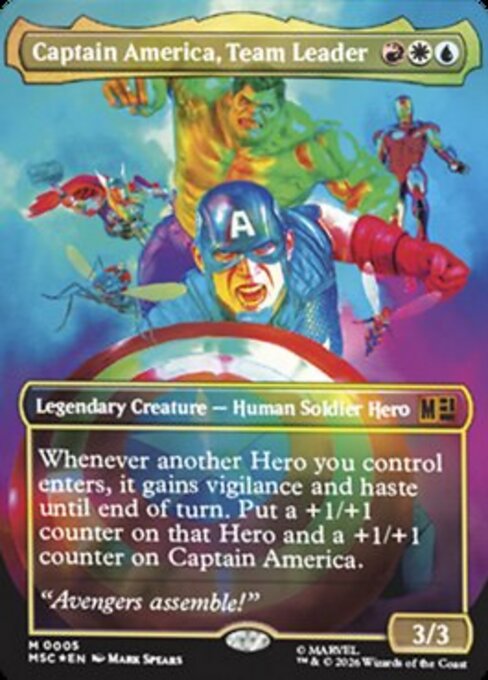
Captain America, Team Leader: He costs three mana and enters play as a 3/3. Where he starts to get very powerful, very quickly, is when you start casting more Hero creatures. For every Hero that enters, they gain Haste and Vigilance until the end of the turn. You also put a +1/+1 counter on it and Captain America, Team Leader. Hero tribal is real in this set. This is the payoff that makes it work. Early damage, anthem effects, card advantage through synergies. The precon is literally built for this.
The Scarlet Witch: Ignore the 'hero' part of this card, Scarlet Witch is an incredible commander for cheating the mana cost on big spells. Just Brainstorm your Omniscience onto the top of your deck, land a hit, and unleash a multiverse of madness. Red has enough pump spells to make her power relevant. Instant and sorcery cost reduction is frontloaded power in spell-slinger decks. This is tier 1 if you have the shell.


The Contenders Worth Watching
A few others merit inclusion in growing metas:
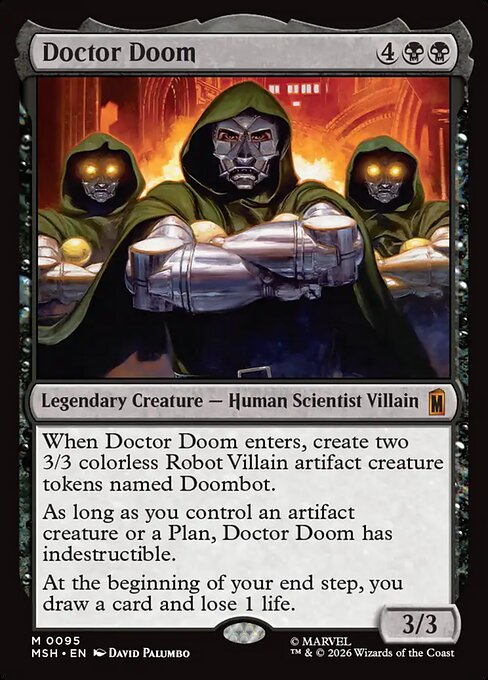
Doctor Doom: Doctor Doom himself seems a bit small as a 3/3 for six mana, but as befitting a Villain of his stature he brings a lot to the party. He enters with two 3/3 Doombots, and so long as you control an artifact creature or a Plan, Doom has indestructible. Darksteel Myr and Darksteel Colossus are going to get a lot of work in future Commander decks led by Doom! And if that wasn't enough, at the beginning of your end step, you draw a card and lose a life. Villain decks are a real archetype here. Doom is their payoff.
Molecule Man: Molecule Man is an impressive new six-mana 5/5 with no colors, so it can go in any deck or become one of the strongest colorless Commanders. This creature grants all of your nonland cards a miracle cost of zero, which means that if it's the first card you draw during a turn, you can cast it for free. That's obscenely strong, and means it's easy to put into so very many decks. The upside is meme-worthy. The reality is efficient. Free spells matter.

Non-Commander Legends Making Noise
Mjolnir is probably one the best cards in the set; a Flame Lash stapled to a damage doubler for legends, with the ability to instant speed discard it to Pyroclasm in a way that's harder to be countered. Equipment decks already existed. Mjolnir is the glue that makes them consistent. Red and white legend decks now have a real payoff. It's not format-warping, but it's format-elevating.
Mjolnir, Hammer of Thor appears in nearly every Boros and Gruul legends list. The cost reduction from attached legends is just math that works.

The Red Flags: What Flopped or Is Overhyped
A few cards entered as "must-plays" but have already faded:
Most transform legends: They're fun. They're not consistent. The front side of Tony Stark sets up the Iron Man back side so well you can't imagine not running Tony out first and working it for a while before transforming. You'll want powerful Equipment cards to eventually attach to the Iron Man side, but you'll stuff your deck with a bunch of other artifacts to ensure you never miss with activating. That's a deckbuilding constraint, not a powerhouse. They're playable, not tier 1.
Narrow tribal payoffs: Hero synergies and Villain synergies exist, but most are context-locked. Play them only if you commit fully to the tribe.
The Real Takeaway: Fundamentals Over Flavor
The main set alone features 270 brand-new cards. On top of this, there are 385 new designs in the set's eternal-legal section, spread across Commander decks, the Jumpstart set, Scene Boxes, and Welcome decks. Many of the new cards here are incredibly powerful, too, with implications in a range of MTG formats. But the signal-to-noise ratio is harsh. Of those 655 new cards total, maybe 20 are actually format-defining in Commander. The rest are good, fine, or fluff.
The winners two weeks in are the generalists: tutoring engines like Cosmic Cube, slot-fillers like the new duals, and commanders that reward the broad strategies people already wanted to play. The losers are the narrow flavor wins—cards that feel like Marvel but don't pull their weight in actual gameplay.
Build around the utility. The theme will follow.
Where the Format Settles From Here
Most major Commander staples from Marvel Super Heroes have already established themselves. Expect minor refinements and edge picks as the metagame matures, but the set's ceiling and floor are now visible. It's a strong set for Commander—probably the strongest Universes Beyond release for the format—but it doesn't warp the format around itself. It fills gaps. That's often more valuable than any flashy home run.


Comments
Join the conversation.