

Magic: The Gathering Board Layout & Game Zones Explained
Understanding Magic: The Gathering Game Zones (The Basics)
Magic: The Gathering uses seven zones: the library, the hand, the battlefield, the graveyard, the stack, exile, and the command zone. Don't let that intimidate you—each zone has a simple job, and once you know what they do, reading the board becomes natural. Let's break down how your first game will actually look.
This is Part 1 of our beginner series, "How to Play Magic: The Gathering for Beginners." By the end of this guide, you'll know exactly where every card belongs and why it matters.
How to Read a Magic Card (Before You Play)
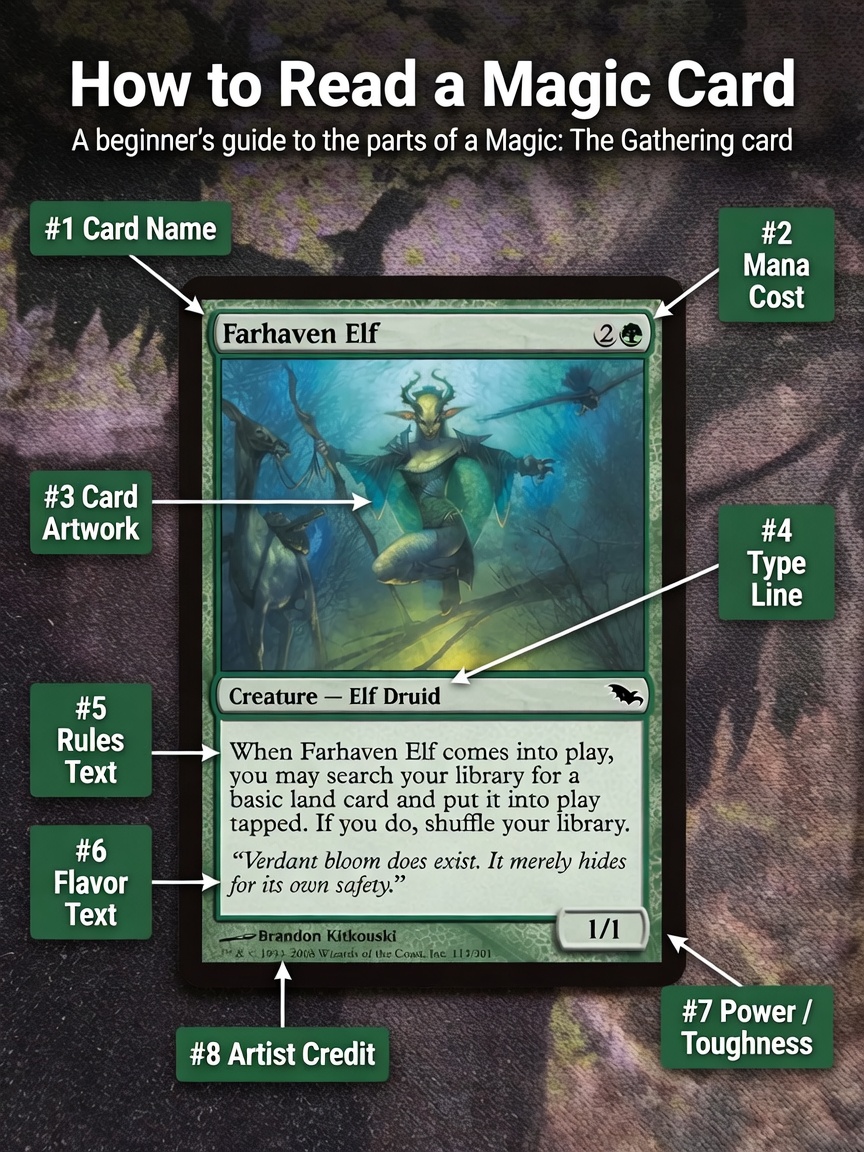
Before we talk about zones, you need to understand what information lives on a Magic card—because the card tells you everything you need to play it.
The Mana Cost (Top Right)
At the top right is the mana cost — a combination of numbers and symbols that show what you need to pay to cast the card. Think of mana as Magic’s “currency.” The colored symbols tell you which specific colors of mana are required. A gray circle with a number inside represents generic mana, meaning you can pay that cost with any color of mana.
The Type Line (Below the Art)
Right below the artwork is the type line. This line tells you what kind of card it is and often includes more specific information called subtypes.
The main card types are: Land, Creature, Artifact, Enchantment, Instant, Sorcery, and Planeswalker.
Many cards also have subtypes that appear after the main type. Here are some common examples:
- Creature types: Goblin, Elf, Dragon, Zombie, etc.
- Artifact subtypes: Vehicles and Equipment (these can be attached to creatures)
- Enchantment subtypes: Sagas and Auras (Auras attach to other permanents)
- Legendary: A special supertype that usually means you may only have one copy of that card can be on the battlefield at a time (very common in Commander)
Rules Text & Abilities (Text Box)
The text box contains the card's special abilities—what makes it unique. Some cards have a lot of text; others have almost none. All the mechanics you need to use the card are spelled out here.
Power and Toughness (Bottom Right—Creatures Only)
Only creatures have this. It tells players the power (left number) and toughness (right number) of a creature. Power dictates how much damage the creature can place upon other creatures in combat, while toughness is how much damage it can take before it's destroyed.
Flavor Text & Art
The illustration is the big picture taking up the upper half of the card. It has no rules meaning, but it's gorgeous and helps you imagine the world of Magic. Below the rules text, you might see italicized flavor text—that's just story flavor, not a game rule.
Magic: The Gathering Game Zones Explained
Your Library (Your Deck)
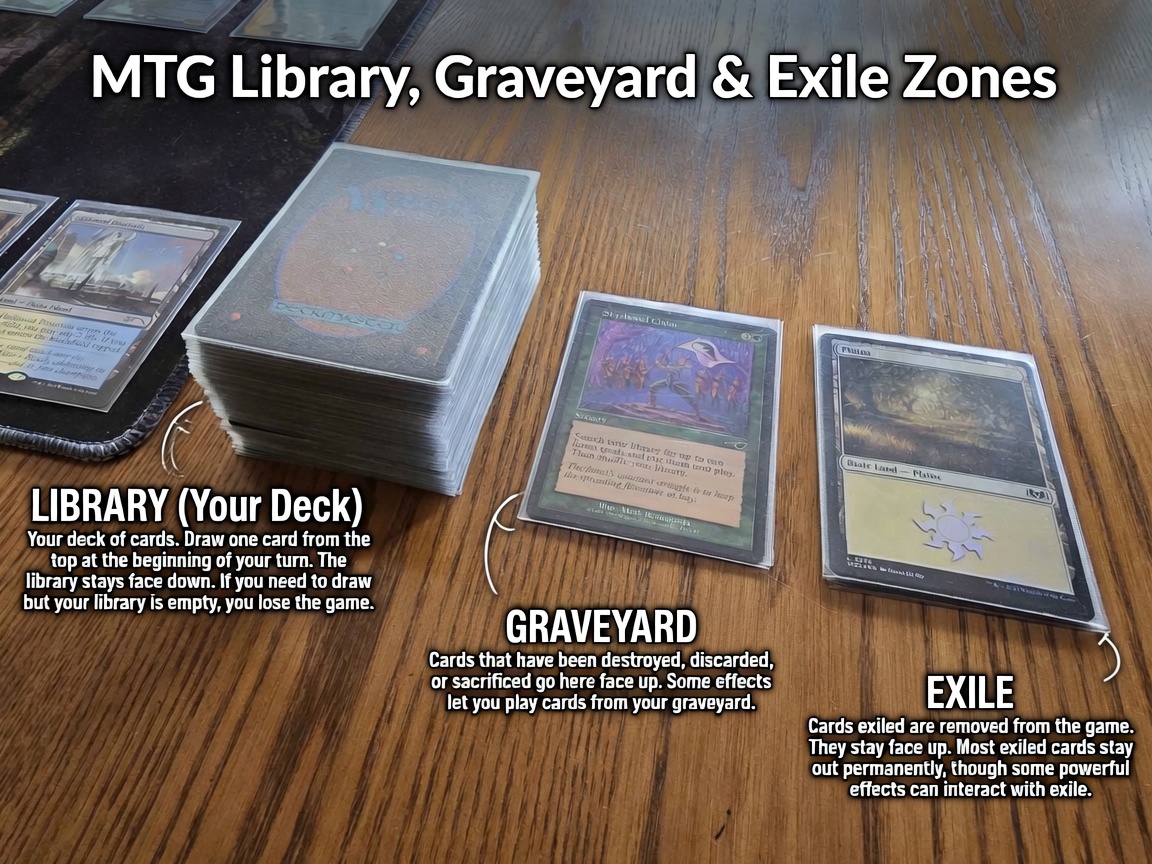
Your library is your deck, from which you draw cards. No player can look at or rearrange the cards of any library unless an effect (like scry or surveil) allows them to. Keep it face-down in a single pile on either side of your battlefield. During a game, you'll draw cards from the top of your library.
Your Hand
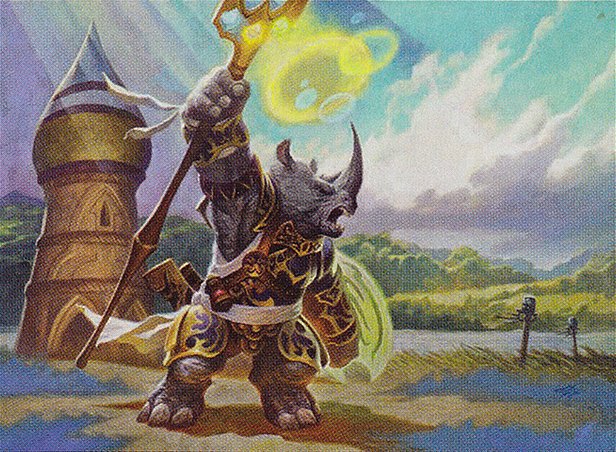
The hand is private—only the controlling player sees its contents, under normal circumstances. This is where your cards live after you draw them and before you cast them. You hold them where only you can see them. You're maximum hand size is 7, unless you have cards out that say otherwise like Reliquary Tower.
The Battlefield
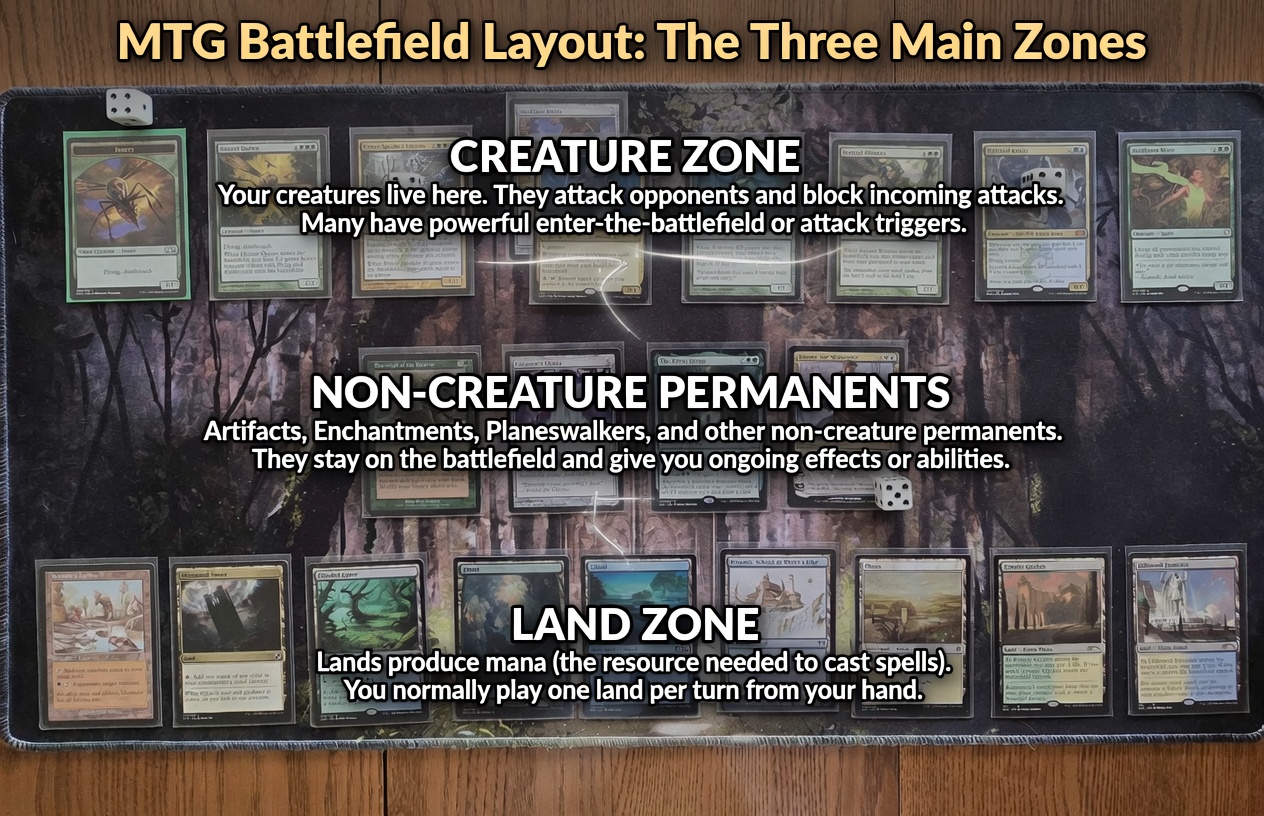
The battlefield is Magic's game board. This is where permanents go, and where most of the action takes place in the majority of games. All the creatures, enchantments, artifacts, and lands that both players have in play are here. Unlike your hand, the battlefield is public—everyone can see what's in play. Each player has their own hand and library, but there's a single battlefield that's shared by all players.
Your Graveyard (Discard Pile)
Your graveyard is your discard pile. Permanents that are destroyed or sacrificed end up there; so do instant or sorceries after they resolve, and any spell that's countered. Keep it face-up in a pile separate from your deck. Unlike your hand, your graveyard is public—your opponent can always look at it. Some cards interact with your graveyard, so keeping it organized (in order) is helpful later, though it's not critical as a beginner.
The Stack
The stack is the game zone where spells and abilities are put when they are played and where they wait to resolve. The stack system allows players to "respond" to the actions of other players before those actions take full effect, enabling interactive gameplay even with "instantaneous" effects. Here's the key: when you cast a spell, it doesn't happen right away. It goes to the stack, and your opponent gets a chance to respond before it resolves. This is where the interactivity of Magic shines. Don't worry too much about this one for your first game—it'll click once you play.
Exile (Removed from Game)
Exile—sometimes called "the removed from game zone" in older rules texts. Cards here are typically unreachable, though a growing body of card effects since the Mirrodin block have given exile interactive properties. If a card says "exile this," it goes to a separate public pile. Cards in exile can't be used unless a spell or ability brings them back into the game.
The Command Zone (Commander Format)
The command zone exists only in specific formats. In Commander, a commander that would move to the graveyard or exile can instead be placed here by its owner, allowing future recast. If you're just learning to play, you don't need to worry about this yet. But if you ever play Commander (a popular casual format), your commander lives here when it's not on the battlefield.
A Quick Visual: How the Board Should Look
How to Set Up Your First Game: Step-by-Step
Step 1: Shuffle Your Deck
At the start of a Magic game, each player shuffles their deck so that the cards are in a random order. Each player may then shuffle or cut their opponents' decks. This ensures fairness and randomness. Shuffle until you feel confident the deck is randomized.
Step 2: Draw Your Opening Hand
Each player draws a number of cards equal to their starting hand size, which is normally seven. You might mulligan (redraw) if they're bad, usually from too few or too many lands.
Step 3: Decide Who Goes First
The players determine which one of them will choose who takes the first turn. In the first game of a match, the players may use any mutually agreeable method (flipping a coin, rolling dice, etc.) to do so. Whoever goes first is called the "starting player." Going first is usually good but not always—it depends on your deck.
Step 4: Set Your Life Total
You both start at 20 life (or 40 if you're playing Commander). Use the free Nerd Leagues Life Tracker app, which handles life totals (and commander damage, if you ever play Commander).
iOS - Download here!
Android - Coming Soon!
Step 5: Play!
The starting player takes the first turn. On each turn, you'll play lands, cast spells, and attack with creatures. Your opponent does the same. Keep track of the zones and life totals, and have fun!
Ready to Learn Turn Phases?
Now that you understand the board and zones, you're ready for the next step: learning how turns actually work. In Part 2 of this series, we'll walk through the phases of a Magic turn so you know exactly what you can do on your turn and when your opponent gets priority.
Until then, practice identifying zones while watching Magic videos or reading cards. The more you see these concepts in action, the faster they'll stick.
Track your games like a pro: Try the free Nerd Leagues Life Tracker to handle life totals, poison counters, and commander damage. It's built by players, for players.
- 1 Magic: The Gathering Board Layout & Game Zones Explained You are here 2 Magic: The Gathering Turn Phases Explained for Beginners 3 All Evergreen MTG Keywords Explained 4 MTG Stack and Priority Explained: When Can You Respond? 5 The Combat Phase in Magic: The Gathering, Step by Step

Comments
Join the conversation.