

Power Nine: The Nine Cards That Broke Magic Forever
What Is The Power Nine In Magic: The Gathering?
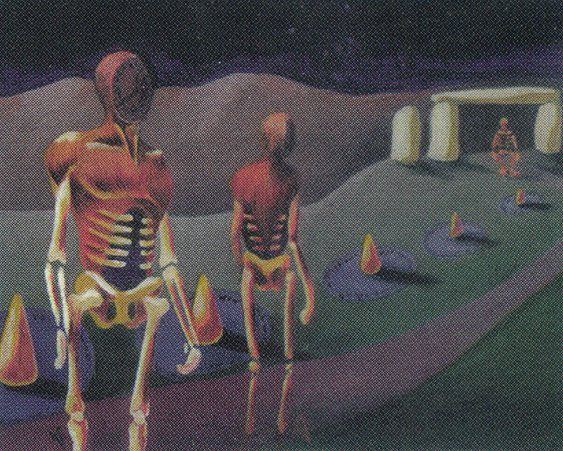
The Power Nine are nine rare cards found in Alpha, Beta, and Unlimited: Black Lotus, Ancestral Recall, Time Walk, Mox Emerald, Mox Jet, Mox Pearl, Mox Ruby, Mox Sapphire, and Timetwister. These cards are widely considered to be the most powerful cards ever printed. In games where they are legal, they play an important role in the competitive tournament atmosphere.
But here's the thing: they're so dominant that in 1994, when Wizards of the Coast decided to create sanctioned tournament play, the Power 9 were restricted in the very first Banned & Restricted announcement, meaning you could only play one of them per deck. That restriction has never been lifted. They are only legal in Vintage in which they are restricted, meaning a deck may not contain more than one copy of the cards.
The Three Blue Cards: Drawing, Taking Turns, Resetting
Blue gets three of the nine, and that's not an accident. During the Gamma design phase of Magic: The Gathering, both Ancestral Recall and Time Walk were common cards; Richard Garfield stated that blue "was easily the most powerful magic, having two extremely insidious common spells", so each was made a rare card before publication.
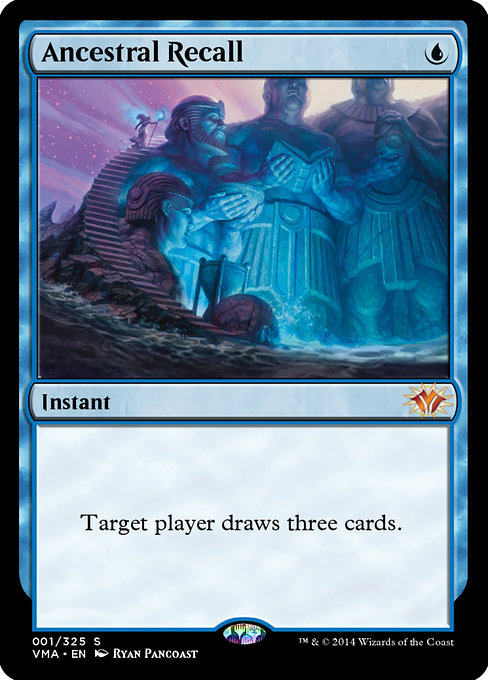
Ancestral Recall costs one blue mana and reads: target player draws three cards. That's it. That's the card. Ancestral Recall was deemed "vastly too powerful"; the functionally similar card Inspiration that was included in the core Sixth Edition allows a player to draw two cards instead of three, at a cost of one blue and three other mana, instead of one blue mana. In constructed formats where this card is legal (Vintage only), it's a format-defining staple because for its extremely low cost of a single blue mana, Ancestral Recall allows a player to gain +2 card advantage (3 cards drawn minus 1 card "spent" in casting Ancestral Recall) at the speed of an instant. No card has ever come close to doing this as cheaply and consistently as Ancestral Recall.
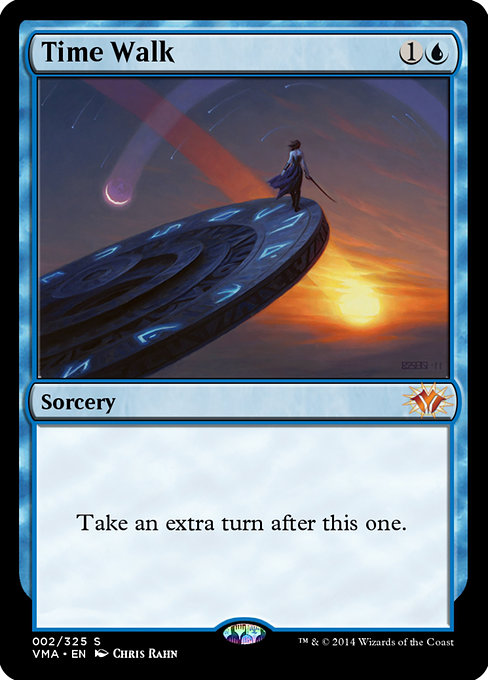
Time Walk costs two mana and gives you an extra turn. Time Walk allows the player to take an extra turn for two mana. In contrast, the equivalent effect of Nexus of Fate costs seven mana. Two turns in a row in the early game of a Vintage format stack is a win condition on its own.
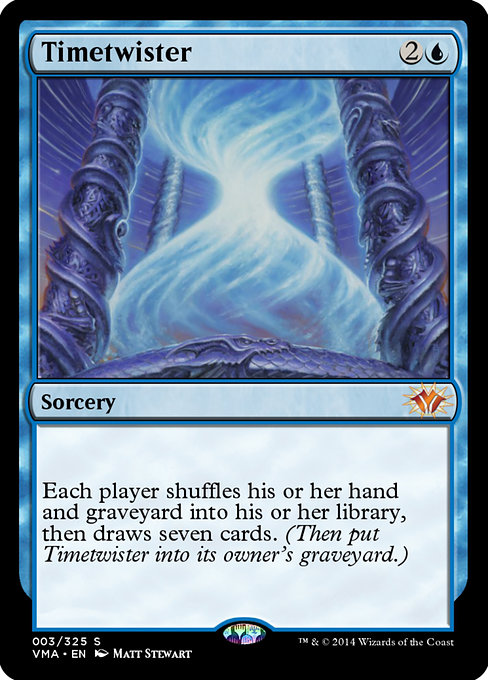
Timetwister costs two mana and is the "runt of the litter" by comparison. Timetwister remains unbanned because it is the runt of the Power 9 litter. It's simply less powerful than the other 8 cards. This is backed up by data, as the other 8 cards in the Power 9 are staples in Vintage, while Timetwister only sees play sporadically. That said, Timetwister is legal in Commander and Oathbreaker, making it the only member of the Power Nine not to be banned or restricted in all formats.
The Five Moxen: Free Mana, Every Turn
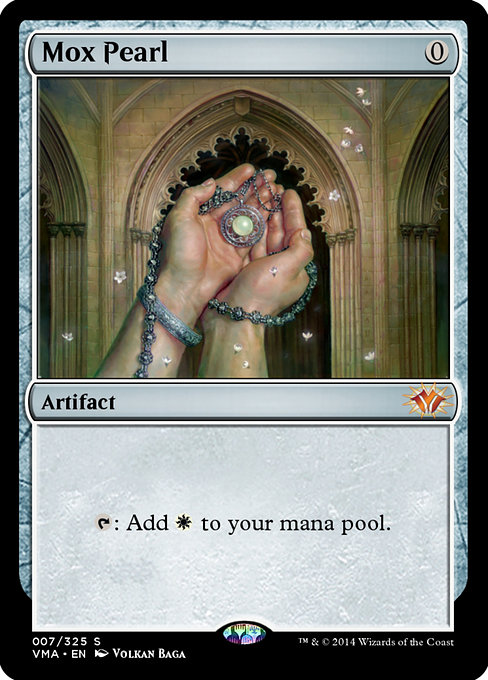
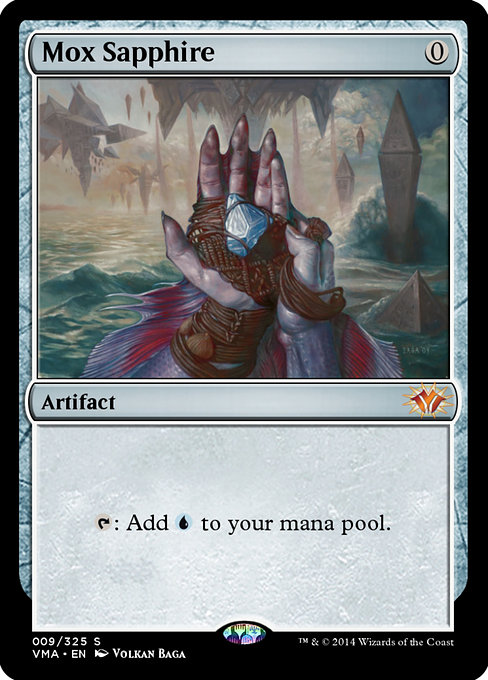
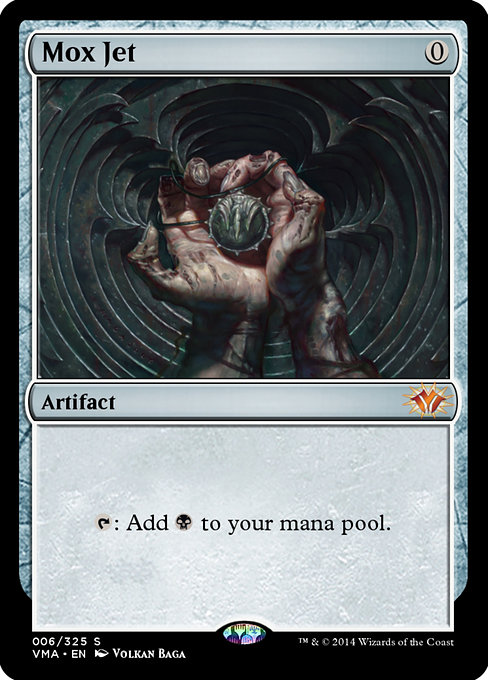
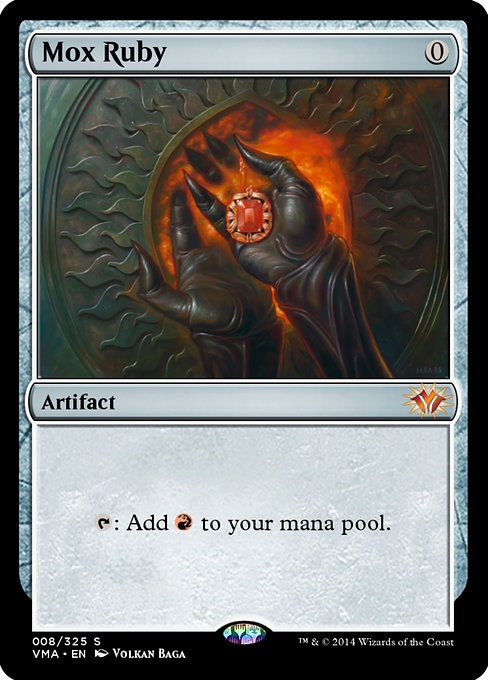
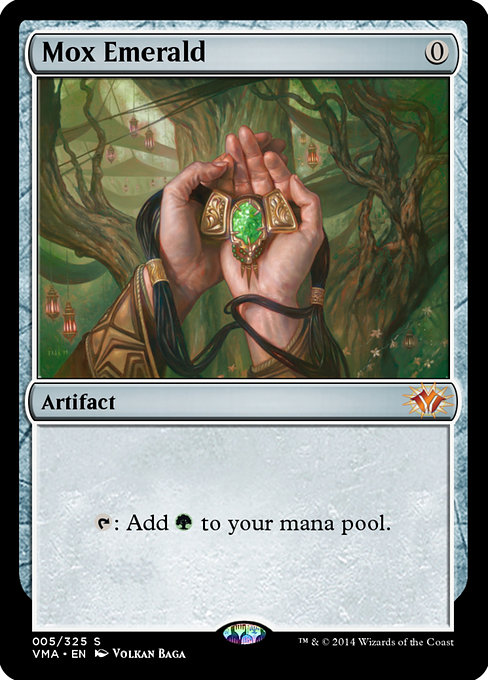
The five Mox cards are colloquially known as "Moxen" or "Moxes", and each represents one of the Magic: The Gathering colors. These cards are similar to the five basic lands in that they cost nothing to play and can add one mana of a specific color to their owner's resource pool. Unlike lands, however, more than one can be played per turn.
That last sentence is key. A Mox is not a land. You can play Mox Sapphire, Mox Pearl, Mox Jet, Mox Ruby, and Mox Emerald all in the same turn if you have them in hand. Before the four-copy deck restriction and before the restricted list existed, players would just run four of each Mox and skip basic lands entirely. The five Mox cards are notable in that they are almost strictly better than land as a mana source. In fact, in the days before their restriction to one card per deck, it wasn't uncommon for players to forego running basic land cards altogether in exchange for four sets of "Jewelry," the reason being that they do not have the "play only one per turn" restriction that land cards have.
Black Lotus: The Most Broken Artifact Ever Printed
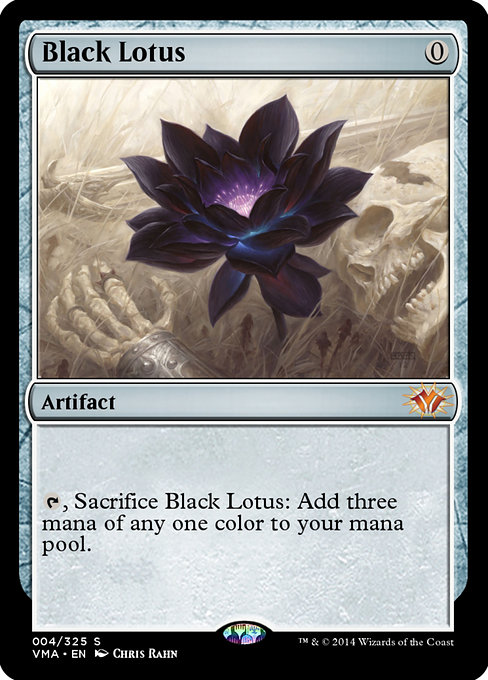
The "Black Lotus" card can be played at zero cost, and it grants three mana (the game's primary resource) when sacrificed (discarded from play). That's the effect. Three mana for free, one time only.
The impact: turn-one Black Lotus into a four-cost threat. In Vintage, where you have Timetwister, the Moxen, and Dark Ritual in the format, a turn-one Lotus can chain into enough acceleration that a player goes from zero to completely unbeatable in sixty seconds of game time.
Former Pro player and Magic writer Zvi Mowshowitz has declared Black Lotus as the best artifact of all time, claiming every deck in the history of the game is better with a Black Lotus in it. That's not hyperbole in context. That's competitive analysis.
Why The Power Nine Are Effectively Banned Everywhere
They are only legal in Vintage in which they are restricted, meaning a deck may not contain more than one copy of the cards. They're banned in Legacy, banned in Modern, banned in Standard, and banned in Commander (except Timetwister, the exception that proves the rule).
The reason is simple: Due to their power, these nine cards are considered "broken" (overwhelmingly powerful). There is no reasonable way to balance a format around "play zero mana for three mana of any color" or "draw three cards for one mana" without removing other tools. Wizards chose to restrict them in Vintage—the format explicitly designed to be powerful—and ban them everywhere else.
The Price Tag: Collector's Items, Not Playable Cards
Black Lotus is usually considered by collectors to be the most valuable non-promotional Magic card due to its limited print and limited distribution. There were 22,800 copies of the card printed overall, about 1,100 in the Alpha edition, and about 3,300 in the Beta edition. That's it. Ever. All of the Power Nine cards are on the Reserved List, preventing them from being reprinted in a tournament legal paper product.
Recent sales show the scale: An Alpha CGC graded at 10 sold for $3,000,000 in 2024. That's a single card. A playable, tournament-legal Black Lotus in Alpha can run into five or six figures depending on condition. The final ranking includes classic Power Nine cards like Alpha Ancestral Recall, Alpha Mox Sapphire, Unlimited/Beta/Alpha Black Lotus as among the most expensive cards on the secondary market as of July 2026.
The Design Philosophy That Created Them
During playtesting before the release of the Alpha edition, the Power Nine were deemed to be powerful cards whose scarcity would ensure the cards would not overpower games, but as print runs increased for each set the design team ultimately decided to remove the cards for the Revised Edition release. In other words: Richard Garfield knew. He printed cards that he hoped would be too rare to break the game. That plan failed spectacularly, and by the time more Unlimited copies hit the market, Wizards pulled the plug and never looked back.
The rarity of many cards was based on the idea that players would have a limited set of cards in a particular area, such that there would only be a few copies of Mox Sapphire or Black Lotus in a particular area, thus naturally restricting the power of these cards. The rapid popularity of the game created a much larger community of players than initially anticipated, making it possible for players to amass large collections of these powerful cards.
The Verdict: Still Unmatched After 33 Years
The Power Nine represent the high-water mark for raw card power in Magic history. No other suite of nine cards has ever been restricted to one-of in a constructed format and kept there without exception for over three decades. Cards like Sol Ring, Yawgmoth's Will, and Tinker are objectively powerful, but they're not restricted. Only the Power Nine command that level of respect—and fear.
For competitive players, they're a format unto themselves: Vintage exists because these nine cards exist. For collectors, they're the crown jewels of the game. For everyone else, they're legend—cards so powerful and so scarce that most Magic players will never hold one in their hands, let alone cast it in a game that matters.
That's the Power Nine. That's why Magic as a competitive game had to invent restrictions on day one of organized play. And that's why, even today, every single one of them costs more than a car.



Comments
Join the conversation.