

Best Commanders for Control Decks in EDH

The Best Commanders for Control in Multiplayer Magic: The Gathering EDH
In multiplayer Commander — three or four opponents, bigger life totals, a hundred-card singleton deck — control becomes a genuinely different and harder puzzle. Unlike one-on-one formats, the core problem is simple math: you have one set of answers and three sets of threats. A counterspell trades one-for-one, but you're outnumbered three-to-one. This guide highlights five control commanders that crack the multiplayer puzzle by generating enough card advantage, board wipes, and recursion to stay ahead of the table.
Why Control Decks Thrive in Multiplayer Commander
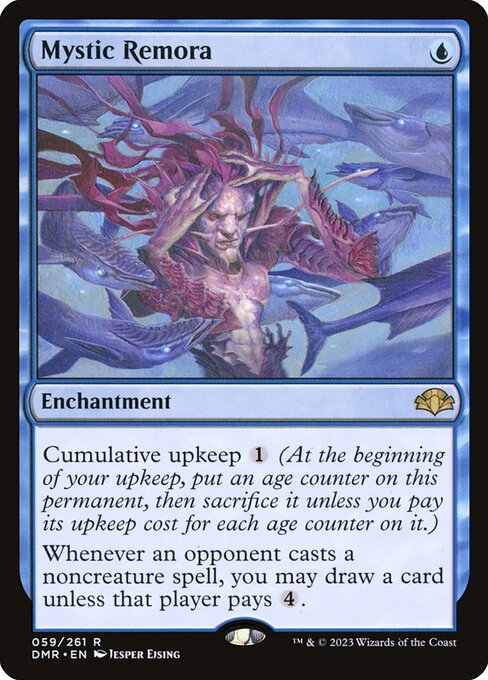
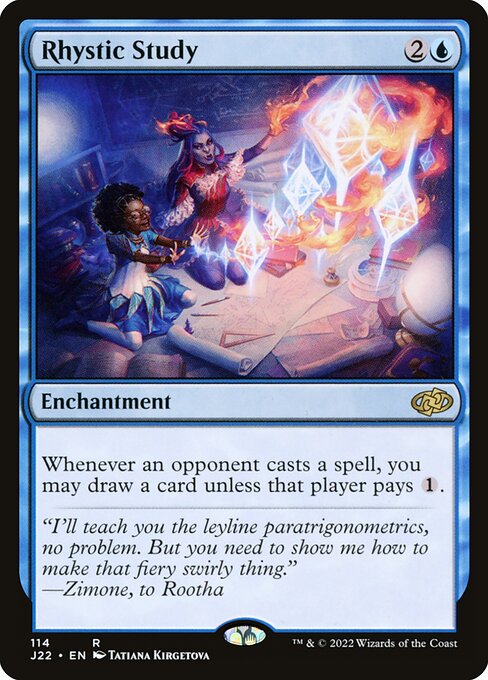
In general, control tends to be one of the strongest archetypes in Commander because the format is multiplayer in nature. It's easier to play defense and "not die" than it is to beat down three opponents with 40 life each. However, card advantage is what makes control mathematically possible in multiplayer — it's how you refill faster than you deplete. Prioritize repeatable draw over one-shot cantrips. A draw engine that ticks every turn (an enchantment like Rhystic Study or Mystic Remora, a planeswalker that generates value, a recurring artifact) compounds across a long game in a way a single "draw two" never will.
1. Rashmi, Eternities Crafter – The Instant-Speed Value Engine
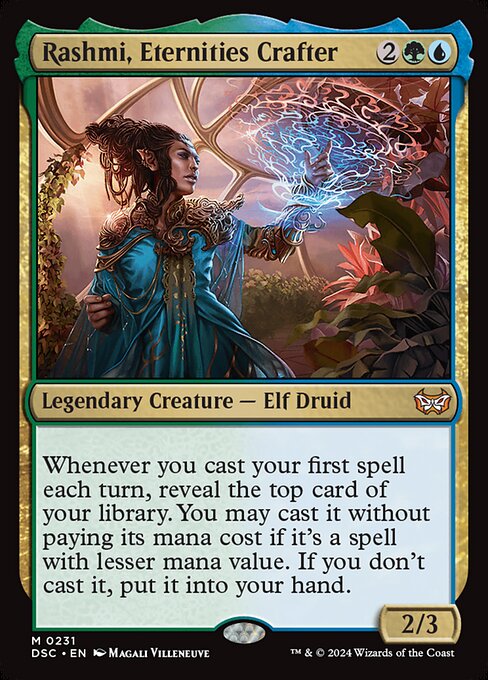
One of the best control commanders around is Rashmi, Eternities Crafter. This Elf Druid lets you reveal the top card of your library after you cast your first spell each turn. So long as the revealed card has a mana value less than the spell you cast, you can cast it for free. If you can't cast it this way, or it's a land, you put that card into your hand.
Rashmi, Eternities Crafter is an extremely popular 2-Color Elf commander and format staple. She specializes in flash and control strategies. Stay engaged at all times with this interactive deck that thrives on playing during your opponents' turns, disrupting their plans and generating relentless value. Packed with instants and flash creatures to respond to anything your opponents throw your way. Generate endless value and card advantage with Rashmi and a suite of card draw and ramp spells.
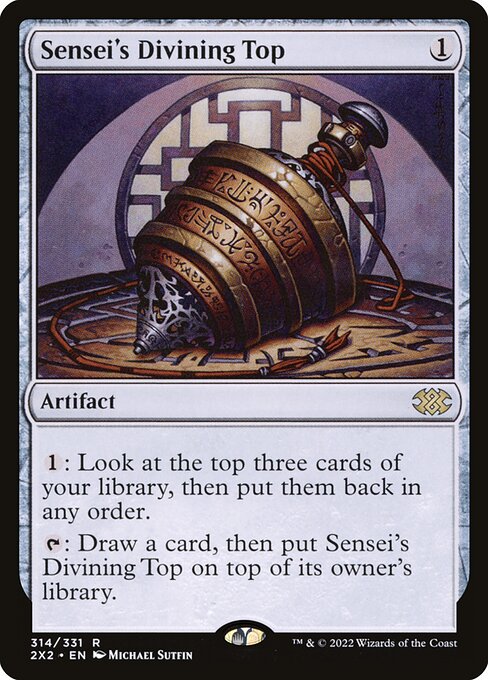
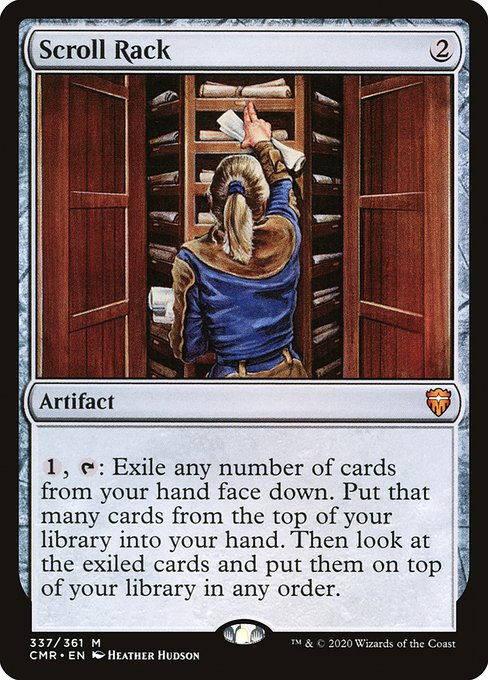
Why it works in control: Rashmi rewards instant-speed play, letting you hold up mana for answers while still generating card advantage when you cast them. You'll want a number of cards to manipulate the top card of your library in some way, like Sensei's Divining Top or Scroll Rack, so you can have some measure of control over what card will appear on the top of your deck.
2. Azami, Lady of Scrolls – The Wizard Tribal Draw Machine
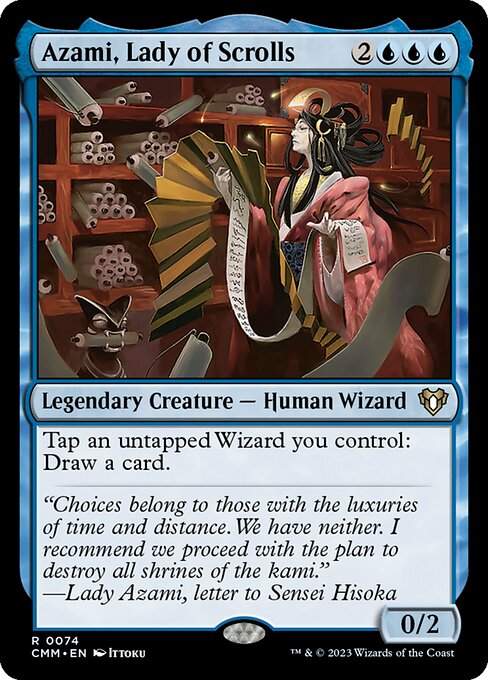
One of the oldest Wizard Kindred commanders in Magic, Azami, Lady of Scrolls takes all your Wizard creatures and turns them into potential card draw. With Azami out, you can tap any of your Wizard creatures to draw a card, which is exceptionally straightforward and very easy to have spiral out of control. The neat thing with Azami is that you don't have to wait to tap those Wizards - you can do it as soon as they enter the battlefield.
Azami is a commander-centric tribal control deck that seeks to develop a board of cheap impactful wizards and leverage them for card advantage all whilst policing the board and preventing other from winning. Azami usually plays as a mostly draw-go style build. Where you play a land, maybe drop a cheap wizard and pass, trying to save most of your game actions until the endstep before your turn, or deploying interaction as needed.
Why it works in control: Every wizard you cast is another outlet for card draw, letting you sculpt your hand in response to the table's threats. The draw-go style keeps mana open for counterspells and removal while you build your wizard engine.
3. Kess, Dissident Mage – The Spellslinger Control Powerhouse
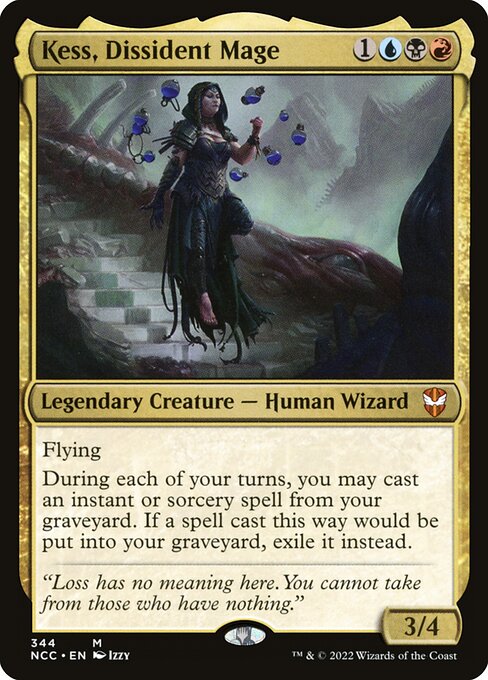
As a Grixis (black, blue, and red) commander, Kess, Dissident Mage is already primed to be a great control Commander due to having access to many of the best counterspells and removal options ever printed. Kess states that, once during each of your turns, you can cast an instant or sorcery from your graveyard, effectively providing each spell of these types with flashback.
This means that each of your powerful control spells can do double duty, being castable twice per game, significantly improving their consistency as well as your flexibility when choosing which spells to cast. Because of that, Kess decks will nearly never run out of gas, consistently maintaining the ability to control the board.
Why it works in control: Kess solves the card disadvantage problem by letting your best answers do double duty. Casting a counterspell twice per game or recurring a board wipe from the graveyard keeps you in the game against three opponents.
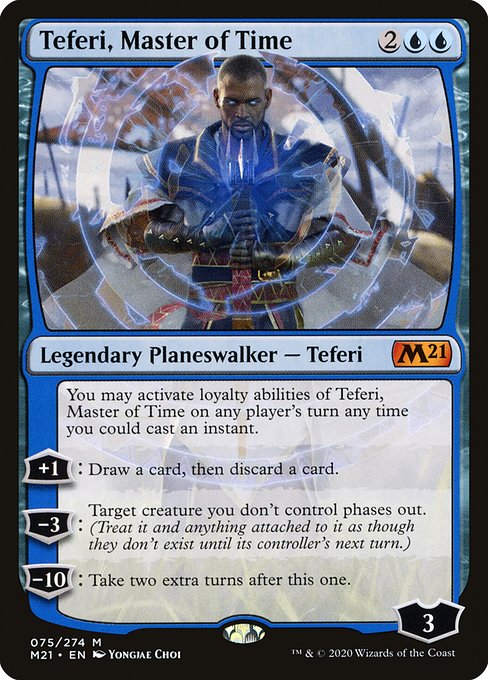
4. Teferi, Master of Time – The Instant-Speed Planeswalker Control
You may activate loyalty abilities of Teferi on any player's turn any time you could cast an instant.+1: Draw a card, then discard a card.−3: Target creature you don't control phases out. This unique design makes Teferi, Master of Time a flexible control tool that operates at instant speed.
As a planeswalker commander, Teferi provides repeatable card draw and creature removal on demand, without requiring you to tap out. The ability to phase out threatening creatures lets you answer problems without committing resources to the board, a critical advantage in multiplayer where threats emerge constantly.
Why it works in control: The instant-speed activation means you maintain mana open for counterspells while still generating value. Phasing out creatures is tempo-efficient removal that doesn't trigger "when" triggers, making it uniquely powerful against the format's engine-heavy decks.
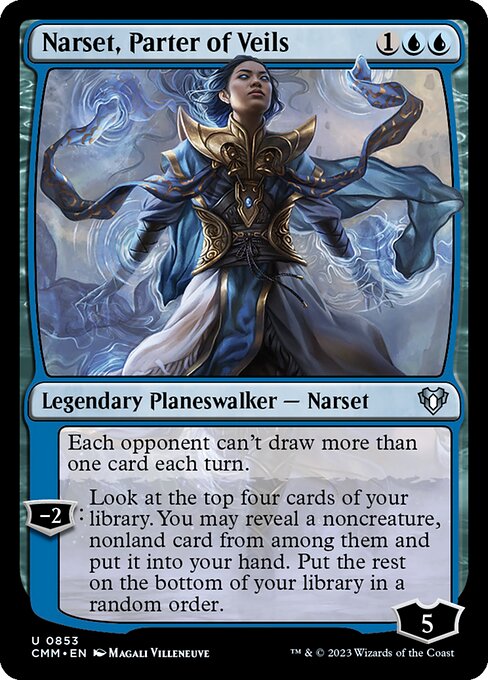
5. Narset, Parter of Veils – The Draw Denial Soft Lock
Narset, Parter of Veils is 
 • Legendary Planeswalker — Narset • Loyalty: 5 • Each opponent can't draw more than one card each turn. In control builds, Narset acts as both a card filter and a soft lock, giving you time to stabilise while opponents flounder.
Combo Breaker: Narset disrupts decks that rely on drawing into combo pieces, forcing them to pivot or stall. In a multiplayer table where card draw runs rampant, Narset's static ability is a powerful asymmetrical effect that slows the format's fastest decks while Narset's -2 ability lets you dig for your own answers.
Why it works in control: As control becomes more popular, opponents lean on card draw to find answers. Narset punishes this strategy while you sculpt your own answers from the top of your deck, creating a potent mana advantage as the game progresses.
Building Around Your Control Commander
Regardless of which commander you choose, successful multiplayer control decks share common principles: Control decks run a high density of diverse answers — spot removal, board wipes, counterspells — and prefer to hold mana open rather than commit to the board, so they can respond to whatever develops. They favor cheap, efficient answers (paying one mana to remove a card an opponent spent five on is a winning exchange) and instant-speed effects that let them keep that mana up.
Include a mix of single-target removal, board wipes, and counterspells, but balance this with repeatable draw engines. Remember: a subtle but powerful Commander control tool is commander denial. Locking an opponent's commander in the command zone (Drannith Magistrate), stealing it, or otherwise shutting off its value can permanently defang a deck in a way a single counter never will. Against value-engine commanders, that's often more important than countering any one spell.
The Control Mirror in Multiplayer EDH
When multiple control decks sit down at the same table, the game often shifts toward attrition and card advantage. These five commanders excel in that environment because they generate value faster than pure counters and removal. Rashmi and Azami draw cards; Kess recycles answers; Teferi phases out threats while drawing; Narset filters your deck while denying opponents. The best control commander for your table is the one that generates the most value while answering the threats you actually face.




Comments
Join the conversation.