

The Wise Mothman Commander Deck: A Bracket 3 Build Where Milled Cards Grow the Team
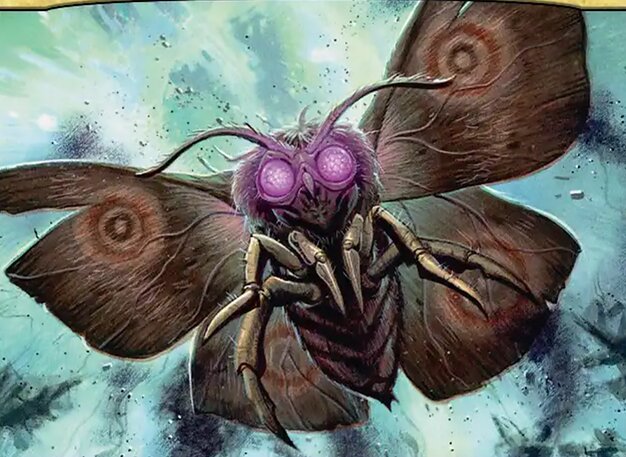
The Wise Mothman commander deck is a mill deck that never has to mill anyone out. Milling is putting cards from the top of a library into the graveyard. The Wise Mothman puts a +1/+1 counter on a creature for every nonland card that gets milled, by anyone, and the other ninety-nine cards are built to make that happen on every turn of the game: landfall crabs, an untap tax, rad counters that make each player mill early in their own turn, and a stack of counter doublers so each trigger lands twice.
The list is our bracket 3 build on the house account, The Wise Mothman Bracket 3, audited at bracket 3 (Upgraded). The audit counts two Game Changers (the cards the bracket system weighs against a deck), Rhystic Study and Fierce Guardianship, and one two-card combo, Bruvac the Grandiloquent with a kicked Maddening Cacophony, which mills every opponent's whole library in one go. The two infinite loops the average list carried were cut, and every change is explained below with the cuts named as cuts.
How Mothman turns mill into a board
The Wise Mothman costs 


 and flies. His text: "Whenever The Wise Mothman enters or attacks, each player gets a rad counter. Whenever one or more nonland cards are milled, put a +1/+1 counter on each of up to X target creatures, where X is the number of nonland cards milled this way."
Rad counters are the Fallout set's mechanic. At the beginning of a player's first main phase, if they have any rad counters, they mill that many cards, and for each nonland card milled this way they lose 1 life and one rad counter. So every rad counter you hand out is a mill on that player's own turn, with Mothman watching. His second ability never says "an opponent mills": it triggers on anyone's mill, yours included, once per mill event, and each event spreads one counter to each of up to X different creatures. That detail shapes the deck. Stacking one creature needs many events; growing the whole team needs one big one.
The counter multipliers make each trigger land harder. Hardened Scales, Winding Constrictor, Ozolith, the Shattered Spire and Kami of Whispered Hopes each add one to every placement, Branching Evolution and the third level of Innkeeper's Talent double it, and Vorinclex, Monstrous Raider doubles it again while also doubling the rad counters Mothman's trigger hands out (yours included) and halving any rad an opponent tries to give you. With Scales and Constrictor out, each counter Mothman places becomes three.
Where the mills come from


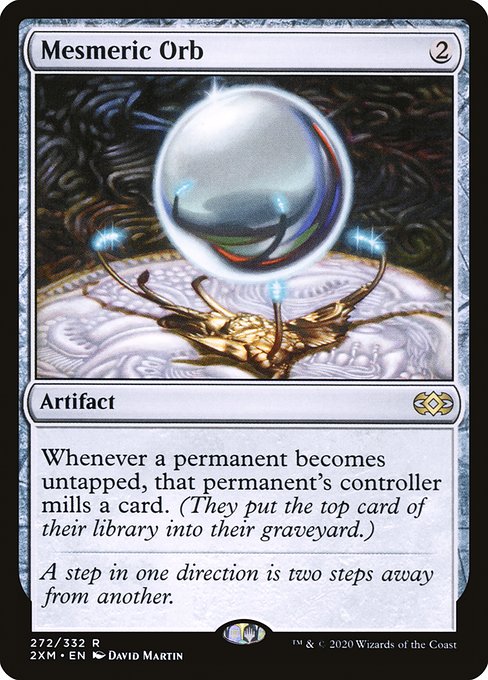

Small, frequent events first. Hedron Crab and Ruin Crab mill three on each landfall trigger (whenever a land enters under your control), and Icetill Explorer gives you a second land drop and lets you replay lands from your own graveyard, so a turn with two lands is four Crab triggers. Altar of the Brood mills each opponent a card whenever another permanent enters under your control. Mesmeric Orb is the quiet engine: every permanent that untaps mills its controller a card, each one a separate trigger, so an opponent untapping eight permanents hands you up to eight Mothman triggers at the start of their upkeep (nobody gets priority in the untap step, so the triggers wait for it), and with Scales out each one is two counters.
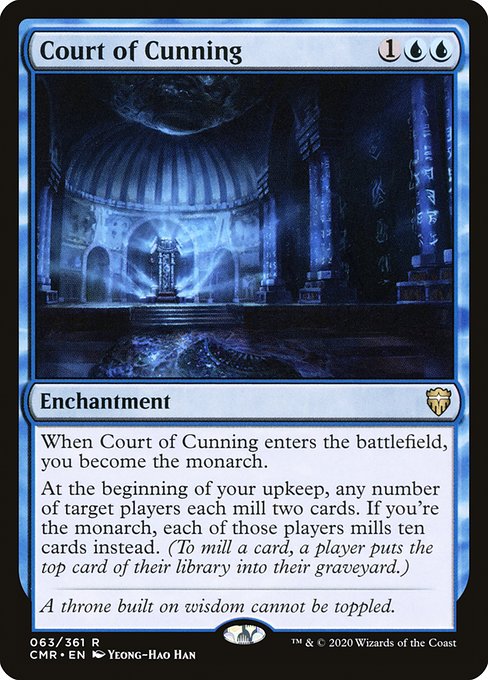
Then the big ones. Court of Cunning mills any number of players two cards at your upkeep, ten each while you are the monarch (a title that draws its holder a card at end step, which this deck wanted anyway). The 0 ability of Jace, Memory Adept mills ten. Maddening Cacophony mills eight each, or half of each library when kicked (kicker is an optional extra cost paid on casting), and Fractured Sanity mills fourteen each for . Bruvac the Grandiloquent doubles all of it, and Bruvac with the kicked Cacophony is the combo the audit names: half of a library twice is all of it. One mass mill is one trigger with an X in the dozens, which in practice means a counter on every creature you control.
Psychic Corrosion and Sphinx's Tutelage turn your draws into mills, and Danny Pink turns counters back into draws: each creature you control draws you a card the first time it gets a counter in a turn. Corrosion into Mothman into Danny Pink into Corrosion is not infinite, but it runs several steps every turn once all three are out.
Proliferate and the rad count
Proliferate (choose any permanents and players with counters, give each another counter of each kind already there) is the glue, because it raises every opponent's rad count and every +1/+1 counter on your board in one action. Evolution Sage proliferates on each land drop, Flux Channeler on each noncreature spell, Inexorable Tide on every spell, Tezzeret's Gambit draws two and proliferates, Cankerbloom and Ripples of Potential do it at instant speed, Karn's Bastion does it from a land, and Roalesk, Apex Hybrid does it twice when he dies. When Vexing Radgull deals combat damage to a player, that player gets two rad if they have none; otherwise it proliferates. Screeching Scorchbeast hands everyone two rad per attack and, once a turn, makes a 2/2 Zombie for each nonland card milled, and every Zombie entering is its own Altar of the Brood trigger. Nuclear Fallout is a sweeper that scales: each creature gets -2X/-2X and every player gets X rad, so keep X below half the toughness of your own counter-stacked creatures (twice X has to stay under their toughness) and it clears their boards while yours stand.
The rules point that decides how you aim it: rad counters leave as nonland cards get milled, one per card, so a player who mills three lands keeps all three counters and loses no life, while a player who mills three nonland cards is down to zero. Proliferate can only add to a player who still has a rad counter, so proliferate the players who still have some, and restart the ones at zero with Radgull, Scorchbeast or a Mothman attack.
Winning the game
Herald of Secret Streams is the cleanest route: creatures you control with +1/+1 counters can't be blocked, and in this deck that is all of them. Consuming Aberration is as big as your opponents' graveyards combined; its own trigger puts cards into their graveyards by revealing rather than by the mill keyword, so Bruvac and Mothman ignore it, and it is here as the body. Syr Konrad, the Grim deals 1 to each opponent for every creature card that reaches a graveyard from a library, so a Fractured Sanity with a dozen creatures among the milled cards is a dozen damage to each opponent. Simic Ascendancy wins at your upkeep with twenty growth counters, and it gets one for every +1/+1 counter placed on a creature you control, so a couple of wide Mothman triggers with a doubler out gets there. And when the table is low on library, Jace, Memory Adept and Bruvac finish the job the old-fashioned way.
Sequencing, mulligans and the traps
Cast creatures before you mill. Mothman's trigger picks its targets when it goes on the stack, so a creature cast after the mill gets nothing. With Danny Pink out, spread the counters across as many creatures as possible rather than stacking one, because each creature's first counter in a turn is a card. With Simic Ascendancy it makes no difference where the counters go, only how many are placed.
Keep a hand with a Crab or Altar of the Brood, a mana creature and three lands. The curve is a Crab, Birds of Paradise or Sol Ring on one, Bloom Tender, Incubation Druid or Arcane Signet on two, Mothman on three off the extra mana, and on four either Swiftfoot Boots to attack at once or a doubler. A hand of mass-mill spells with no creatures to put counters on is a mulligan: the mills happen and the counters have nowhere to go.
Two traps. Mesmeric Orb mills you too, every time your own permanents untap, which feeds Mothman but eats your library over a long game; Icetill Explorer and Muldrotha, the Gravetide replay what it bins, and you should count your library once it passes the halfway mark. And Nuclear Fallout gives you X rad counters along with everyone else, one more if Winding Constrictor is out (its second clause adds one to any counters you get) and double if Vorinclex, Monstrous Raider or the third level of Innkeeper's Talent is, so cast it with the life to spare.
Where it loses
Milling is a gift to a reanimator deck (one that puts creatures from a graveyard straight onto the battlefield), and an Eldrazi titan milled off the top shuffles its owner's whole graveyard back into their library and undoes a turn of work. Graveyard exile cuts both ways: Consuming Aberration shrinks when an opponent's graveyard is exiled, but graveyard hate aimed at your own yard makes Syr Konrad, the Grim ping each opponent for every creature card that leaves it. Assassin's Trophy, Boseiju, Who Endures and Cankerbloom answer the permanents that exile on repeat. A deck that pays life to its own rad counters, to Underground River (a land that deals 1 damage when it taps for color) and to shocklands (two-color lands that cost 2 life to enter untapped) also has to respect aggressive tables. And without a Crab or Altar in the opening hand it is a slow starter, which is why the mulligan advice above is strict.
The Wise Mothman Bracket 3 (EDH)
- 1 Altar of the Brood
- 1 Arcane Signet
- 1 Mesmeric Orb
- 1 Mindcrank
- 1 Sol Ring
- 1 Swiftfoot Boots
- 5 Forest
- 4 Island
- 2 Swamp
- 1 Screeching Scorchbeast
- 1 Birds of Paradise
- 1 Vexing Radgull
- 1 Hedron Crab
- 1 Ruin Crab
- 1 Forgotten Ancient
- 1 Bloom Tender
- 1 Evolution Sage
- 1 Incubation Druid
- 1 Evolution Witness
- 1 Glen Elendra Archmage
- 1 Consuming Aberration
- 1 Fathom Mage
- 1 Flux Channeler
- 1 Icetill Explorer
- 1 Herald of Secret Streams
- 1 Cankerbloom
- 1 Ouroboroid
- 1 Winding Constrictor
- 1 Kami of Whispered Hopes
- 1 Branching Evolution
- 1 Court of Cunning
- 1 Hardened Scales
- 1 Hollowmurk Siege
- 1 Inexorable Tide
- 1 Psychic Corrosion
- 1 Rhystic Study
- 1 Simic Ascendancy
- 1 Sphinx's Tutelage
- 1 Terrasymbiosis
- 1 Innkeeper's Talent
- 1 Assassin's Trophy
- 1 Didn't Say Please
- 1 Fierce Guardianship
- 1 Heroic Intervention
- 1 Pongify
- 1 Ripples of Potential
- 1 Snakeskin Veil
- 1 Swan Song
- 1 Revitalizing Repast // Old-Growth Grove
- 1 Bojuka Bog
- 1 Command Tower
- 1 Drowned Catacomb
- 1 Fabled Passage
- 1 Hinterland Harbor
- 1 Karn's Bastion
- 1 Misty Rainforest
- 1 Polluted Delta
- 1 Rejuvenating Springs
- 1 Underground River
- 1 Undergrowth Stadium
- 1 Verdant Catacombs
- 1 Woodland Cemetery
- 1 Breeding Pool
- 1 Sodden Verdure
- 1 Sunken Hollow
- 1 Watery Grave
- 1 Overgrown Tomb
- 1 Vernal Fen
- 1 Zagoth Triome
- 1 Ozolith, the Shattered Spire
- 1 The Great Henge
- 1 Muldrotha, the Gravetide
- 1 Zellix, Sanity Flayer
- 1 Bruvac the Grandiloquent
- 1 Syr Konrad, the Grim
- 1 Roalesk, Apex Hybrid
- 1 Danny Pink
- 1 Vorinclex, Monstrous Raider
- 1 Bristly Bill, Spine Sower
- 1 Boseiju, Who Endures
- 1 Otawara, Soaring City
- 1 Takenuma, Abandoned Mire
- 1 Jace, Memory Adept
- 1 Farseek
- 1 Fractured Sanity
- 1 Maddening Cacophony
- 1 Nature's Lore
- 1 Nuclear Fallout
- 1 Tezzeret's Gambit
- 1 Three Visits
- 1 Toxic Deluge
- 1 The Wise Mothman
The full list is above, and the bracket 3 audit is of exactly these hundred cards. If you copy it to your account and put the Mindcrank loops back in, run it through the Commander Bracket Calculator again before you tell the pod it is a 3, and record the games so the deck's rating shows whether growing the team beats milling it out at your table.


Comments
Join the conversation.