

The Best Graveyard Hate in Commander, Color by Color: What Each Card Is For

Graveyard hate in Commander has a problem the other utility slots do not. A removal spell always has a target and a ramp spell always ramps, but a graveyard card does nothing at all unless somebody at the table is using their graveyard: reanimating creatures (returning a creature card from a graveyard to the battlefield), casting spells out of it, or milling themselves to fill it. In a 100-card deck with no sideboard, the question for every piece on this list is what it costs you in the games where nobody does any of that. The best graveyard hate in EDH is the set of cards that answer that question well.
This is the latest of our color-by-color utility lists, after the best ramp by color and the best removal by color, and it works the same way: a few picks per color, each with the one job it does, plus the colorless pieces every deck can run. Two labels come up on every card. The job is one of four: a one-shot that exiles a whole graveyard, a repeatable snipe that exiles one card at a time, a standing wall that stops graveyards being used at all, or a stack-speed answer you hold for the moment a reanimation spell is cast. The cost is what the card does when there is nothing to exile: replace itself, hold a land slot, carry a body, or nothing.
Colorless: the pieces every deck can run
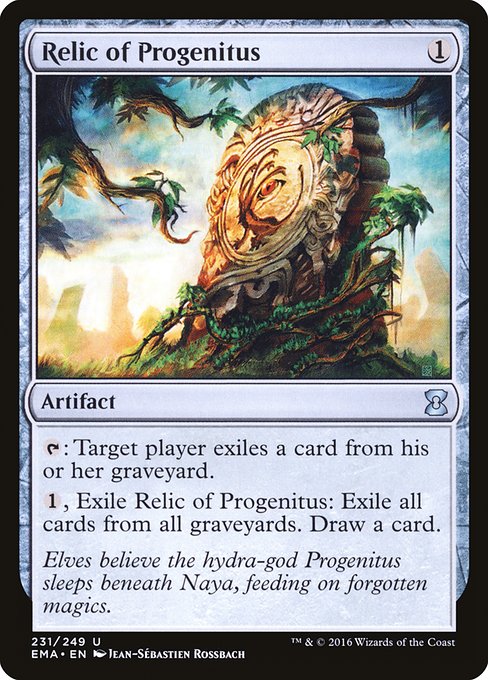


Relic of Progenitus: the one-shot that replaces itself. A  artifact with two abilities. Tapping it, for no mana, makes a player exile a card from their graveyard, but that player chooses, so the tap only matters when the card they need is alone in the graveyard. That is rare: even right after an Entomb, the Entomb itself is sitting there for them to pick instead. The real job is the second ability: and exiling the Relic exiles every graveyard and draws you a card. With no graveyard deck at the table it replaces itself for now and later, which is the cheapest a dead card ever gets, and it is the first piece to add to any deck that does not use its own graveyard.
Soul-Guide Lantern: the one-sided one-shot. It exiles a card when it enters, then taps and sacrifices to exile each opponent's graveyard while leaving yours alone, or, when nobody is doing anything with their graveyard, taps and sacrifices for to draw a card. If your deck wants its own graveyard, this replaces the Relic.
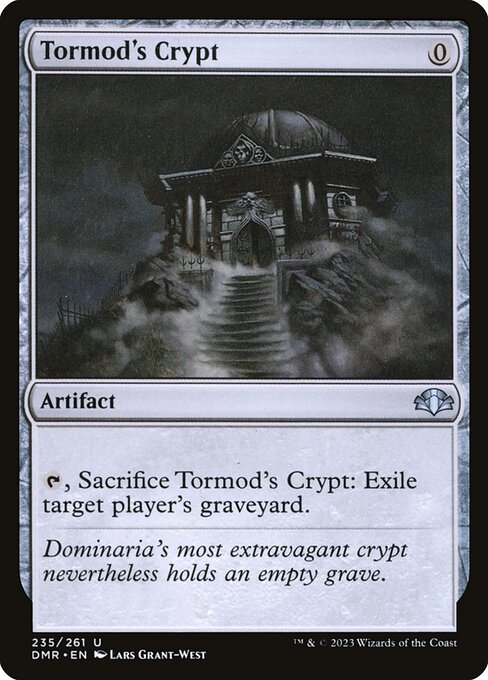
Tormod's Crypt: the free one-shot. Zero to cast, then tap and sacrifice to exile target player's graveyard, so it costs nothing on the turn you also need to cast your commander. The price is that it does nothing else, and that it exiles one player's graveyard rather than everyone's.
Scavenger Grounds: a one-shot in a land slot. It taps for  , and for
 plus tapping and sacrificing a Desert (itself, nearly always) it exiles all graveyards, at instant speed. A land that does the job of a spell is the cheapest hate there is, and it dodges discard and counterspells. The costs are that it is symmetrical and that it is a colorless land, which three-color decks feel.
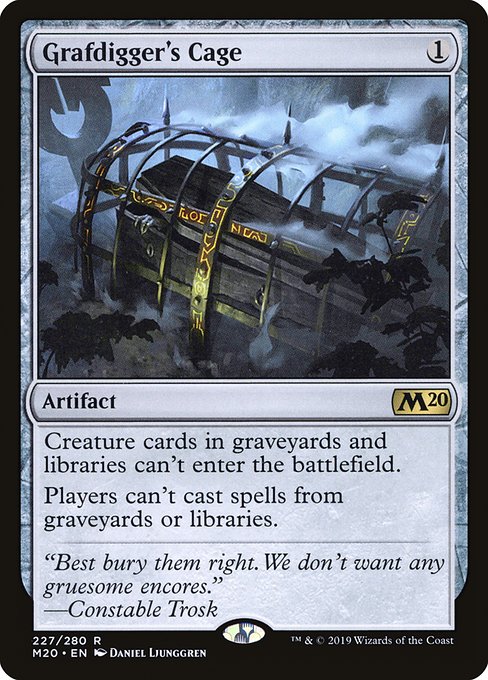
Grafdigger's Cage: a wall for . Creature cards in graveyards and libraries cannot enter the battlefield, and nobody can cast spells from graveyards or libraries, which shuts off reanimation spells, flashback and escape (two of the keywords that let a card be cast from a graveyard) and anything that cheats creatures in from the top of a library. It is symmetrical, so leave it out of a deck that puts its own creatures onto the battlefield from its library or casts its own spells from the graveyard. Living Death is the best-known way around it: it exiles the creature cards first and returns them from exile, which the Cage does not cover.
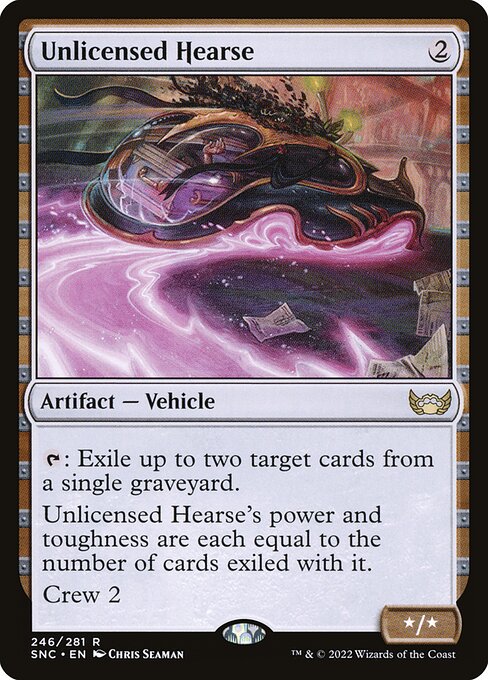
Unlicensed Hearse: a repeatable snipe that becomes a threat. A Vehicle that taps, for no mana, to exile up to two target cards from a single graveyard, and its power and toughness equal the number of cards it has exiled, so after three activations it is a 6/6 with crew 2 (tap creatures with total power 2 or more to make it a creature until end of turn). Activate it in the end step of the player before you and it untaps in time to crew and attack. The real trade-off is the other way round: once it attacks, it stays tapped through everyone else's turns and cannot answer a reanimation spell on the stack. Two more worth knowing: Stone of Erech exiles your opponents' creatures instead of letting them die, then sacrifices to exile a graveyard and draw, and Ghost Vacuum is a snipe that, late in the game, puts every creature card it exiled onto your battlefield as 1/1 fliers.
White
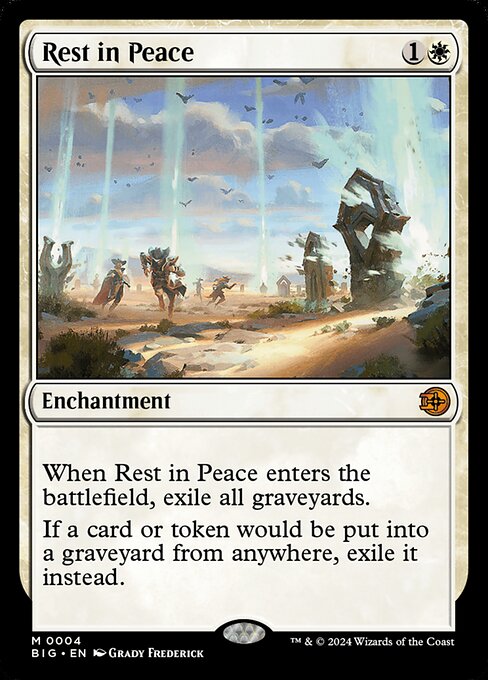


Rest in Peace: the hardest wall in the format. When it enters, every graveyard is exiled, and from then on any card or token that would go to any graveyard is exiled instead. Nothing gets reanimated, flashed back, escaped or dredged (returned to hand in place of a draw) while it is on the table. The cost is total symmetry. Your own creatures never die (exiled is not dead), so your death triggers stop working, and so do persist and undying, the keywords that bring a dying creature back with a counter. Run it in a deck that does not care about its graveyard, and expect to be the table's enemy the moment it resolves against a graveyard deck.
Remorseful Cleric: a one-shot on a body. Two mana for a 2/1 flier that sacrifices itself, at instant speed and for no mana, to exile target player's graveyard. It attacks for two in the air until it is needed, and a sacrifice ability is far harder to stop than a spell.
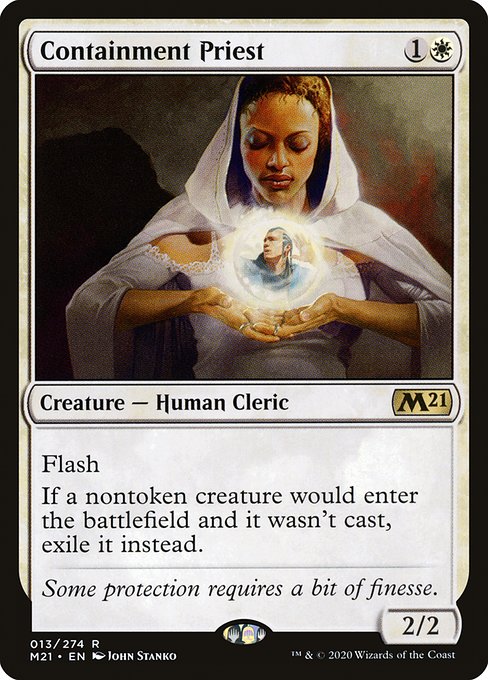
Containment Priest: a flash wall against cheating. A 2/2 with flash: if a nontoken creature would enter the battlefield and it was not cast, it is exiled instead. Flash it in response to a reanimation spell and the creature never arrives. It is symmetrical, and it hits your own flicker effects (exiling a creature and returning it to the battlefield) too, since a creature returning from exile was not cast either. It does not stop Living Death, which sacrifices the Priest before anything comes back.
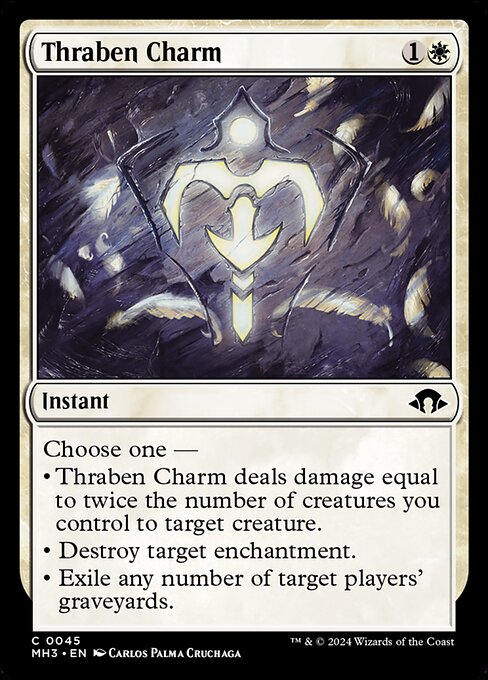
Thraben Charm: the instant-speed one-shot that is never dead.  for one of three modes: exile any number of target players' graveyards (you choose which players, so your own stays), destroy an enchantment, or deal damage to a creature equal to twice the number of creatures you control. Three jobs on one card is how white pays the dead-card cost.
Lion Sash: a repeatable snipe that grows. : exile target card from a graveyard, and if it was a permanent card the Sash gets a +1/+1 counter. It is a creature, or for an Equipment that gives the creature carrying it +1/+1 for each counter on the Sash. Every spare white mana at the end of a turn becomes a card out of someone's graveyard and a bigger attacker. Also worth knowing: Farewell has an exile-all-graveyards mode on a six-mana sweeper, and Ashes of the Abhorrent stops anyone casting spells from graveyards or activating abilities of cards there, which answers flashback, escape and unearth (returning a creature from the graveyard for one turn) but does nothing against a Reanimate cast from hand.
Blue
Blue cannot exile a graveyard by itself, so stop looking for the blue Relic. What blue does is answer the moment the graveyard gets used, and it is better at that than any other color.
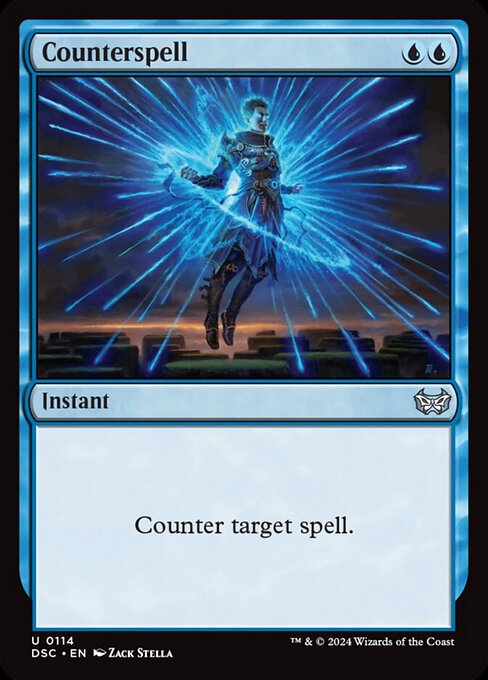


Counterspell and its relatives: the plain answer. A reanimation spell is a spell, and so is a card cast with flashback or escape. Our counterspells list sorts them by the job they do. The limit is that a counterspell only ever gets the spell: a creature that was reanimated rather than cast, or a trigger, is out of reach, and the counters that hit only noncreature spells miss escape creatures entirely.
Tale's End: the counter for things that are not spells.  counters a triggered ability, an activated ability or a legendary spell. The graveyard decks that hurt most often do their work with abilities: Karmic Guide, Reveillark and Sun Titan return cards with triggers, and unearth and Priest of Fell Rites are activated abilities. A counterspell gets those creatures only as they are cast; Tale's End gets the ability itself.
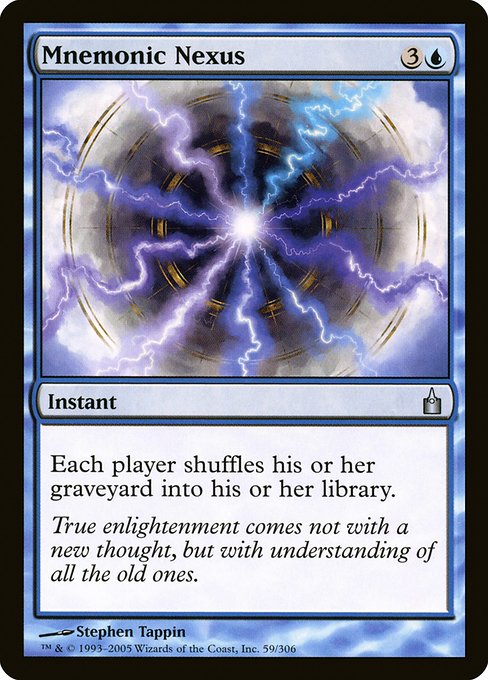
Mnemonic Nexus: the stack-speed reset.  at instant speed: each player shuffles their graveyard into their library. Cast it in response to a reanimation spell once the target is chosen and the spell has nothing left to return. It is symmetrical and it exiles nothing, so a tutor (a card that searches your library) finds the cards again, but four mana held up on an opponent's turn is something a blue deck was doing anyway.
Narset's Reversal: the theft. Copy target instant or sorcery spell and return the original to its owner's hand, choosing new targets for the copy. Cast it on their Reanimate and the copy puts their best creature onto the battlefield under your control (you lose life equal to its mana value, since you control the copy), and they get the Reanimate back with the creature it was cast for already on your side. Commit // Memory deserves a line as well: the Memory half, cast from your own graveyard, makes every player shuffle their hand and graveyard into their library and draw seven, which resets every graveyard at the table at once.
Black
Black has the most graveyard hate because black is also the color that uses graveyards most, so its tools are built to be one-sided.
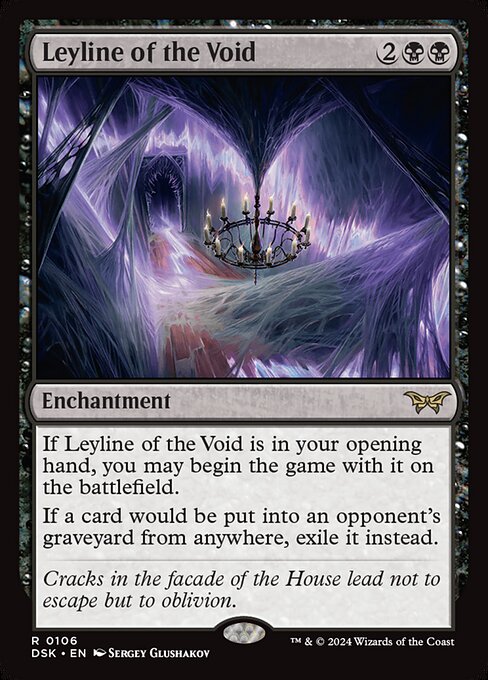



Leyline of the Void: the one-sided wall. If a card would be put into an opponent's graveyard from anywhere, it is exiled instead, and if it is in your opening hand you may begin the game with it on the battlefield. Your own graveyard is untouched, so a black reanimator deck can run it without a second thought. The cost shows up when it is not in the opening hand: a four-mana enchantment that only matters against the opponents who use their graveyards, and the right play is often to leave it in hand.
Dauthi Voidwalker: the wall with a payoff. Two mana for a 3/2 with shadow (it can block or be blocked only by creatures with shadow, so in practice never) whose static ability is Leyline's: opponents' cards are exiled with a void counter instead of going to their graveyards. Later, tap and sacrifice it to play one of those exiled cards without paying its mana cost, which is usually the best thing an opponent has drawn all game.
Bojuka Bog: the one-shot in a land slot. It enters tapped, exiles target player's graveyard when it does, and taps for  afterwards. That puts black in its color identity, so it is a black deck's card rather than a colorless one. The catch is timing: a land drop is sorcery speed and visible, so it cannot answer a reanimation spell on the stack. In exchange it costs no card slot and comes back with any land recursion.
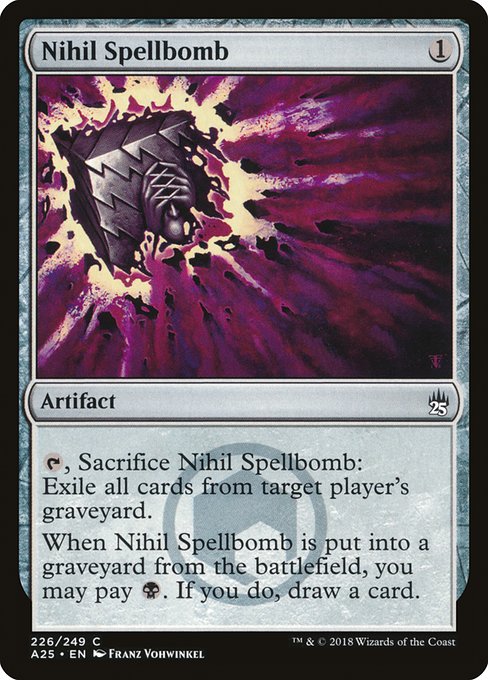
Nihil Spellbomb: the one-shot that replaces itself. It costs ; tap and sacrifice it, for no mana, to exile target player's graveyard, and when it goes to the graveyard you may pay to draw a card. That is the only reason it is not in the colorless section above. In a black deck it is Tormod's Crypt with a card attached.
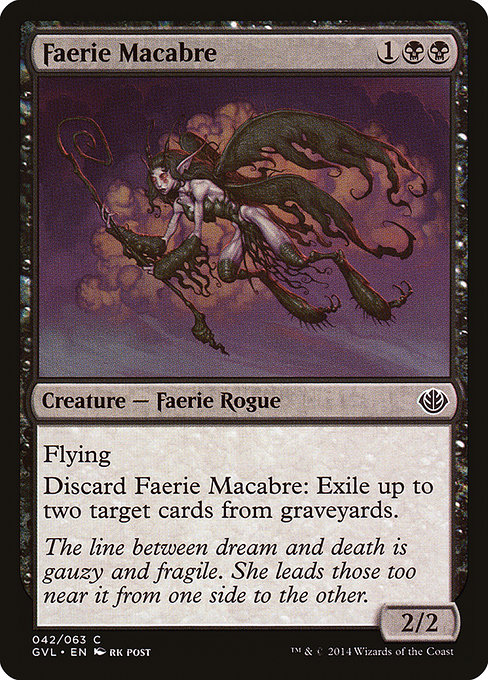
Faerie Macabre: the free snipe no counterspell can touch. Discard it from your hand to exile up to two target cards from graveyards. That is an activated ability from your hand, not a spell, so it costs no mana, works at instant speed and only an ability counter like Tale's End can stop it. Two targets is enough to strip the creature they just put in the graveyard and the one they were going to get next.
Ravenous Trap: the one-shot against self-mill. at instant speed to exile target player's graveyard, or  if an opponent had three or more cards put into their graveyard this turn. When a deck mills itself, casts a wheel (a spell that makes everyone discard and redraw) or chains Entomb into Buried Alive, the condition is met on the turn it sets up, which is exactly when you want to fire it.
Behind those six: Cling to Dust exiles one card for and either gains you 3 life (a creature card) or draws a card (anything else), then escapes from your graveyard to do it again. Graveyard Trespasser exiles a card whenever it enters or attacks and drains each opponent for 1 when that card was a creature. Withered Wretch exiles a card for as often as you have the mana. Yixlid Jailer makes cards in graveyards lose all abilities for two mana, which turns off flashback, escape, unearth and every card that does something "as long as it is in your graveyard".
Red
Red cannot remove a card from a graveyard that is already there, with one exception, so red's version of graveyard hate is to stop the card arriving in the first place.



Burn Away: the exception. Five mana at instant speed for 6 damage to a creature, and when that creature dies this turn, its controller's graveyard is exiled. Kill the reanimated creature and the graveyard it came from with one spell. Expensive, but it is the only mono-red card that exiles a whole graveyard, and it is removal every time you draw it.
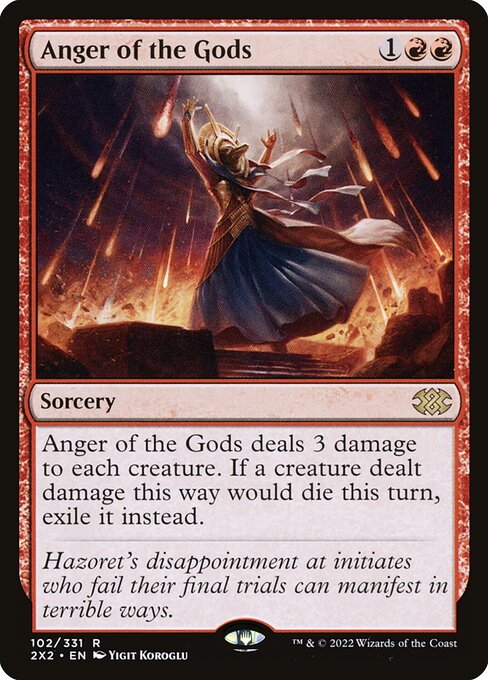
Anger of the Gods: the sweeper that denies the graveyard. 3 damage to each creature, and anything that would die from that damage is exiled instead. Against a deck of small creatures with death triggers and recursion, the exile clause is worth more than the damage.
Scorching Dragonfire, Lava Coil and Magma Spray: removal that exiles. Each deals damage to a creature (3 at instant speed, 4 at sorcery speed, 2 for a single  ) and exiles it if it would die this turn, so the creature is never in a graveyard to be returned. When the table has a reanimator in it, these are the burn spells to run over the cheaper ones that do not exile.
Green
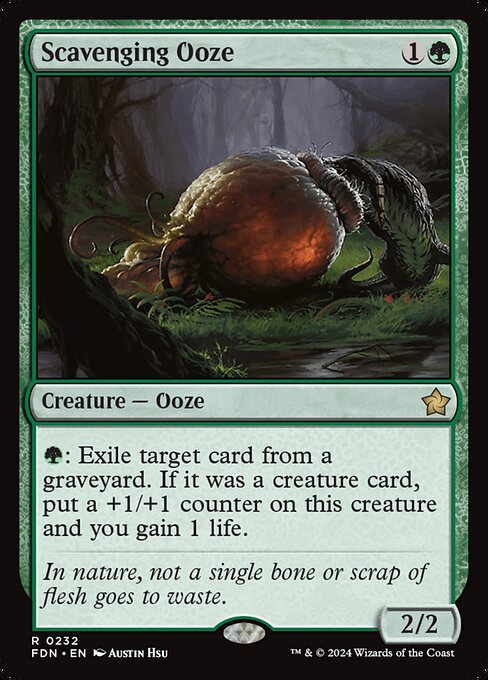


Scavenging Ooze: the repeatable snipe that grows.  : exile target card from a graveyard, and if it was a creature card the Ooze gets a +1/+1 counter and you gain 1 life. Every unspent green mana at an end step goes into it, one card at a time, and against a creature-based graveyard deck it is the first thing they have to kill.
Endurance: the free, one-sided reset. Flash, reach, and when it enters, up to one target player puts every card in their graveyard on the bottom of their library in a random order. Pay , or exile a green card from your hand for its evoke cost, and it is a whole-graveyard answer at instant speed, aimed where you choose, and aimed at yourself when someone is milling you out. The cards are not exiled, so a tutor can find them again, but the reanimation spell on the stack has lost its target.
Loaming Shaman: the selective reset on a body. Three mana for a 3/2 that, when it enters, makes target player shuffle any number of target cards from their graveyard into their library. Take their three best cards and leave the rest, or point it at yourself to reload a thin library late in a long game.
Night Soil: the snipe that makes bodies. and exiling two creature cards from a single graveyard makes a 1/1 Saproling. It only touches creature cards, which is the half of a graveyard that reanimation cares about, and in a long game it makes a token a turn out of the dead. It needs two creature cards in one graveyard, so it cannot answer a lone Entomb.
Ground Seal: the wall that replaces itself. Draw a card when it enters; cards in graveyards cannot be the targets of spells or abilities. That stops Reanimate, Animate Dead, Karmic Guide and every "return target card" effect in the format, while leaving the non-targeted things (Living Death, flashback, escape) alone. It also stops your own targeted recursion, and your own targeted hate: do not pair it with the Ooze, Deathrite Shaman, the Sash or Faerie Macabre, all of which target cards in graveyards. Hate that targets a player, the Bog, the Crypt and Endurance, still works under it.
Two colors and more
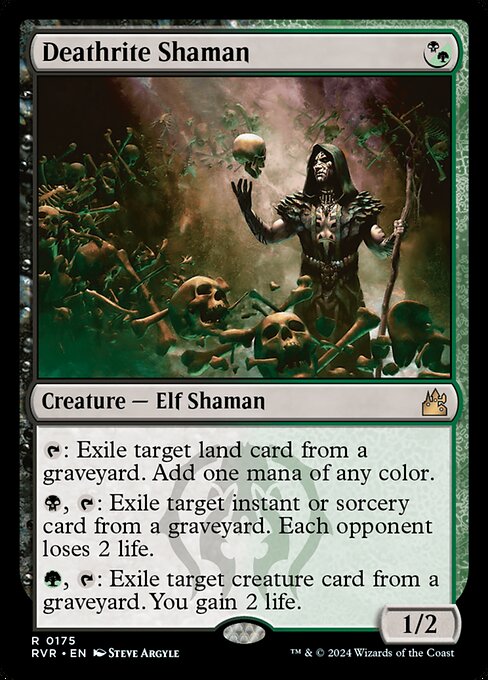


Deathrite Shaman (black-green): the snipe that is also a mana dork. Tap to exile a land card from a graveyard and add one mana of any color; and tap to exile an instant or sorcery card and make each opponent lose 2 life; and tap to exile a creature card and gain 2. A one-mana creature that ramps you on turn two off anyone's fetchland (a land sacrificed to find another) and eats graveyards for the rest of the game. Its cost is hybrid, so its color identity is both colors and it needs a black-green commander.
Rakdos Charm (black-red): the instant one-shot with two spare modes. Exile target player's graveyard, or destroy an artifact, or have each creature deal 1 damage to its controller, which is the mode that kills the player who just made twenty tokens.
Ashiok, Dream Render (blue-black): the repeatable one-sided one-shot. Three mana for a planeswalker whose minus ability mills a target player four cards and then exiles every opponent's graveyard, on each of the turns Ashiok survives, while the static ability stops opponents searching their libraries, which also switches off their tutors. Hybrid cost again: blue-black identity.
Kaya's Guile (white-black): the one-shot with an edict attached. At instant speed, choose two of: each opponent sacrifices a creature, exile all opponents' graveyards, make a 1/1 flying Spirit, gain 4 life, or pay more to entwine and take all four. Exiling the graveyards and forcing a sacrifice in response to a reanimation spell is the pair you will choose most.
Anafenza, the Foremost (white-black-green): a one-sided creature wall that can be your commander. A 4/4 for three mana: a nontoken creature an opponent owns that would die is exiled instead, and so is any creature card headed for an opponent's graveyard from anywhere else. Their creatures never reach the graveyard; yours do.
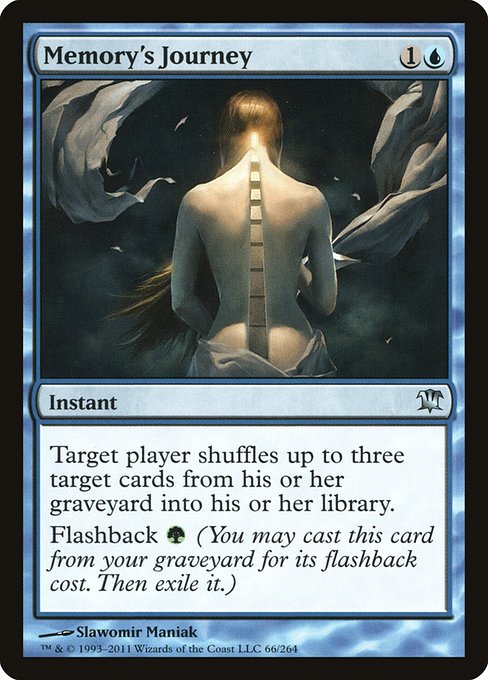
Memory's Journey (blue-green): the stack-speed snipe. For at instant speed, target player shuffles up to three target cards from their graveyard into their library, and its flashback cost of casts it a second time from your own graveyard. That in its text is why a mono-blue deck cannot run it. Cast it in response to the reanimation spell once the target is chosen, and it also saves your own best cards from a mill deck.
When to fire it
Most graveyard hate is wasted by being used too early or too late, and the right moment depends on how the graveyard is being used.
- Against reanimation spells (Reanimate, Animate Dead, Victimize), wait. Let them cast the spell and choose its targets, then exile the graveyard, or every card it targets (Victimize has two), in response. With no legal target left the spell does nothing and goes to the graveyard, and the mana is spent. This is the moment the Relic, the Crypt, the Lantern and Faerie Macabre are held for, and Mnemonic Nexus and Endurance too, with the difference that those two shuffle the creature away rather than exiling it, so a tutor can find it again.
- Against cards cast from the graveyard (flashback, escape), do not wait. Once the card is being cast it is on the stack, not in the graveyard, and exiling the graveyard in response does nothing. Snipe the key card at their end step or on your own turn, while their mana is tapped.
- Against self-mill engines that refill the graveyard every turn, a one-shot buys one turn. Use a wall (Rest in Peace, Leyline, the Voidwalker, the Cage) or a repeatable snipe pointed at the cards their commander wants, and keep the one-shot for the turn they cast the big spell.
- Against mass reanimation (Living Death), the one-shot in response is exactly right. Living Death exiles creature cards from graveyards and brings them back as it resolves, so emptied graveyards return nothing, and everyone still sacrifices their board. With a one-sided one-shot like the Lantern, your creatures come back and theirs do not.
Land-slot hate has its own rule. Bojuka Bog cannot answer a spell on the stack, so its window is the turn after a Buried Alive (a sorcery, so you see it coming) or once a self-mill deck has spent a couple of turns filling its graveyard, before the reanimation turn. Entomb is an instant and usually lands in the end step right before the reanimator's turn, which is a job for Scavenger Grounds, the version that waits for the spell.
How many, and which kind
Our rule for the 99 (every card but your commander) is one repeatable piece that is never dead (the Ooze, Deathrite, the Sash, the Hearse), one free or instant-speed answer (the Crypt, Faerie Macabre, Endurance, the Cleric) and one in a land slot (Scavenger Grounds, or the Bog in black). That is three cards, two of which do something in every game, and it is enough for a pod with one graveyard deck that wins its share. A graveyard deck that wins every third game earns the wall as well. The decks that beat you most often are the ones to build against, which is one more reason to keep a record of your pod's games: the numbers tell you whether that deck is a problem or a story.



Comments
Join the conversation.