

The Best Finishers in EDH, Color by Color: What Each One Needs First
Every list of the best finishers in EDH ends up naming the same fifteen cards, so this one sorts them differently. It goes color by color, and it tags each card with what it needs from you before it can end the game: a board of creatures already in play, a pile of mana, or time. Which kind you want depends on what your deck is already good at, and that is the question to answer before you pick one.
A finisher, for this post, is the card that turns an advantage you already have into a won game, in one swing or as the last blow. Each color gets its four best, with the job each one does and a line of play. Our best ramp cards by color and best removal by color guides cover the cards that get you there; this one covers the last card you cast.
Green
Green closes games in combat. Three of its four finishers need a board, and the fourth buys one.
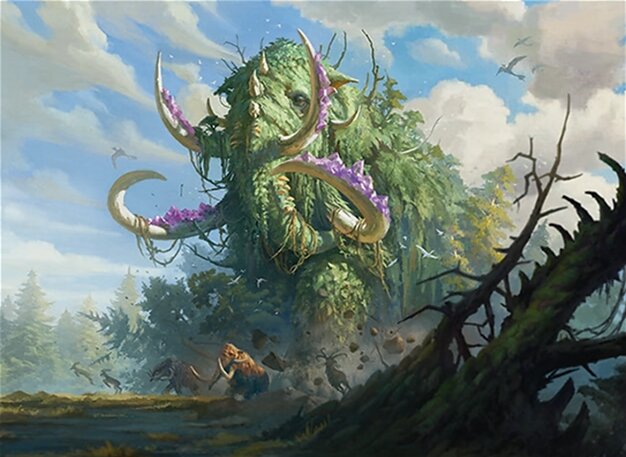
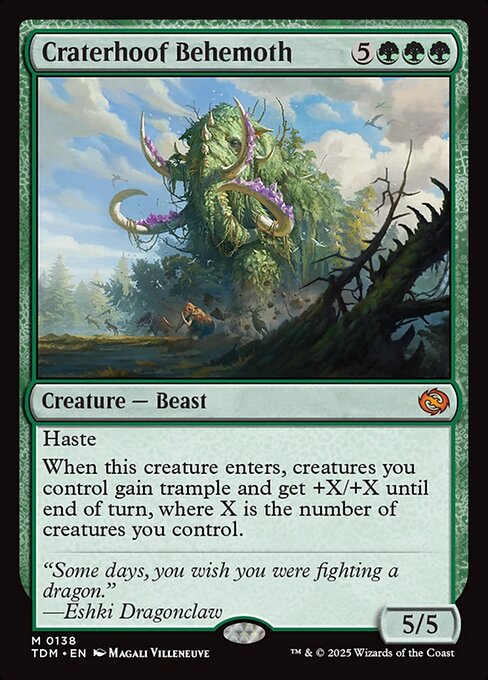
Craterhoof Behemoth (board). Eight mana for a hasty body that, on entry, gives every creature you control trample (damage beyond a blocker's toughness carries over to the player) and +X/+X, where X is the number of creatures you control. Count before you cast, because each opponent has to take their whole life total from the creatures you point at them. Five 1/1s plus the Behemoth is six creatures getting +6/+6: 35 power from the tokens and 11 from the Behemoth, 46 in all, which kills one opponent at 40. Ten 1/1s plus the Behemoth is eleven creatures at +11/+11, about 136 trampling power, and that is the table. Below eleven creatures, send lethal at the player most likely to win next and keep the rest home. End-Raze Forerunners is the budget version: a fixed +2/+2 with vigilance and trample for the team, so it wants creatures that were already big.
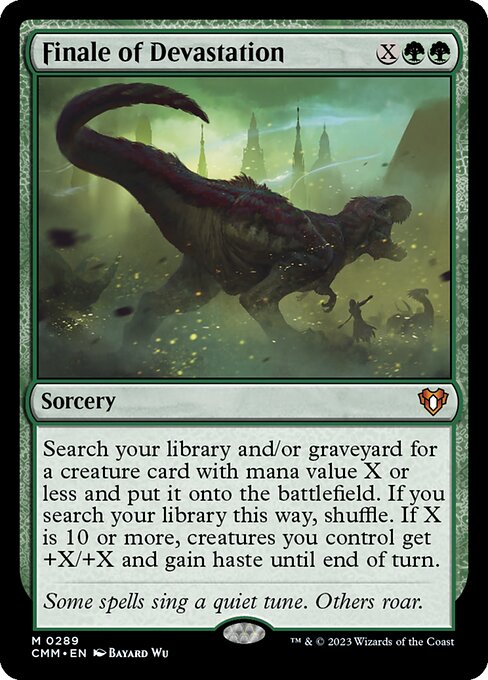
Finale of Devastation (mana). 
 finds a creature with mana value X or less from your library or graveyard and puts it onto the battlefield, and if X is 10 or more your creatures get +X/+X and haste. At twelve mana it fetches the Behemoth (mana value 8) and stacks its own +10/+10 and haste on top of the Behemoth's trigger: six creatures already in play plus the Behemoth is seven attackers at 18 and 22 power, 130 trampling damage, lethal for the whole table. Below ten it is a tutor (a card that searches your library for another card) that puts the creature straight into play, which is why it stays in the deck even when you never reach twelve.
Triumph of the Hordes (board, and a table that will forgive you). Four mana: your creatures get +1/+1, trample and infect until end of turn. Infect means damage to players is dealt as poison counters, and ten poison counters loses the game regardless of life total. Three creatures with 3 power become 4-power infect tramplers, twelve poison, lethal to one opponent, and a player sitting at 80 life is no safer than one at 10. A chump blocker (a cheap creature thrown in front of an attacker) soaks only its toughness and the rest tramples through. Split the attackers so each opponent takes ten: thirty trampling power across three players is a table kill from a board that would barely dent 120 life with a normal pump spell (a one-turn +X/+X with no infect attached). The social cost is real. An infect win is the one people remember, so it is a finisher for a pod that has agreed it is fine.
Overwhelming Stampede (board, with one big creature in it). Five mana: your creatures gain trample and +X/+X, where X is the greatest power among creatures you control. One 8-power creature and five 1/1s is six attackers at +8/+8. The timing is the turn after your largest creature lands, before someone answers it, because the whole spell is keyed to that one body. Beastmaster Ascension is the three-mana cousin: it gets a counter for each creature that attacks, so a single attack with seven creatures switches on a permanent +5/+5 for the team, and nobody counts it until it is too late.


Red
Red turns mana into damage directly, so two of its finishers want a pile of mana or time, and the other two want a board, one of which can belong to someone else.
Crackle with Power (mana).  deals five times X damage to each of up to X targets. X of 3 is eleven mana for 15 damage to each of three targets; X of 4 is fourteen mana for 20 to each of four. A full table at 40 needs X of 8 and twenty-six mana, so in practice Crackle is the second blow: cast it after an attack has done the first half, with rituals (one-shot spells that add mana, covered in the ramp guide) paying for the X.
Insurrection (board, theirs). Eight mana: untap all creatures, gain control of them until end of turn, and they all gain haste. This is the finisher that wants your opponents to have boards, and the line is to attack each player with the other two players' creatures. A sacrifice outlet (a permanent that lets you sacrifice creatures at will) on your side means none of them go home at end of turn, which is the difference between a finisher and a one-turn loan.
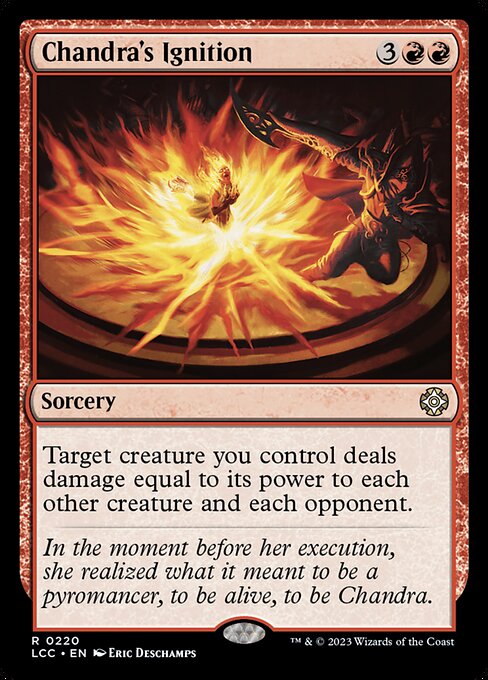
Chandra's Ignition (board, one big creature). Five mana: a creature you control deals damage equal to its power to each other creature and each opponent. On a 20-power commander it is 20 to each opponent and a board wipe of everything with toughness 20 or less, your own creatures included, so it belongs in a deck built around one large attacker. Give that creature lifelink first and every point it deals, to creatures and opponents alike, comes back as life.
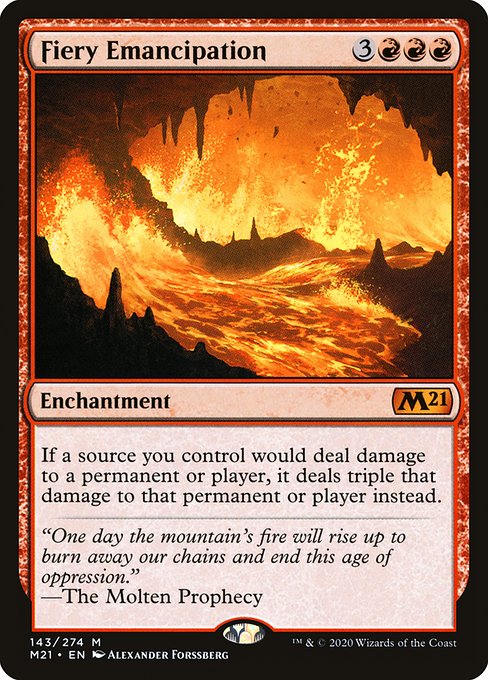
Fiery Emancipation (time). Six mana: damage from sources you control is tripled. Cast it before combat and that turn's attack already deals triple. It carries the time tag because at six mana it usually lands with little mana left over, so the big turn is the next one, when every small source has become a finisher. Impact Tremors with seven creatures entering is 21 to each opponent instead of 7, and Crackle with Power at X of 3 becomes 45 to each of three targets for eleven mana. Aggravated Assault is red's other multiplier, one of several extra-combat cards in the color:  untaps your creatures and adds a combat, so two activations send a board of ten 2-power tokens in three times for sixty damage.


Black
Three of black's four finishers subtract from life totals directly, so blockers never enter their math: two of them need mana and Gray Merchant needs black permanents on the battlefield. The fourth borrows a board from the graveyards.
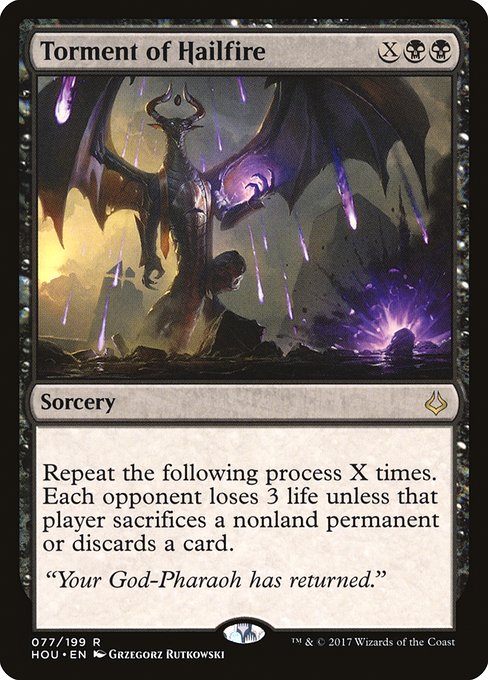
Torment of Hailfire (mana, and empty hands across the table).  , repeated X times: each opponent loses 3 life unless they sacrifice a nonland permanent or discard a card. The count that matters is how many things each opponent can pay with. A player with five cards in hand and six nonland permanents pays eleven times before losing a point of life; a player with nothing takes 3X. So Torment is a late-game card, cast after a board wipe (a spell that destroys every creature) or into a table that has emptied its hands, and X of 10 at that point is 30 life from each opponent.
Exsanguinate (mana). : each opponent loses X life and you gain the total. It is rarely lethal from 40, since that X costs 42 mana, but it is the best second half of a race in the game: after an attack has put everyone at 13, X of 13 (fifteen mana) kills the table and gains you 39 on the way. Cast it when X reaches the highest opponent's life total.
Gray Merchant of Asphodel (board, measured in black mana symbols). On entry, each opponent loses life equal to your devotion to black (the number of symbols in the mana costs of permanents you control) and you gain the total. Devotion of 10 is 10 from each opponent and 30 for you, and because it is a creature, a reanimation spell (one that returns a creature from your graveyard to the battlefield) gives you the trigger again. Two triggers at devotion 10 take 20 from each opponent, which ends a game against a table that is already low, so build the deck to recur it rather than to cast it once.
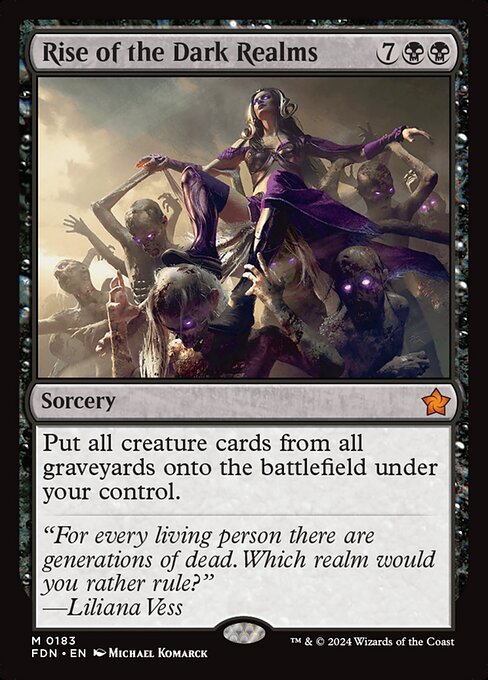
Rise of the Dark Realms (board, borrowed from every graveyard). Nine mana: every creature card in every graveyard enters the battlefield under your control. They arrive without haste, so the line is to cast it the turn after a board wipe, when the graveyards are full and the board is empty, with a haste source or a sacrifice outlet waiting. Black also owns the two-card drain loop: Exquisite Blood (whenever an opponent loses life, you gain that much) and Sanguine Bond (whenever you gain life, target opponent loses that much) feed each other from any single point of life lost, and the bracket calculator flags that pair as a two-card infinite combo. Bolas's Citadel's last ability,  and sacrifice ten nonland permanents to make each opponent lose 10 life, finishes a table that is at 10 or less, and the Citadel is a Game Changer (one of the cards the bracket system singles out as pushing a deck's power; our guide to the brackets explains the five levels).


Blue
Blue has no card that converts a board or a mana pile into damage. It wins outright with the Oracle. Otherwise it clears the way: the Rift and the Horror remove whatever stops your attack, and Expropriate buys the turn to make it.
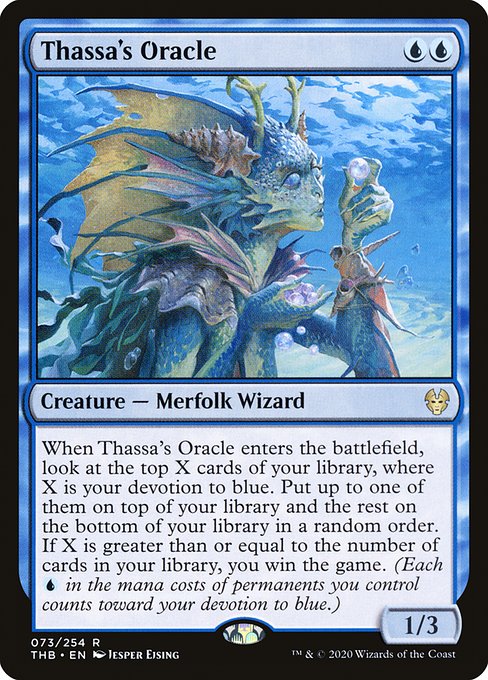
Thassa's Oracle (mana, just three of it, plus its partner card). Two mana: on entry, look at the top X cards of your library where X is your devotion to blue, and if X is at least the number of cards in your library, you win. The sequence is the whole card. Cast the Oracle, and with its trigger on the stack, cast Demonic Consultation naming a card that is not in your deck, which exiles your entire library; the trigger then resolves against zero cards. Tainted Pact does the same job in a deck with no two cards sharing a name, which means one of each basic land at most. The Oracle is a Game Changer, and in the bracket calculator the pair is a two-card combo. Laboratory Maniac and Jace, Wielder of Mysteries win the same way on your next draw, and are not Game Changers.
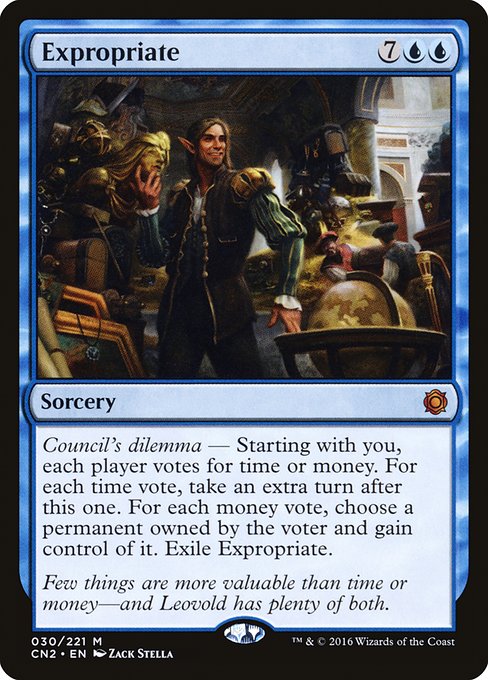
Expropriate (mana). Nine mana. Each player, starting with you, votes for time or money: each time vote gives you an extra turn, and each money vote hands you a permanent that voter owns. Once you have a board, opponents vote money, so the usual result is one extra turn plus three permanents of your choice, and the extra turn is the part that wins. Expropriate was on the Game Changers list when the brackets launched; the calculator reads the current list, so run your deck through it before you plan a bracket around this card.
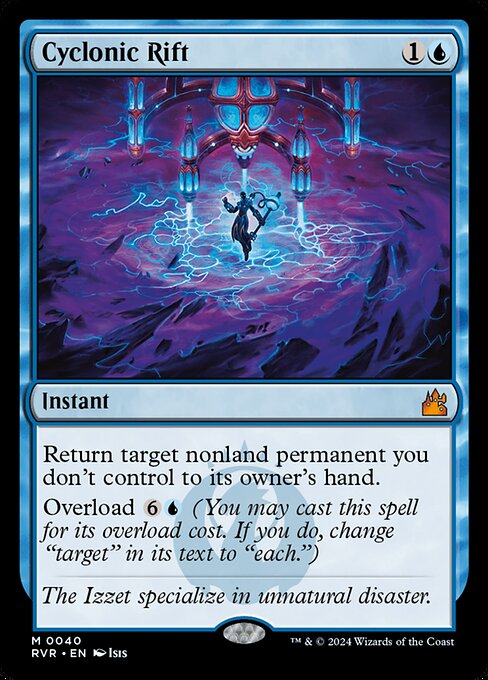
Cyclonic Rift (board, yours). Two mana to bounce one nonland permanent, or seven for the overload cost, which changes "target" to "each" and returns every nonland permanent you do not control to its owner's hand. Cast it at the end of the turn before yours, untap, and attack into three empty boards. The Rift is the enabler for an alpha strike (sending everything at once), and it is a Game Changer.
Hullbreaker Horror (time). Seven mana, flash, cannot be countered, and whenever you cast a spell you may bounce a spell you do not control or a nonland permanent. Its triggers deal no damage and do not need to: a cheap spell on your turn bounces the best blocker, a second one bounces the answer they cast in response, and the Horror's own body or the rest of your board does the hitting, while a cheap spell on their turn bounces whatever they try to resolve. Blue's inevitability is a permanent nobody can answer on their own turn.

White
White's finishers want a board, with one exception that wants seven draws.
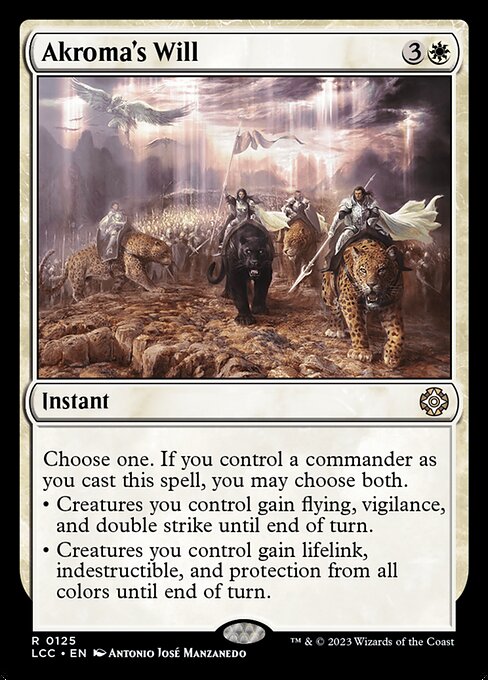
Akroma's Will (board, with a commander in it). Four-mana instant with two modes, and with a commander on the battlefield you get both: flying, vigilance and double strike, plus lifelink, indestructible and protection from each color. Protection from a color means a creature of that color cannot block the attacker, so after attackers are declared and before blocks, only colorless creatures with flying or reach can block anything, and double strike (two damage steps; our combat phase guide walks through them) doubles the damage. A board of 20 power is 40 nearly unblockable damage with lifelink attached.
Moonshaker Cavalry (board). Eight mana: on entry, your creatures gain flying and get +X/+X, where X is the number of creatures you control. It is the Behemoth with flying instead of trample and without haste on itself, so count your attackers without it, and count the fliers and reach creatures on the other side. Against deathtouch blockers flying is the better evasion, which is the case for the Cavalry over the Behemoth in a deck that can cast either.
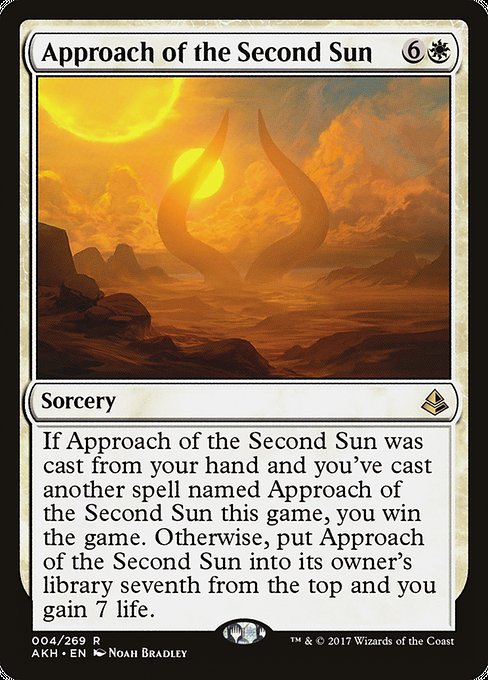
Approach of the Second Sun (time). Seven mana: the first cast gains you 7 life and puts the card seventh from the top of your library; the second cast, from your hand, wins the game. The clock is seven draws, so draw-two effects shorten it to two or three turns. Two traps. Anything that shuffles your library after the first cast, a fetchland or a tutor for another card, moves Approach away from seventh. And the winning cast has to come from your hand: casting it from the top of your library with something like Bolas's Citadel only puts it back seventh and gains 7 again. In a four-player pod the first cast tells the table exactly what is coming, so the real cost is three players' worth of attention for the next three turns.
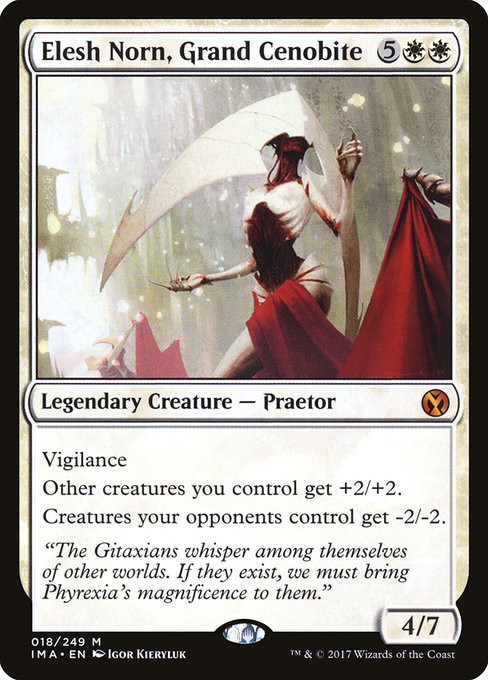
Elesh Norn, Grand Cenobite (board; also a wrath, meaning a board wipe). Seven mana: your other creatures get +2/+2, your opponents' creatures get -2/-2. Every creature with toughness 2 or less on the other side dies on arrival, tokens included, and what survives blocks a team that just grew. It is the one white finisher that also answers the board it is attacking into. Felidar Sovereign is the alternate win that announces itself: 40 or more life at your upkeep wins, and every opponent gets a full turn cycle to stop it.

Colorless
Any deck can run these four. Three want mana and one wants a single connection.
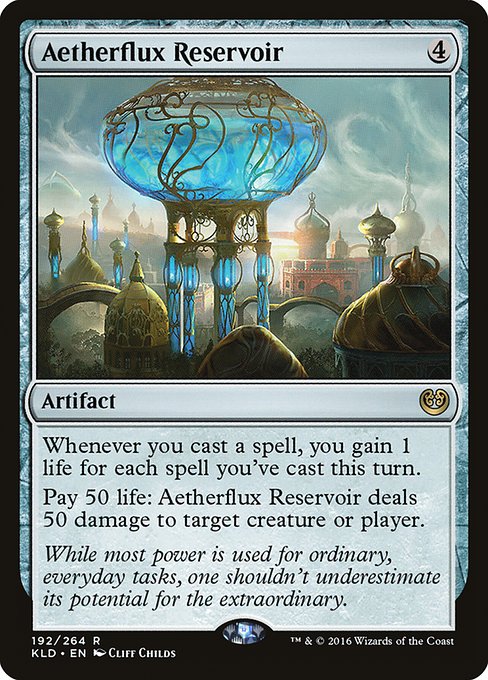
Aetherflux Reservoir (mana, spent on a storm turn). Whenever you cast a spell, you gain 1 life for each spell you have cast this turn, so a storm turn (casting many cheap spells in one turn) of ten spells gains 55 life. Pay 50 life: 50 damage to any target. The arithmetic is that you need 51 life to fire once and survive, and the second shot needs another 50, so it kills one opponent per big turn unless the lifegain is already infinite.
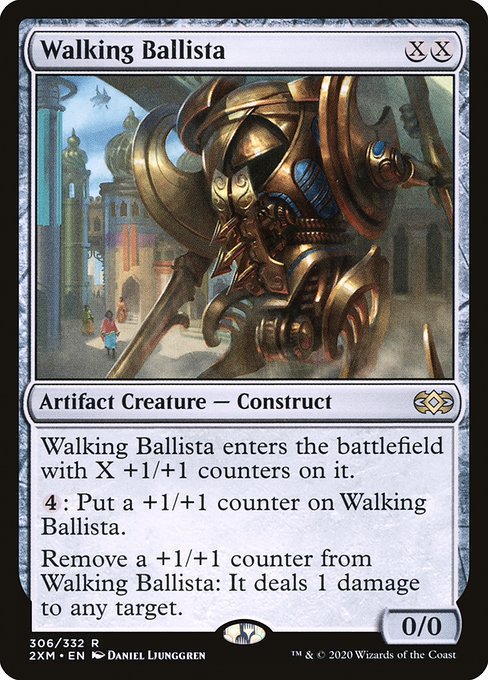
Walking Ballista (mana, ideally infinite). Enters with X +1/+1 counters, adds one for  , and removes one to deal 1 damage to any target. With infinite mana it is the whole table; with fourteen mana it is a 7-damage split any way you like. It is the finisher combo decks in every color reach for, because it asks for nothing but mana.
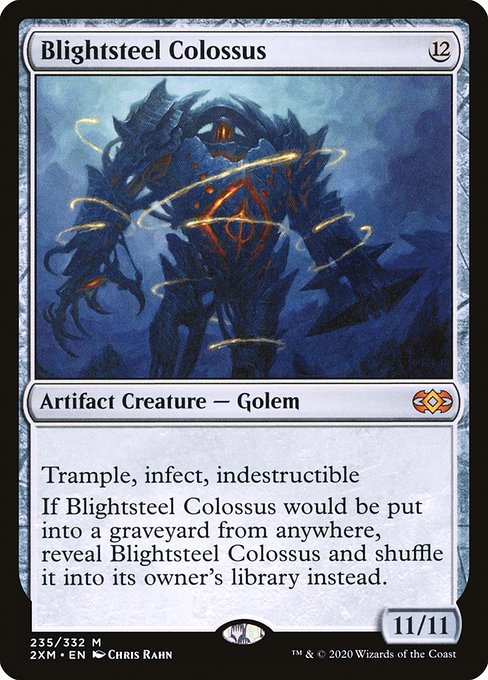
Blightsteel Colossus (board, one connection). Twelve mana for an 11/11 with trample, infect and indestructible that shuffles itself back into your library instead of going to the graveyard. One hit is eleven poison counters and a dead opponent, and a second combat does it again. Cheat it into play (put it onto the battlefield without paying its cost) and give it haste, since bounce, edicts (each player sacrifices a creature) and theft all answer it, and remember that it can never be reanimated, because it never stays in a graveyard.
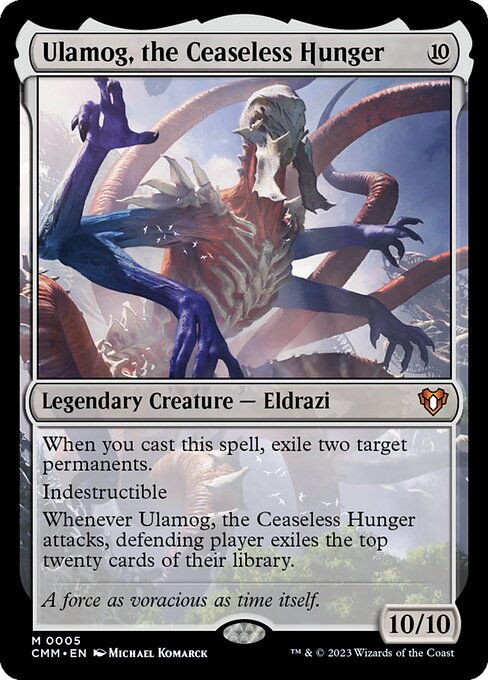
Ulamog, the Ceaseless Hunger (mana). Ten mana. Casting it exiles two target permanents (a cast trigger, so a counterspell on Ulamog does not stop it), it is indestructible, and whenever it attacks the defending player exiles the top twenty cards of their library. Three or four attacks empty a mid-game library (a player who has to draw from an empty library loses), each one also hits for 10, and the cast trigger doubles as the removal you were short on.
Picking the one your deck can actually cast
Count what your deck reliably has on turn seven. Six or more creatures means a board finisher: the Behemoth, the Cavalry, Triumph, Overwhelming Stampede, Akroma's Will, Elesh Norn, or the Rift to clear the way for them, with Gray Merchant and Rise for the decks whose board lives in the graveyards. A board of one huge creature, or none of your own, points at Chandra's Ignition, Blightsteel for the single connection, or Insurrection to borrow everyone else's. Fifteen or more mana in a turn means a mana finisher: Crackle, Torment, Exsanguinate, a big Finale, Expropriate, Walking Ballista, Ulamog or the Reservoir. A full hand and a stable board but neither of those means a time finisher: Approach, Hullbreaker Horror or Fiery Emancipation, plus the removal to protect it. The Oracle package is its own category, three mana and a counterspell to protect the trigger. A deck that runs a finisher it cannot pay for on time is a deck with a dead card in it.
Two bracket facts to keep straight. Cyclonic Rift, Thassa's Oracle and Bolas's Citadel are Game Changers, and the two combo pairs on this page (the Oracle with Consultation, Exquisite Blood with Sanguine Bond) keep a deck out of bracket 2 on their own. A finisher that needs a tutor to show up on time is really two cards, and our best tutors by color guide covers which tutors cost you a Game Changer slot. Paste your list into the Commander Bracket Calculator and it will show you both counts, and the public deck explorer lets you browse rated public decks in your colors to see what they close with.


Comments
Join the conversation.