

Star Trek Commander Precons Ranked: Which of the Four Decks Does Its Job Out of the Box

The four Star Trek Commander precons shipped on November 13: Federation Fleet, Klingon Fury, Landing Party and We Are the Borg. Three days is not long enough to know which one wins the most games, but it is long enough to read all four hundred cards and work out which deck does what its box promises without help. That is the ranking below: the hundred cards as you open them, judged against three opponents who are paying attention.
We ranked the decks, not the commanders. Our ranking of the set's commanders already covers what Picard, Worf, Spock and the Borg Queen do from the command zone, and the mechanics explainer covers station, assimilate and the rest in rules terms. The full lists are on the precon decklists page. The bracket system uses the average precon as its example of its second tier, Core, so treat this as a ranking within a tier rather than across one.
The yardstick: turn six, four players, no changes
A precon has two jobs: do its thing out of the box, and be worth upgrading. The ranking weights the first, because the second is true of all four. Concretely, we asked how many of the deck's own cards push its plan by turn six against three opponents, how badly one wrath (a spell that destroys every creature) sets it back, and whether the commander is the engine or only the finisher. Price played no part. The Collector's Edition of each deck reprints the same 100 cards in surge foil, so nothing below changes between the two versions.
1. Landing Party: Spock turns every attack into a free card, and forty lands pay for it
Commander Spock (


 ) has strange new worlds, the set's ability word for counting the differently named lands you control. Whenever he enters or attacks, you reveal the top card of your library. You may cast it for free if its mana value is no more than that count, you may put it onto the battlefield tapped if it is a land, and if the card is still on top afterwards you draw it. Nothing in the trigger is wasted, which is why he leads the deck that leads this list.
The deck backs him with 40 lands, more than any of the other three, plus ramp (extra lands or mana ahead of schedule) from Cultivate, Farseek, Nature's Lore, Rampant Growth, Growth Spiral, Lotus Cobra and Exploration. The landfall payoffs (landfall triggers whenever a land enters under your control) are what make it a deck rather than a Spock deck: Scute Swarm copies itself once you control six lands, Ancient Greenwarden doubles every landfall trigger and lets you play lands from your graveyard, M'Ress, Crew Coordinator makes two Officer tokens per land, and Starship Enterprise gets four charge counters per land. That reaches its 16-counter flying threshold in four land drops without ever stationing it (station: tap another creature you control to put charge counters equal to its power on a Spacecraft, which becomes an artifact creature at its threshold).

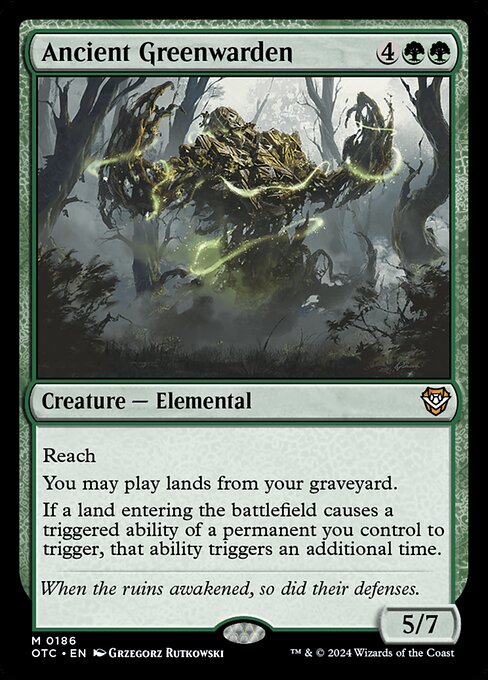


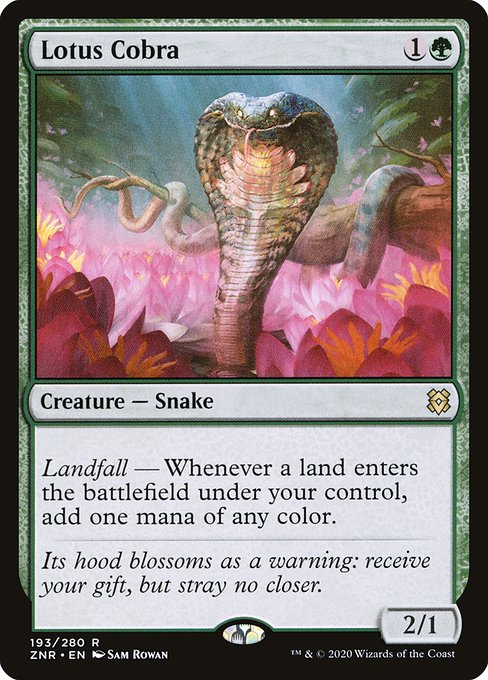

The trick that makes Spock better than his text is Augur of Autumn. Augur lets you look at the top card of your library at any time and play lands from the top, so you know what Spock's attack trigger will reveal before you declare him as an attacker, and you can play a land off the top to change it. Brainstorm and Ponder do the same job at instant and sorcery speed. Pavel Chekov, First Posting turns every draw into a choice of land or nonland, so the deck rarely stalls on either.
The weakness is the count itself. The deck runs four Forests, two Islands and two Plains, and duplicates add lands without adding names, so a Cultivate that fetches a second Forest does nothing for Spock, Lieutenant Nyota Uhura, Chief Montgomery Scott or Lt. Arex, Ever-Adapting, whose power and toughness are the count. Point Farseek and Nature's Lore at the typed two-color lands (Canopy Vista, Scattered Groves, Sodden Verdure, Rain-Slicked Copse, Prairie Stream and Irrigated Farmland), which add a name (Nature's Lore reaches only the four with Forest in the type line), and send Cultivate, Rampant Growth and the fetch lands after a basic type you don't control yet. Nothing in the deck searches for a Planet (Earth, Sector 001, Risa, Vulcan, Shore Leave Planet); those come off the top of your library.
Spock wants to attack into three opponents, but he can also trigger from home. Attack first, then play your land in the second main phase, and Chief Kyle, Transporter Tech exiles him and returns him at the end step for a second reveal. Temporal Tribulation, Balance of Terror and The Guardian of Forever do the same job, and Tribulation doubles as protection alongside Heroic Intervention, Merciful Mandate and U.S.S. Defiant, Mirror Migrant (flash it in to phase him out, so he is treated as though he doesn't exist until your next turn). Hold one of them before you swing.
2. Klingon Fury: attack all three players or don't bother
Worf, Defiant Commander (
 ) makes a 2/1 red Klingon Warrior token with haste when he enters and has battlefront, the deck's signature mechanic: whenever you attack, exile the top X cards of your library, where X is the number of opponents you attacked this turn, and you may play them until the end of your next turn. Every battlefront card in the deck counts opponents, not creatures, so one 1/1 at each opponent maxes the trigger and an alpha strike (attacking with everything) sent at one player wastes two thirds of it.
The payoffs stack fast. Kurn, Son of Mogh draws X cards and loses X life when he attacks, Martok, Hero of the Empire puts counters on X creatures, Korok, Liberated Rage gives the team +X/+X, Rite of Ascension makes X tapped and attacking 2/1 tokens, and The Beacon of Kahless taps for X mana of one color after you attack. Gagh Slinger makes Klingon and Warrior spells cost  less and pings (deals 1 damage to) every opponent as each one arrives, Warleader's Call pings for every creature that enters, and Combat Celebrant, World at War and Own the Day give you second combats, with Own the Day costing less per opponent you attacked.


The line to learn is Merciful Mandate. Attack all three opponents with everything, let the battlefront triggers resolve (Worf's three exiled cards, Kurn's three cards, Martok's counters, the Rite's tokens), then cast Mandate in the declare attackers step for : untap all your creatures and end the combat phase before blockers are declared. You keep every trigger and your whole board stays untapped. Cast it before the triggers resolve and it exiles them off the stack along with everything else. The price is that nobody takes combat damage, so treat it as a value turn, or as the setup for Own the Day: after you attacked three opponents it costs in the second main phase and gives you a second combat in which every battlefront trigger fires again.
What holds the deck at second is the thing the commanders ranking already said about Worf: it is the deck most dependent on nobody casting a wrath. The rebuild exists, but the turn after a Wrath of God you are rebuilding from hasty tokens (Worf's own when you recast him, Cha'DIch Investigator's, the three from Glory to the Empire!), and The Promise of Kahless needs a Klingon or Warrior on the battlefield to sacrifice before it returns the rest from your graveyard. Seven enchantments do survive the wipe. Ruinous Ultimatum is the deck's own answer to a board that got ahead of it: destroys every nonland permanent your opponents control and none of yours.
3. We Are the Borg: the strongest 99 behind the slowest commander
The Borg Queen costs  . For seven mana you get +2/+2 for your artifact creatures and, whenever she enters or attacks, a target opponent exiles cards from the top of their library until they hit a creature, which you assimilate: it comes in under your control with a +1/+1 counter as a Borg artifact creature and loses its other creature types. That is a strong card and a slow one. The deck spends three slots pulling her forward (Queen's Diamond, Type-03 Borg Vessel, and Võx, Child of the Collective, whose undaunted takes
 off her at a four-player table), which is the box admitting that seven mana is the weak point: the rest of the deck has to work before she arrives.
The 99 (the other 99 cards) does not need her. It is an artifact-creature deck stacked with anthems (permanents that pump your whole team): Tempered Steel gives artifact creatures +2/+2, Forsaken Monument gives colorless creatures +2/+2, which every 1/1 Borg token is, Locutus, the One Who Speaks gives them +1/+1 for , The Immortal Sun adds another +1/+1, and Class-4 Tactical Cube brings two tokens with it and adds +1/+1 once stationed to seven. The tokens come from everywhere: Conquest Mission, Maturation Chamber, Stratagem Emulator, Borg Incursion and Deliver from Chaos, and Hugh, First of Many gives every artifact spell replicate (pay it any number of times as you cast the spell and copy it that many times), so the artifact token makers (the Cube, the Chamber, the Emulator) come in multiples. Battle of Wolf 359 is a one-sided wrath, giving nonartifact creatures minus X where X is the number of artifact creatures you control.


Two traps. Skullclamp draws two when the equipped creature dies, and it kills a 1/1 by giving it +1/-1, but under Tempered Steel your tokens are 3/3 and a 4/2 does not die. Clamp the tokens before the anthems land, or feed them to Reclamation Specialist, which sacrifices an artifact creature for to draw a card and turns a clamped token into three cards. The second: Join the Collective destroys all creatures, yours included, and only pays out a Borg token for each nonartifact creature it kills. Cast Emergency Regeneration first, giving your artifacts hexproof and indestructible until end of turn, and the wrath becomes one-sided with a bonus.
Assimilated creatures keep their colors, so Forsaken Monument does not grow them; Tempered Steel and the Queen do, because they are artifact creatures. Queen's Diamond taps for one mana per charge counter on it, but only to cast your commander, which is the deck telling you the Queen is the finisher. Optimization Annex adds one extra charge counter every time you put any on an artifact, so station through it and the Diamond and the Cube reach their thresholds a creature sooner.
4. Federation Fleet: the deck that deals the whole table in
Jean-Luc Picard, Luminary () draws a card whenever another historic permanent (an artifact, a legendary, or a Saga) with mana value 3 or more enters under your control, and has seek out, the deck's mechanic: whenever you draw your second card each turn, put a +1/+1 counter on a creature and two charge counters on a Spacecraft. Twenty-two legendary creatures at three mana or more, all five Spacecraft and the bigger artifacts (Commander's Sphere, Hedron Archive, Stonespeaker Crystal, Alhammarret's Archive) mean he draws a lot, and eleven other cards in the deck trigger on that second draw, from Data, Exploring Humanity (discover 4: exile from the top until a nonland card with mana value 4 or less, then cast it free) to Ro Laren, Double Agent (2 damage to each opponent) to Rom and Leeta, Unlikely Pair (two tapped Treasures).
The problem is who else draws. Howling Mine gives every player an extra card, Fevered Visions draws for every player at their end step, Commander William Riker and Loran of the Third Path hand an opponent cards every time they hand you cards, and Ambassador K'Ehleyr has every player draw at your combat. At a four-player table that is three opponents being dealt in, and the payoffs you buy with it are mostly modest: 4 life from Dr. Pulaski, Cynical Clinician, +2/+0 and lifelink from Vic Fontaine, One Night Only. The Spacecraft want power tapped into them to station, and U.S.S. Enterprise-E, Sovereign, the deck's best card because it destroys all tapped creatures when it enters, needs eight before it flies. Cast it before you station or tap any creature of your own, ideally after Cryptic Command has tapped every opposing creature, and it is a one-sided wipe.
What saves the deck from being a worse Howling Mine is Riker. For and a tap, you and a target opponent each draw two cards, at instant speed, on anyone's turn. He taps, so he is once per rotation. Spend it on an opponent's turn, where you otherwise draw nothing: the two cards are your first and second of that turn, so every seek out card you control fires, and Ro Laren deals 2 to each opponent, Rom and Leeta make Treasures, Data discovers, Picard grows a creature and charges a ship. Your own turn finds its second draw from Howling Mine or K'Ehleyr's parley, and Loran of the Third Path plus Seven of Nine, Tertiary Adjunct can reach two draws on another opponent's turn. Give Riker's two cards to the opponent furthest behind, or to the one you want Fevered Visions to burn, since Visions deals 2 to an opponent holding four or more cards at their end step and two extra cards get them there. Best of all, activate him in response to the Visions trigger on that opponent's end step. With Alhammarret's Archive out, your two cards are four.


It is fourth because it is the deck least likely to end a game. Its interaction is the best of the four (Cryptic Command, Supreme Verdict, Swords to Plowshares, Chain Reaction, Fractured Identity), and its answers keep it alive into long games. Turning that into a win takes Tom Paris, Risk-Taker giving the team flying and double strike on a second draw, or U.S.S. Prometheus, Prototype at eight counters dealing its combat damage to every other opponent as well, and both arrive late.
The first card to change in each deck
- Landing Party: some of the duplicate basics. Any uniquely named land, even one that enters tapped, raises the count for Spock, Uhura, Scott and Arex, and the deck has the ramp to afford slow lands. Keep one of each basic type, because Cultivate, Rampant Growth, the fetch lands and Captain Kirk, Boldly Going find only basics.
- Klingon Fury: wrath insurance. Boros Charm costs , and its indestructible mode turns a destroy or damage wrath into a bad turn for its caster. Cut Pest Control for it: it destroys every nonland permanent with mana value 1 or less, your own 2/1 Warrior tokens and Sol Ring included.
- We Are the Borg: the commander. Hugh, First of Many costs and is in the deck, and our commanders ranking put him above the Queen for the same 99. Swap them, and swap Queen's Diamond for a rock that pays for anything, since its mana only ever casts whoever sits in the command zone.
- Federation Fleet: Howling Mine, for a card that draws only for you or punishes the draws you give away. Faerie Mastermind does both at : whenever an opponent draws their second card each turn you draw one, so every Riker activation gives you three cards and them two.
Which one to buy
Buy Landing Party if you want the deck most likely to do its own thing as printed, Klingon Fury if your pod answers threats with blockers rather than wraths, We Are the Borg if you intend to upgrade (it has the highest ceiling and the best reprints for an artifact deck in Skullclamp, Toxic Deluge, The Immortal Sun and Forsaken Monument), and Federation Fleet if your table is the kind that likes everyone having cards. Whichever you open, run it through the Commander Bracket Calculator, import it into the deck builder and record the first ten games. Three days of reading tells you what a deck does; the results tell you whether it wins.

Keep Reading

The Best New Commanders in Star Trek, Ranked by What They Do From the Command Zone
November 05, 2026
Star Trek cEDH Set Review: The Few New Cards That Clear the Bar, and the Reprints That Matter More
November 16, 2026
Comments
Join the conversation.