

Aerid Konstrari Commander Deck: Let the Legend Rule Pay for Your Mana

Aerid Konstrari is a four-mana flying Sphinx from Reality Fracture. It costs 

 , and whenever it enters or dies you get a Heartwood: a red and green artifact token that taps for or . Pay
 and it makes another Heartwood, then gets +X/+0 until end of turn, where X is the number of artifacts you control. That is the whole engine of this Aerid Konstrari commander deck. The Sphinx makes mana rocks (artifacts that tap for mana), the rocks pay for the Sphinx, and once the pile is tall enough the Sphinx hits every opponent for its power at the same time.
This is our bracket 3 build. We started from the list most players arrive at, made 15 changes, and explain each one below. If you want the Sphinx in context with the set's other legends, our ranking of Reality Fracture's new commanders covers that. This post is only about the deck.
What a Heartwood is worth
A Heartwood enters untapped. The token Aerid makes when it lands can be tapped the same turn, so a turn-four Sphinx leaves you a spare mana on the spot. It is also an artifact, so it adds one to X every time you pay . Each activation makes its Heartwood before it counts artifacts, so the second activation in a turn is one bigger than the first, and the third is one bigger again.
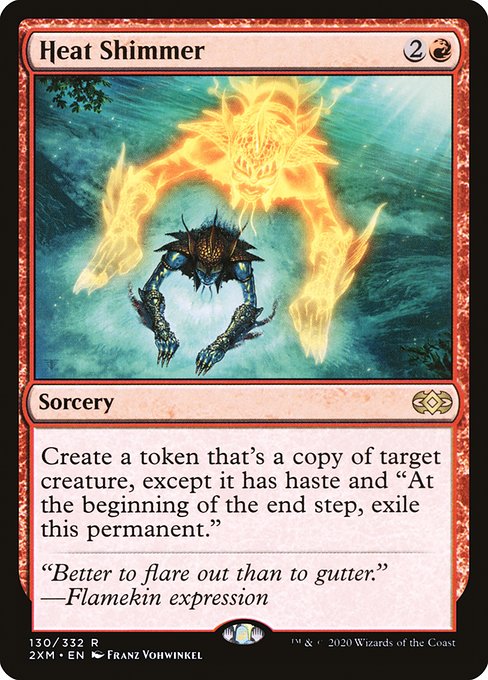
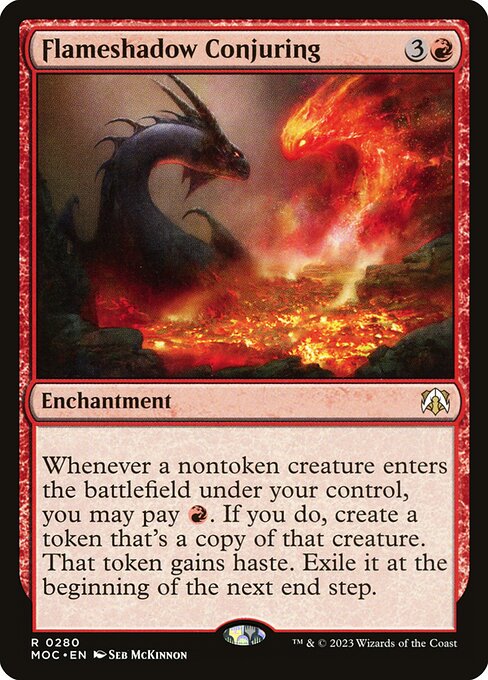
The second thing to understand is the legend rule. Aerid is legendary, and so is every token copy of it. When Heat Shimmer or Electroduplicate copies the Sphinx, the copy enters and the game immediately makes you keep one Aerid. Keep the real one and the token goes straight to the graveyard, which counts as dying. Its enters trigger and its dies trigger then both resolve, and you collect two Heartwoods from a token that never gets to do anything. Every clone spell in the deck works this way, and the exile clauses on Flameshadow Conjuring and Heat Shimmer never matter, because the token is already gone.
Helm of the Host is the exception, and the reason to keep it. Its copies are not legendary, so each of your combats you get another flying Sphinx that stays, makes its own Heartwood, and carries its own ability.


The list
Aerid Konstrari Bracket 3 (EDH)
- 1 Arcane Signet
- 1 Ashnod's Altar
- 1 Cursed Mirror
- 1 Decanter of Endless Water
- 1 Gruul Signet
- 1 Heartstone
- 1 Idol of Oblivion
- 1 Mind Stone
- 1 Minion Reflector
- 1 Rings of Brighthearth
- 1 Sol Ring
- 1 Talisman of Impulse
- 1 Thought Vessel
- 1 Thran Dynamo
- 1 Adaptive Omnitool
- 1 Battlemage's Bracers
- 1 Blade of Selves
- 1 Improvised Arsenal
- 1 Swiftfoot Boots
- 1 Great Furnace
- 1 Treasure Vault
- 20 Forest
- 5 Mountain
- 1 Bramble Sovereign
- 1 Heartwood Crafter // Soul Tether
- 1 Beast Whisperer
- 1 Reckless Fireweaver
- 1 Tenured Tethermage
- 1 Konstrari Improviser // Soul Tether
- 1 Drumhunter
- 1 Flameshadow Conjuring
- 1 Greater Good
- 1 Guardian Project
- 1 Mana Reflection
- 1 Myth Unbound
- 1 Tribute to the World Tree
- 1 Up the Beanstalk
- 1 Utopia Sprawl
- 1 Wild Growth
- 1 City of Death
- 1 Nyxbloom Ancient
- 1 Beast Within
- 1 Chaos Warp
- 1 Fling
- 1 Fury Storm
- 1 Heroic Intervention
- 1 Momentous Fall
- 1 Nature's Claim
- 1 Return of the Wildspeaker
- 1 Second Harvest
- 1 Soul's Fire
- 1 Command Tower
- 1 Opal Palace
- 1 Reliquary Tower
- 1 Spire Garden
- 1 Cinder Glade
- 1 Sheltered Thicket
- 1 Stomping Ground
- 1 Helm of the Host
- 1 Roxanne, Starfall Savant
- 1 Agatha of the Vile Cauldron
- 1 Sokenzan, Crucible of Defiance
- 1 Blasphemous Act
- 1 Chandra's Ignition
- 1 Devastating Onslaught
- 1 Electroduplicate
- 1 Farseek
- 1 Flare of Cultivation
- 1 Genesis Storm
- 1 Heat Shimmer
- 1 Jeska's Will
- 1 Life's Legacy
- 1 Natural Order
- 1 Nature's Lore
- 1 Rampant Growth
- 1 Three Visits
- 1 Aerid Konstrari
The deck lives at Aerid Konstrari Bracket 3, and its bracket audit grades it bracket 3, Upgraded. It runs two Game Changers, Jeska's Will and Natural Order. Game Changers are the cards on the official list of high-impact staples; bracket 3 allows up to three, and our brackets guide has the full rules. There is no mass land denial and no extra-turn card.
The audit flags two infinite lines, and there is a third it does not catch. With Nyxbloom Ancient and Mana Reflection both out, a Heartwood taps for six mana, exactly the cost of the activation that makes the next one. Agatha of the Vile Cauldron takes her power off the cost of every activated ability your creatures have, down to a floor of one mana; her own power is small, but once an Improvised Arsenal or Adaptive Omnitool on her pushes it to five, each costs and each new Heartwood pays for the next. The third line is any copy of Nyxbloom Ancient, which is not legendary: Heat Shimmer, Electroduplicate, Devastating Onslaught, Flameshadow Conjuring, Minion Reflector, Bramble Sovereign and Helm of the Host can all copy it, and two triplers make a Heartwood tap for nine, so every activation returns more than it costs for as long as the copy lasts.
The first two lines need 13 mana of enchantments on the battlefield, or Agatha equipped and surrounded by artifacts. The third can happen on turn six off a turn-five Natural Order and a three-mana clone, so it is the one to mention before you sit down. The audit grades the deck bracket 3 on the two lines it sees. If your table does not want the fast loops, pull Nyxbloom Ancient and Agatha of the Vile Cauldron and give Natural Order a new target or a new slot. Mana Reflection still allows a slower four-card loop with Roxanne, Starfall Savant, Battlemage's Bracers on the Sphinx and Rings of Brighthearth (each Heartwood taps for three, and the activation plus both copies costs nine), so pull it as well if the table wants none of these.
Turns one to four
The opening is ramp (cheap spells and rocks that get you extra mana early), and the deck is built so that almost any hand has some. Thirty-five lands plus Sol Ring, Arcane Signet, Gruul Signet, Talisman of Impulse, Mind Stone, Thought Vessel, Wild Growth and Utopia Sprawl get the Sphinx down on turn three often and on turn four almost always. Nature's Lore and Three Visits fetch a Forest card untapped and Farseek fetches a Mountain card, and Cinder Glade, Stomping Ground and Sheltered Thicket are all both, so each of those spells can fetch a dual (a land that makes two colors) instead of a basic (Sheltered Thicket still enters tapped).
The one-mana creature worth a close look is Heartwood Crafter // Soul Tether. It uses Reality Fracture's prepared mechanic, which our mechanics explainer covers: the creature enters prepared, and while it is prepared you may cast a copy of its spell, Soul Tether, which makes a Heartwood. Casting it unprepares the Crafter, so that happens once. The Crafter's own mana cannot be spent on spells from your hand, but the command zone is not your hand: it pays for the Sphinx itself, which is how this deck casts Aerid on turn three off three lands. It also pays for the , for equip costs, and for anything Jeska's Will exiles. Konstrari Improviser // Soul Tether is the same idea at two mana, and Tenured Tethermage trades a land for two Heartwoods.
Before you cast the Sphinx, check what is waiting for it. With Flameshadow Conjuring out, Aerid entering gives you two triggers, and you choose their order: put the Heartwood trigger on top, tap the fresh Heartwood for , and pay for the Conjuring copy with it. The copy enters, dies to the legend rule, and you have three rocks from one cast without spending a mana beyond the Sphinx. With Myth Unbound out as well, every later recast is cheaper and draws a card on the way back to the command zone. Guardian Project draws when the cast Sphinx enters (the Conjuring copy is a token and does not count), since a commander returning from the command zone shares a name with nothing you control unless a Helm of the Host copy is still around.
The big turn, and three ways it ends the game
The pump is the finisher. Count your artifacts, pay as many times as the mana allows, and the Sphinx's power climbs by the artifact count each time. Then pick the spell that fits the board:
- Chandra's Ignition is the table kill. For
 , Aerid deals damage equal to its power to each opponent and to every other creature. With ten artifacts, two activations add 23 power, enough to finish any opponent at 23 life or less, and four activations add 50, which ends a full-life table for 24 mana plus the spell. That is a real turn once a mana multiplier is on the battlefield. It also kills your own Nyxbloom Ancient and Agatha of the Vile Cauldron, which is fine if the game is ending and a real cost if it is not.
- Fling and Soul's Fire point the same power at one opponent. Soul's Fire keeps the Sphinx. Fling sacrifices it, which gives you a Heartwood and sends the Sphinx back to the command zone to be recast. Hold Fury Storm for either: it copies itself once for each time you have cast your commander from the command zone, and copies of Fling deal damage based on the same sacrificed creature. Cast the Sphinx once this game and Fury Storm arrives with one copy; both copy Fling, and with the original that is three Flings pointed at three opponents.
- Commander damage in the air. Improvised Arsenal gives +1/+0 per artifact and Adaptive Omnitool gives +1/+1 per artifact. With both on a flying Sphinx and a dozen rocks, one unblocked swing deals well over 21 commander damage, the amount from a single commander that kills a player on its own. Blade of Selves gives the Sphinx myriad (when it attacks, a copy attacks each other opponent), and because those copies die to the legend rule the moment they appear, each attack is two Heartwoods per extra opponent.
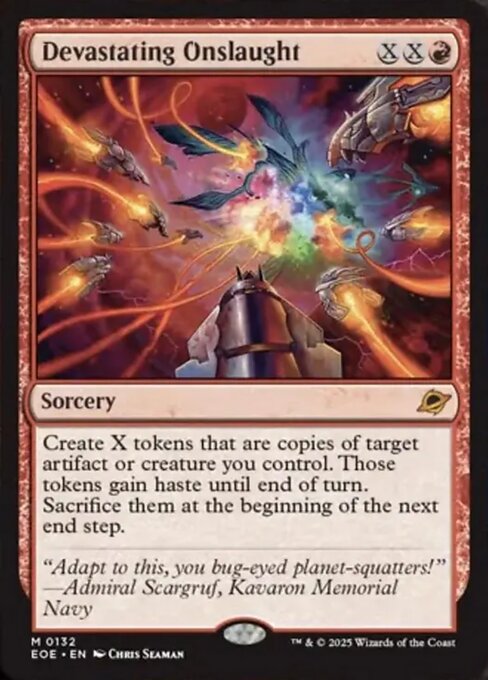
Devastating Onslaught is the turn that sets all of this up. For X, you get X copies of Aerid that die to the legend rule at once: X Heartwoods from entering, X more from dying, and 2X untapped rocks you can tap immediately. The spell costs  and hands back 2X mana the same turn, so it is nearly free and leaves 2X permanent artifacts behind. With Reckless Fireweaver out, each of those Heartwoods is also a point of damage to every opponent: Onslaught for five is ten damage to each opponent before you have activated anything.
Draw keeps pace through the same number. Momentous Fall, Life's Legacy, Greater Good and Return of the Wildspeaker all draw cards equal to a creature's power, and a pumped Sphinx is the biggest thing you will control. Thought Vessel, Decanter of Endless Water and Reliquary Tower let you keep what you draw. Drumhunter is the quiet one: it checks for a creature with power five or greater at your end step, and Aerid's pump lasts until end of turn. With four artifacts already out, one activation puts the Sphinx at five power or more whatever its printed number, so activating on your own turn is a card.
What we cut from the average list
The list most people start from has 38 lands and almost no removal. Both are what averaging does to a deck, and both had to go.
- Wooded Ridgeline, Highland Forest and Mountain Valley (cut): three lands that always enter tapped, in a deck that wants to spend six mana on its own turn. We kept one tapped Mountain Forest, Sheltered Thicket, because it cycles for
 when you have lands to spare. Thirty-five lands plus the rocks is plenty.
- Null Brooch (cut): a counterspell that discards your hand, in a deck whose best turn is drawing ten off Momentous Fall.
- Bind and Warping Wail (cut): one counters an activated ability, the other exiles a creature with power or toughness one or less. Neither answers the permanents that beat you.
- Family's Favor (cut): a shield counter (it absorbs one hit of damage or destruction) and a maybe-draw that need the Sphinx to attack every turn.
- Court of Garenbrig (cut): it makes you the monarch (an extra card at each of your end steps, and whoever hits you takes the title), which invites attacks at a deck with few blockers.
- Flamerush Rider and Felhide Spiritbinder (cut): both make a copy of Aerid, with strings attached. Flamerush Rider only copies a creature attacking alongside it, so the Sphinx has to be in combat. Felhide Spiritbinder has to attack, survive and untap, then charges for the copy. Heat Shimmer does the same job for three mana with no conditions.
- Garruk's Uprising, Elemental Bond, Outcaster Trailblazer, Garruk's Packleader and Colossal Majesty (cut): five draw effects that never see the pump. The first four check a creature's power as it enters, and the clones enter at the Sphinx's printed size, never its pumped size; Colossal Majesty checks at your upkeep, after the pump has worn off, so the pump never counts toward it. The pumped number is the one this deck makes interesting, and none of these five reads it, so we moved that draw onto effects that read it or ignore it: Return of the Wildspeaker draws the pumped power at instant speed, Idol of Oblivion draws a card on any turn you made a token, and Guardian Project draws for any creature you cast. Tribute to the World Tree stayed because it never does nothing: a creature that misses its bar gets two +1/+1 counters instead of a card.
What went in, and why
- Beast Within, Chaos Warp, Nature's Claim and Blasphemous Act: the removal the list lacked. Beast Within and Chaos Warp hit any permanent at instant speed. Nature's Claim is one mana for an opposing Rhystic Study or Sol Ring. Blasphemous Act is close to one-sided in a deck with ten creatures besides the Sphinx, and if it catches Aerid you get a Heartwood and recast it.
- Chandra's Ignition and Soul's Fire: the finishers above. The average list had only Fling to turn the Sphinx's power into damage.
- Rings of Brighthearth: to copy the activation is a second Heartwood and a second pump for a third of the price. It also copies Mind Stone, Treasure Vault and Idol of Oblivion.
- Heartstone: takes off the activation and stacks with Agatha. It is an artifact, so it also adds one to X.
- Thran Dynamo:
 per tap is half an activation from one card, and another artifact.
- Idol of Oblivion: taps to draw on any turn you made a token, which in this deck is nearly all of them.
- Guardian Project: every creature in the deck is a singleton, so it draws on each of them, and on every recast of the commander.
- Reckless Fireweaver: a point of damage to each opponent for every artifact that enters under your control. It turns Onslaught, Second Harvest and every loop above into damage without needing a Fling.
- Return of the Wildspeaker: an instant that draws the Sphinx's pumped power (Aerid is a Sphinx, so it counts as non-Human), or gives your non-Human creatures +3/+3 when you need to survive a combat.
- Jeska's Will (Game Changer): with the Sphinx on the battlefield you take both modes, a pile of red mana for activations and three cards to play.
- Natural Order (Game Changer): the additional cost is sacrificing a green creature, and Aerid is one. Sacrifice the commander, collect the Heartwood and the Myth Unbound card, and put Nyxbloom Ancient onto the battlefield on turn five.
Mulligans, sequencing and two traps
Mulligans. Keep a hand with three lands and one of the two-mana rocks or ramp sorceries; the Sphinx on turn three is the plan and the deck has more than a dozen ways to get there. Mulligan a hand that is all payoff: Chandra's Ignition, Fury Storm and Devastating Onslaught do nothing until the board exists, and the deck draws plenty once it does.
The legend rule choice. When a token copy enters, keep the nontoken Sphinx. Cursed Mirror is a judgment call. It can enter as a copy of Aerid, and either way you collect two Heartwoods: one from the copy entering, one from whichever Aerid dies. Keep the Mirror and you have a hasty flying Sphinx for the turn, a card from Myth Unbound, and a mana rock afterwards; the price is recasting the real Sphinx next turn at more, the usual commander tax, which Myth Unbound trims by . Keep the real Sphinx and the Mirror dies as a creature, rock and all. Take the first line when you have the mana to recast, the second when you do not.
Trap one: Tethermage's tokens enter tapped. Tenured Tethermage's two Heartwoods arrive tapped, so they pay for nothing the turn you cast it. Aerid's own Heartwoods and the clone-spell Heartwoods are untapped, and that difference decides whether you can activate the same turn.
Trap two: Blasphemous Act is rarely here. Its discount counts creatures, and Heartwoods are artifacts. Against a table with few creatures and a board full of your own rocks, expect to pay  or
 for it, and plan the turn so you can.
Sequencing with Roxanne. Roxanne, Starfall Savant adds a mana whenever you tap an artifact token for mana, so with her out three Heartwoods pay for an activation instead of six. Her Meteorite deals two damage when it enters, which picks off a mana dork (a creature that taps for mana) or finishes a wounded blocker.
And Devastating Onslaught does not have to copy the Sphinx. Aimed at Nyxbloom Ancient, it is the third loop described above, and the one your table will remember.
Taking it to a table
The Copy to my account button on the decklist above puts the list in your own deck builder once you sign in, and from there you can register it to a league and record the games it plays. The question that matters about any new build is whether it wins, and the deck's own ELO after a month of games is the only honest answer. If you swap the Game Changers out for a lower-powered table, run the new list through the bracket calculator before you claim a number: the audit linked above is tied to this exact 99, and one swap can move it.



Comments
Join the conversation.