

Atraxa, Praetors' Voice Commander Deck: Count the Proliferates, Not the Damage
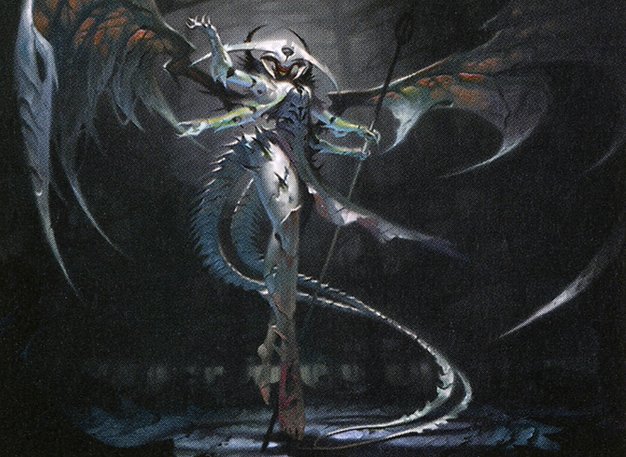
Most decks measure a turn in damage. This Atraxa, Praetors' Voice commander deck measures it in proliferates, and the unit matters: one proliferate adds a poison counter to every poisoned opponent at once, and no amount of lifegain takes it back. Atraxa, Praetors' Voice hands you one at each of your end steps for free. The deck's job is to get a first counter onto each opponent, then make that trigger happen more often and count for more.
This is our Bracket 3 build. It started from the typical poison list, the cards that show up in most Atraxa poison decks, and changed in ten places. The bracket audit is linked so the number can be checked. The arithmetic comes first, then the cards that matter, sorted by what they do for it.
The trigger the deck is built around
Atraxa costs 


 for a 4/4 with flying, vigilance, deathtouch and lifelink, plus one line: "At the beginning of your end step, proliferate." To proliferate, you choose any number of permanents and players, and each one you chose gets another counter of each kind it already has. Players carry poison counters, so an opponent with one poison counter can be chosen and gets a second.
Two thresholds decide the game. Ten poison counters loses. Three switches on the "corrupted" abilities from the Phyrexia sets: Ixhel, Scion of Atraxa starts exiling that opponent's top card for you to play, Glistening Sphere starts tapping for three mana, and Skrelv's Hive gives every creature you control with toxic lifelink. The deck pushes everyone past three quickly and past ten eventually, and the gap between those two numbers is where the games are won. A 4/4 flier connecting is four damage to one life total out of 120 at the table; a proliferate with the whole table poisoned is a step toward three separate kills.
How many end steps to ten
Every line below starts from the same position: each opponent has one poison counter, Atraxa is on the battlefield, and nothing attacks.
- Atraxa alone: one counter per opponent per end step. One to ten is nine end steps. Slow, which is why the rest of the list exists.
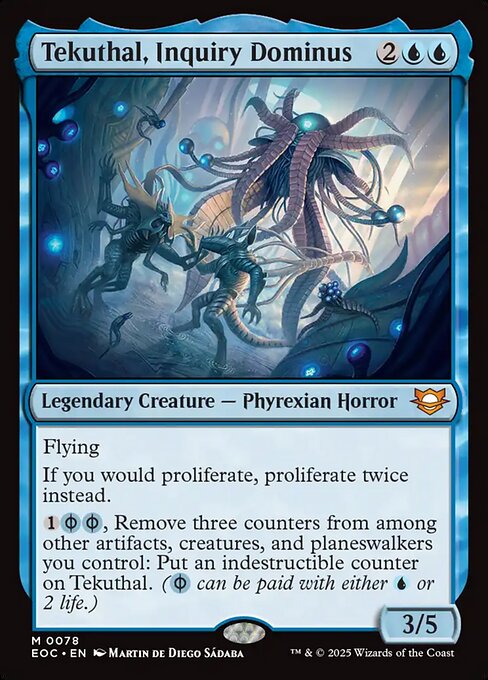
- Atraxa with Tekuthal, Inquiry Dominus: "If you would proliferate, proliferate twice instead." Two per end step: 1, 3, 5, 7, 9, 11. Five end steps, and every opponent is corrupted after the first one.
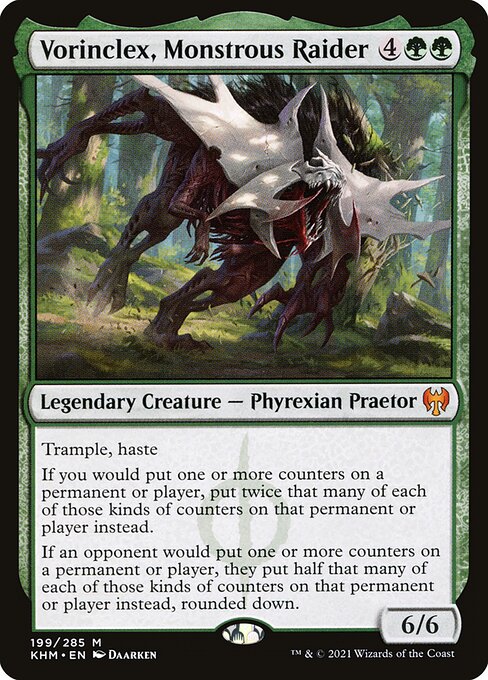
- Atraxa with Vorinclex, Monstrous Raider: Vorinclex doubles every counter you put on a permanent or a player, so each proliferate is two poison on each opponent you chose. Also five end steps.
- Atraxa with both: two proliferates, each doubled, is four per end step: 1, 5, 9, 13. Three end steps.
- Atraxa with Flux Channeler and two noncreature spells a turn: each spell is a proliferate, so a turn is three counters: 1, 4, 7, 10. Three of your turns. With Tekuthal as well it is six a turn, 1, 7, 13: two turns.
Tekuthal is the card to find first. It costs  , one turn after Atraxa, and halves every line above. Vorinclex costs
 and also halves the counters opponents put anywhere, rounded down, so their planeswalkers enter with half their loyalty and a lone +1/+1 counter from their side becomes none.
The same triggers draw cards and make mana
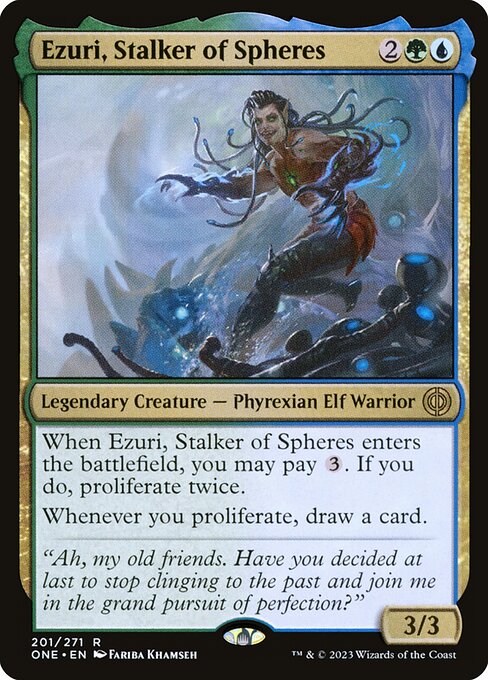
Ezuri, Stalker of Spheres reads "Whenever you proliferate, draw a card," and Tekuthal's two proliferates are two triggers. With both out, Atraxa's end step is two poison on everyone and two cards for you before you cast anything. Fathom Mage draws whenever a +1/+1 counter is put on it, and once it has one (from its evolve ability, which adds a counter when a bigger creature of yours enters, or from Brokers Ascendancy at your end step) every proliferate adds one and draws. Tekuthal, Ezuri and Fathom Mage together turn the end step into four cards.
The cheap proliferate spells get the same multiplier. Contentious Plan is  for proliferate, draw a card; with Tekuthal and Ezuri out it is three cards and two poison on every poisoned opponent. With Flux Channeler out too, Tekuthal doubles its cast trigger as well: four proliferates, four poison on each poisoned opponent and five cards, for two mana. Drown in Ichor is the removal version for , -4/-4 on a creature and then a proliferate. Tezzeret's Gambit draws two and proliferates for

 (a Phyrexian symbol: pay or 2 life). Experimental Augury digs three deep and proliferates at instant speed.
Mana grows the same way. Astral Cornucopia cast for  with X at one is a three-mana rock (an artifact that taps for mana) with one charge counter, tapping for one. Atraxa adds a counter every end step, so it taps for two the next turn and three the turn after, and with Tekuthal it climbs by two. Everflowing Chalice with its multikicker paid once (two mana for one charge counter) does the same. Vivid Creek and Vivid Grove enter with two charge counters that each pay for a mana of any color, and the end step puts back the one you spent. Once any opponent has three poison, Glistening Sphere taps for three mana of one color, three of the four that a Bastion, Clasp or Drake activation costs below.

Getting a counter onto every opponent by turn four
None of that starts until each opponent has a counter, so the list carries thirteen cards at three mana or less that hand one out; call them seed cards. Five need no combat: Prologue to Phyresis (, instant, each opponent gets a counter and you draw), Infectious Inquiry (, each opponent gets a counter, you draw two and lose 2 life), Vraska's Fall (, instant, each opponent sacrifices a creature or planeswalker and gets a counter), Phyresis Outbreak (, each opponent gets a counter, then their creatures shrink by their poison totals) and Infectious Bite (, instant, one of your creatures deals damage to one of theirs and each opponent gets a counter; it needs one of your creatures and one of theirs to target).
Eight connect while boards are empty, one opponent per hit: Blighted Agent (infect, can't be blocked), Plague Stinger (infect, flying), Skrelv, Defector Mite and the Mite that Skrelv's Hive makes each upkeep (toxic 1), Tainted Observer (toxic 1, flying), Bloated Contaminator (toxic 1, trample, a proliferate on hit), Fynn, the Fangbearer (deathtouch, and two poison whenever a deathtouch creature of yours connects) and Venerated Rotpriest, toxic 1 plus a counter for an opponent whenever any spell targets one of your creatures, their removal included. Infect and toxic differ. Infect changes what the damage does: a player dealt it gets that many poison counters instead of losing life, and a creature gets -1/-1 counters instead of damage marked on it. Toxic N sits on top of normal damage: the player loses the life and gets N counters too. A creature with both gives both.
Thirteen cards in ninety-nine and ten cards seen by your fourth turn means that about three games in four you hold a seed card without digging, and the five spells alone turn up a little under half the time. The mulligan follows from that number. Keep three lands covering two of the four colors, one ramp piece (a rock or a land-fetching spell) and one seed card. Lands and rocks with no seed card is a mulligan here even when the colors are perfect, because Atraxa's first end step would have nothing to grow.
The one sequencing rule: the counter goes on them before Atraxa's trigger resolves, never after. Prologue to Phyresis and Vraska's Fall are instants, so the cheap line is to cast them at the end of the turn before she comes down. A seed that lands after the end-step trigger is a whole proliferate thrown away.
The proliferate sources, priced
Once the counters are out, each card in the engine half of the list is an exchange rate: what you pay for one more proliferate.
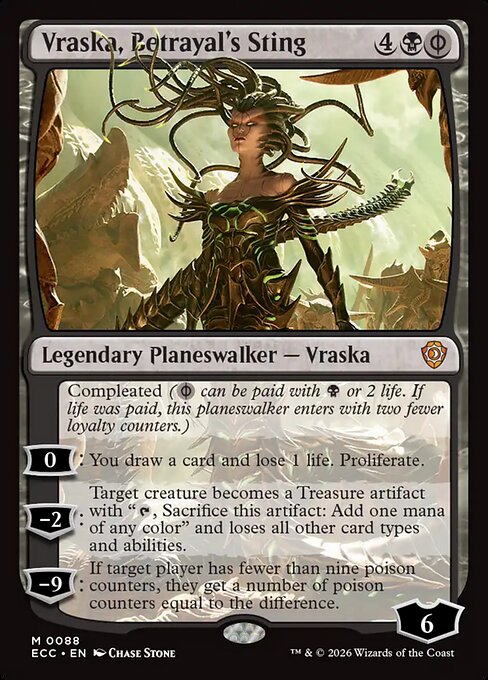
Free, on something you were doing anyway. Flux Channeler on each noncreature spell. Inexorable Tide on every spell, creatures included, for . Evolution Sage on every land that enters: Cultivate, Farseek and Rampant Growth become proliferate spells, and Evolving Wilds and Terramorphic Expanse are two proliferates each, the land itself and the basic it fetches. Metastatic Evangel when another nontoken creature of yours enters. Thrummingbird, Grateful Apparition and Bloated Contaminator when they deal combat damage to a player. Sword of Truth and Justice when the creature wearing it connects, with a +1/+1 counter on a creature first, which is a Fathom Mage draw. Vraska, Betrayal's Sting's 0 ability, a card and a proliferate for 1 life.
Two mana. Tainted Observer offers a proliferate for whenever another creature of yours enters, tokens included.
Four mana. Karn's Bastion (,  ), Contagion Clasp (, , after its -1/-1 counter on entry) and Viral Drake (, as often as you can pay). Glistening Sphere's three corrupted mana plus one land pays for one of these, and all three work on an opponent's turn.
An artifact. Throne of Geth taps and sacrifices one to proliferate. The Hive's Mite each upkeep, the three Mites Vishgraz, the Doomhive brings and a Clasp that has placed its counter are all fodder.
Once. Cankerbloom for , Glistening Sphere on entry, and Ezuri's own entry: pay and he proliferates twice, drawing for each; with Tekuthal out that is four proliferates and four cards.
Tekuthal doubles every rate above and Vorinclex doubles every counter it places, which is why Counterspell and Reject Imperfection are for those two rather than for Atraxa, who comes back from the command zone.
Cutting the count short
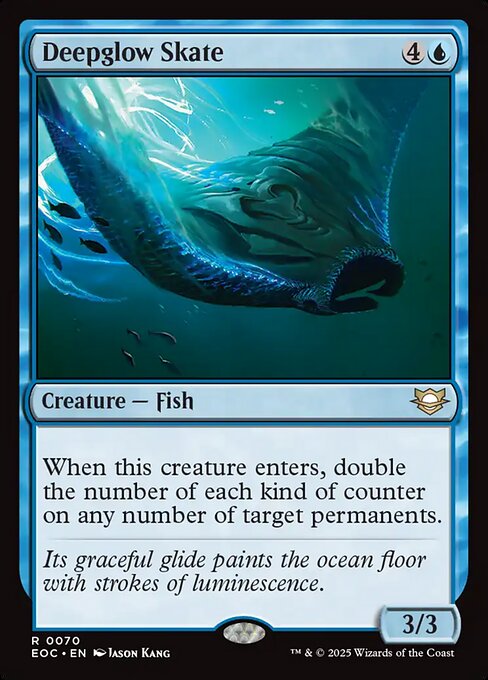
Some lines skip the arithmetic. Vraska, Betrayal's Sting enters with six loyalty if you pay for her  symbol rather than 2 life (a compleated planeswalker enters with two fewer loyalty counters when the life is paid). Her -9 reads: "If target player has fewer than nine poison counters, they get a number of poison counters equal to the difference." It sets a player to nine and Atraxa's end step makes it ten. Deepglow Skate doubles the counters on any number of permanents as it enters, so Skate after Vraska is twelve loyalty and the -9 the turn she arrives. That is eleven mana in one turn; a turn later works too, since her 0 and Atraxa's end step take her to eight and the Skate makes that sixteen. Vorinclex doubles her loyalty on entry the same way, and under Vorinclex the difference is doubled as well: a player at one poison gets sixteen, which kills on the spot with no end step needed.
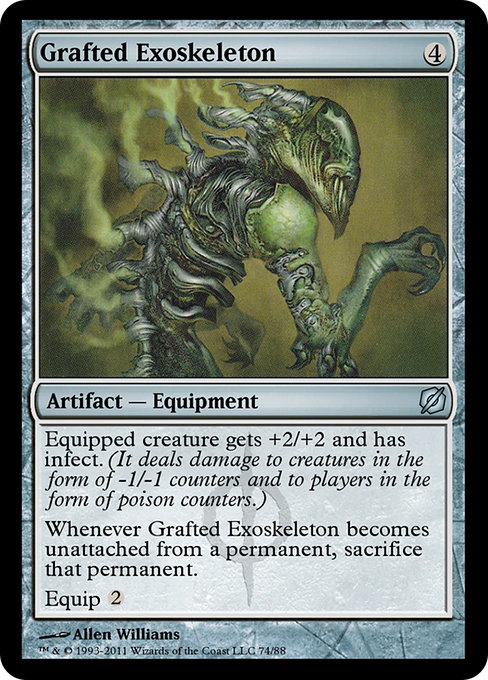
Combat has shortcuts of its own. Fynn gives two poison whenever a deathtouch creature of yours deals combat damage to a player, and Atraxa has deathtouch, so a connecting Atraxa is two from Fynn and one more at the end step. Grafted Exoskeleton makes her a 6/6 flier with infect: six poison a hit, and lifelink still gains six because infect damage is still damage. Skithiryx, the Blight Dragon is a 4/4 flying infect body with haste for , four poison the turn it lands and eight under Vorinclex, and regenerates it, so as long as you keep open a destroy effect taps it instead of killing it.
Triumph of the Hordes is the one-swing finish: your creatures get +1/+1, trample and infect until end of turn. A Mite becomes a 2/2 with infect and toxic 1, and the two stack, so each unblocked Mite is three poison, four with Necrogen Rotpriest out to add its extra counter. Phyrexian Swarmlord makes a 1/1 infect Insect at your upkeep for every poison counter your opponents have between them; three opponents at three poison is nine Insects a turn, which is the board Triumph wants.
Keep one instant-speed proliferate for the last counter: Experimental Augury, Reject Imperfection on a cheap spell, Viral Drake, Karn's Bastion or Throne of Geth. A player at nine dies in their own upkeep, or in response to the removal they aimed at Atraxa, and never gets the turn they were counting on.

Bracket 3 on one card: the audit
The list is Atraxa, Praetors' Voice Bracket 3, and its bracket audit returns Bracket 3 with one Game Changer: Narset, Parter of Veils. Game Changers are the cards the Commander bracket system singles out as stronger than a precon table expects, and Bracket 3 allows up to three; the brackets guide covers the rest. The audit finds no tutors (cards that search your library for a specific card), no two-card infinite combos, no extra turns and no mass land destruction.
Narset is the whole margin: cut her and the same audit returns Bracket 2. That tells you how the deck plays. It is a Bracket 2 engine carrying one strong card, not a pile of staples. She earns the slot because proliferate pays her back: her -2 digs four cards for a noncreature, nonland card, Atraxa's end step refunds one loyalty, and with Tekuthal out she digs every turn for nothing. Her static ability, which stops each opponent drawing more than one card a turn, is the part the table will object to.
Atraxa, Praetors' Voice Bracket 3 (EDH)
- 1 Arcane Signet
- 1 Astral Cornucopia
- 1 Chromatic Lantern
- 1 Contagion Clasp
- 1 Everflowing Chalice
- 1 Fellwar Stone
- 1 Glistening Sphere
- 1 Sol Ring
- 1 Throne of Geth
- 1 Grafted Exoskeleton
- 1 Sword of Truth and Justice
- 5 Forest
- 4 Island
- 4 Plains
- 4 Swamp
- 1 Evolution Sage
- 1 Deepglow Skate
- 1 Fathom Mage
- 1 Flux Channeler
- 1 Bloated Contaminator
- 1 Tainted Observer
- 1 Thrummingbird
- 1 Viral Drake
- 1 Venerated Rotpriest
- 1 Cankerbloom
- 1 Metastatic Evangel
- 1 Blighted Agent
- 1 Phyrexian Swarmlord
- 1 Plague Stinger
- 1 Necrogen Rotpriest
- 1 Grateful Apparition
- 1 Brokers Ascendancy
- 1 Inexorable Tide
- 1 Norn's Decree
- 1 Skrelv's Hive
- 1 Counterspell
- 1 Experimental Augury
- 1 Infectious Bite
- 1 Path to Exile
- 1 Prologue to Phyresis
- 1 Putrefy
- 1 Reject Imperfection
- 1 Swords to Plowshares
- 1 Vraska's Fall
- 1 Arcane Sanctum
- 1 Command Tower
- 1 Evolving Wilds
- 1 Exotic Orchard
- 1 Karn's Bastion
- 1 Llanowar Wastes
- 1 Opal Palace
- 1 Opulent Palace
- 1 Path of Ancestry
- 1 Sandsteppe Citadel
- 1 Seaside Citadel
- 1 Sungrass Prairie
- 1 Terramorphic Expanse
- 1 Vivid Creek
- 1 Vivid Grove
- 1 Yavimaya Coast
- 1 Canopy Vista
- 1 Sunken Hollow
- 1 Prairie Stream
- 1 Skrelv, Defector Mite
- 1 Fynn, the Fangbearer
- 1 Ixhel, Scion of Atraxa
- 1 Skithiryx, the Blight Dragon
- 1 Ezuri, Stalker of Spheres
- 1 Tekuthal, Inquiry Dominus
- 1 Vishgraz, the Doomhive
- 1 Vorinclex, Monstrous Raider
- 1 Ajani, Sleeper Agent
- 1 Ajani, the Greathearted
- 1 Narset, Parter of Veils
- 1 Tamiyo, Field Researcher
- 1 Vraska, Betrayal's Sting
- 1 Contentious Plan
- 1 Cultivate
- 1 Drown in Ichor
- 1 Farseek
- 1 Infectious Inquiry
- 1 Phyresis Outbreak
- 1 Rampant Growth
- 1 Tezzeret's Gambit
- 1 Toxic Deluge
- 1 Triumph of the Hordes
- 1 Atraxa, Praetors' Voice
Ten swaps, sorted by what they add to the clock
The typical poison list spends many slots on small toxic bodies that deliver one counter if they connect and nothing after the first blocker appears. Ten cards came out, grouped here by what the replacement does for the count.
Bodies that stop connecting, out; bigger hits and multipliers in. Bilious Skulldweller (a one-mana deathtouch toxic 1), Pestilent Syphoner (a 1/1 flier with toxic 1), Voidwing Hybrid (a toxic 1 flier that returns from your graveyard when you proliferate) and Blightbelly Rat (toxic 1, one proliferate when it dies) are cut. In come Fynn, Viral Drake, Skithiryx and Vorinclex, all covered above: two poison per Atraxa hit, a repeatable proliferate on a flying infect body, four hasty infect power, and the doubler.
Two one-shot proliferates out; a repeatable proliferate and a finisher in. Thirsting Roots (a basic land to hand or one proliferate for ) and Unnatural Restoration (one proliferate plus a permanent card back from the graveyard) are cut for Throne of Geth, which proliferates every turn for a Mite, and Triumph of the Hordes, the one-swing finish the list had no clean version of.
A seed that hurt you, out; a seed that sweeps, in. Ichor Rats gives every player a counter when it enters, you included, and is a three-mana 2/1. It is cut for Phyresis Outbreak, which seeds every opponent and then gives each of their creatures -1/-1 for every poison counter its controller has. Cast with everyone at three it is a one-sided -4/-4 for .
Two more per hit, out; six per hit in. Necrogen Communion, an Aura that grants toxic 2 and returns the creature when it dies, is cut for Grafted Exoskeleton, the six-poison line above.
An eleventh mana source, out; a sweeper in. Commander's Sphere is cut for Toxic Deluge. The list had eleven mana sources beyond lands and nothing that reset a board that got ahead of it. Glistening Sphere already covers the three-mana any-color rock, with a proliferate attached, and Atraxa's lifelink pays Deluge's life.
Counters on the wrong side of the table, out; protection in. Hardened Scales only grows +1/+1 counters on your own creatures, a side theme here (Brokers Ascendancy, Ajani, the Greathearted, Ajani, Sleeper Agent, Fathom Mage); it adds nothing to a poison counter or a loyalty counter, which is where this deck wins. It is cut for Sword of Truth and Justice: Atraxa becomes a 6/6 with protection from white and from blue, so Swords to Plowshares, Path to Exile and targeted blue bounce can't be pointed at her, white and blue creatures can't block her, and every hit is a +1/+1 counter and a proliferate.
Kept on purpose: Narset; the Vivid lands; Opal Palace, because recasting Atraxa with its mana gives her +1/+1 counters, one per time she has been cast from the command zone, and those proliferate too; Brokers Ascendancy, since a counter on Fathom Mage every end step is a card; and Deepglow Skate for the Vraska line.
The rules the count depends on
Deepglow Skate does not touch poison. It targets permanents, and players are not permanents. Aim it at loyalty, charge counters and +1/+1 counters. Vishgraz is a trap of the same kind: its size is a static bonus per poison counter your opponents have, not counters on it, so the Skate does nothing for it.
Order your end-step triggers. Ixhel's corrupted exile and Atraxa's proliferate both trigger at the beginning of your end step, and both are yours, so you pick the order they go on the stack. Put Ixhel's on first so Atraxa's resolves first: an opponent who reaches three poison from that proliferate is caught by Ixhel's exile the same turn, because Ixhel checks who is at three as it resolves.
Grafted Exoskeleton's last line. "Whenever this Equipment becomes unattached from a permanent, sacrifice that permanent." If an opponent destroys the Exoskeleton while Atraxa wears it, you sacrifice Atraxa, and paying to move it to a Mite does the same. Equip her when she is swinging for the rest of the game and never equip away. Against a table holding artifact removal, a Mite wears it instead.
Protection cuts both ways. With the Sword on, your own white and blue spells and abilities can't target Atraxa either: Skrelv can't give her toxic 1 and hexproof, and Tamiyo, Field Researcher's +1 can't pick her. An overloaded bounce spell, which hits everything it names without targeting anything (an overloaded Cyclonic Rift returns every nonland permanent its caster doesn't control), isn't stopped by protection.
Toxic Deluge's X is usually three. Atraxa (4 toughness), Tekuthal (5), Skithiryx (4), Viral Drake (4), Vorinclex (6), Ixhel (5), Necrogen Rotpriest (5), Bloated Contaminator (4) and Phyrexian Swarmlord (4) live through -3/-3, and so does Vishgraz once the table has any poison. Everything at three toughness or less dies, Ezuri, Flux Channeler, Evolution Sage and Tainted Observer included, so Deluge resets your engine too. Cast it when the engine is already gone or the table is further ahead than you are; by then the cheap bodies have delivered the one counter each that was their job.
Poison decks are judged by how fast a table learns to answer them, and the only way to know whether this one wins at yours or merely threatens is to record the pods. Every game you log on Nerd Leagues moves the deck's own rating at once, so a dozen games in you will know whether the count actually finishes.



Comments
Join the conversation.