

The Best Blink Commanders in EDH, Ranked by How Little the 99 Has to Do

Blink, or flicker, means exiling a permanent you control and returning it to the battlefield, so it enters again and every "when this enters" ability fires again. The best blink commanders are the ones that do that for you every turn without asking the 99 for anything, because every slot you don't spend on a flicker spell is a slot for another creature worth flickering. That is the ranking principle here: how little of the blinking the rest of the deck has to do.
Two rules notes before the list, because they decide half the picks. A blinked permanent comes back as a new object: counters and Auras fall off, it is summoning sick (it can't attack or use a tap ability until your next turn), and a removal spell that was targeting it fizzles (it does nothing, because its only target is gone). And a token that gets exiled never comes back, which turns a few of these commanders into removal.
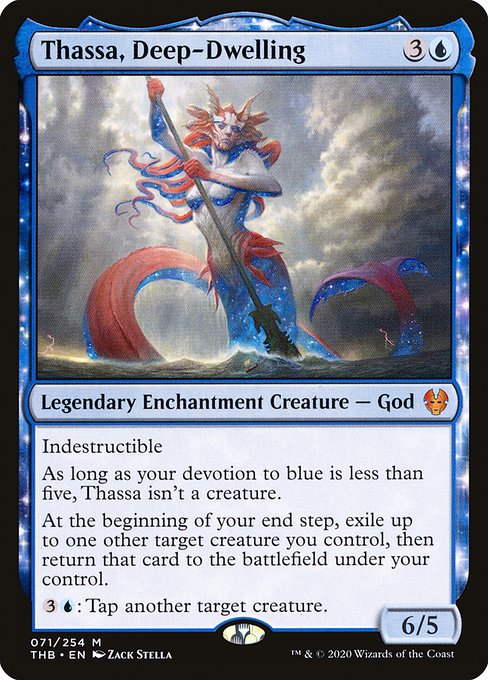
1. Thassa, Deep-Dwelling
Thassa, Deep-Dwelling costs 
 and, at the beginning of your end step, exiles up to one other creature you control and returns it immediately. Nothing to pay and nothing to connect: the blink simply happens. Thassa is indestructible and is not a creature until your devotion to blue reaches five (the number of symbols in the mana costs of your permanents), so for most of the game creature removal cannot touch it.
The timing is the thing to learn. An end-step blink means the enters trigger happens at the end of your turn, which is perfect for Frost Titan (it taps a permanent that then misses its controller's next untap step, so a blocker tapped at your end step cannot attack on their turn and is still tapped when you attack next) and for Agent of Treachery (a permanent stolen every turn). Peregrine Drake at end step untaps five lands that stay untapped through your opponents' turns, so it is open mana for counterspells, flash creatures and Thassa's own tap ability, but never extra mana for your main phase. Mulldrifter is the awkward one: its two cards arrive just before the hand-size check. Mono-blue is the cost: no Ephemerate and no white enters creatures, so Thassa does more of the work and the payoffs are steals, taps and card draw.

2. Brago, King Eternal
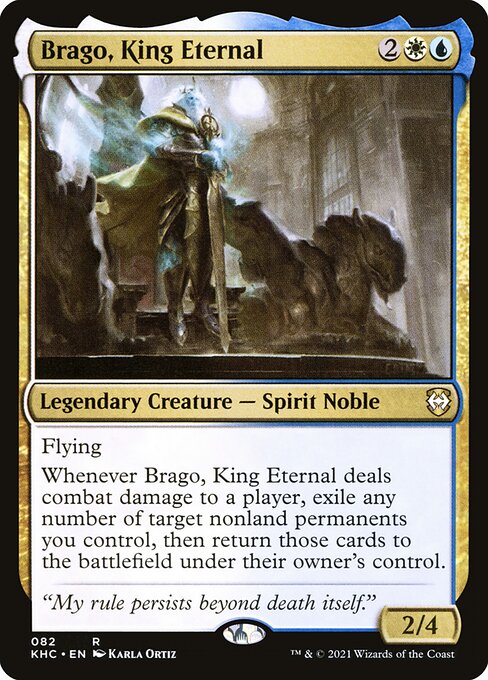
Brago, King Eternal costs 
 , flies, and whenever it deals combat damage to a player exiles any number of nonland permanents you control and returns them at once. Every planeswalker comes back at its starting loyalty, and every mana rock you tapped before combat comes back untapped for your second main phase. Tap the rocks in your first main phase, connect, and spend them again.
The ceiling is the highest on this list, and so is the dependence on one combat. Brago has to hit a player, so the deck needs protection and evasion to go with the payoffs. One trap: the permanents return under their owner's control, so anything you stole with Agent of Treachery goes home if you include it. Leave stolen permanents out of the exile.
Strionic Resonator copies the trigger, but not the way people expect. The copy resolves first, and the original then finds its targets are new objects and does nothing, so point the copy at different permanents, and include the Resonator itself: it returns untapped and can copy the still-waiting original for another . With a Sol Ring in the exile each time, that repeats without limit, which is a loop to run through the Combo Finder before you call the deck casual.
3. Oji, the Exquisite Blade
Oji, the Exquisite Blade costs , gains you 2 life and scries 2 on entry (look at the top two cards of your library and put any of them on the bottom), and blinks up to one creature you control whenever you cast your second spell in a turn, returning it at once. Read "each turn" literally: it counts on your opponents' turns too, so two instants on someone else's turn is a blink at instant speed, which saves a creature from removal and gets another enters trigger out of it.
The deck wants cheap spells rather than big creatures, so it plays like a spellslinger (a deck built around casting many cheap instants and sorceries) with enters creatures as the payoff. Mystic Snake is out of its colours, but Venser, Shaper Savant and Reflector Mage are in, and a counterspell you were holding anyway is half of a blink. Our counterspells guide covers which ones to hold.
4. Roon of the Hidden Realm
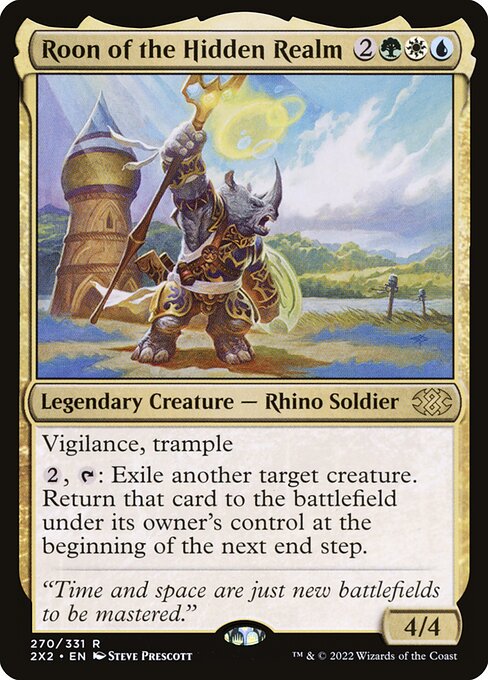
Roon of the Hidden Realm costs  and for and a tap exiles another target creature, returning it at the beginning of the next end step. "Another target creature" is the point: it means any creature, so Roon exiles an opponent's token for good, sends their biggest attacker away for a turn, or saves your own creature in response to a removal spell. Vigilance means Roon can attack and still have the tap ability available.
Bant (green, white and blue) adds green's enters creatures, Eternal Witness and Knight of Autumn among them. Activate on an opponent's turn and your creature returns at their end step with its trigger paid out, and it is not summoning sick on your turn.
5. Abuelo, Ancestral Echo
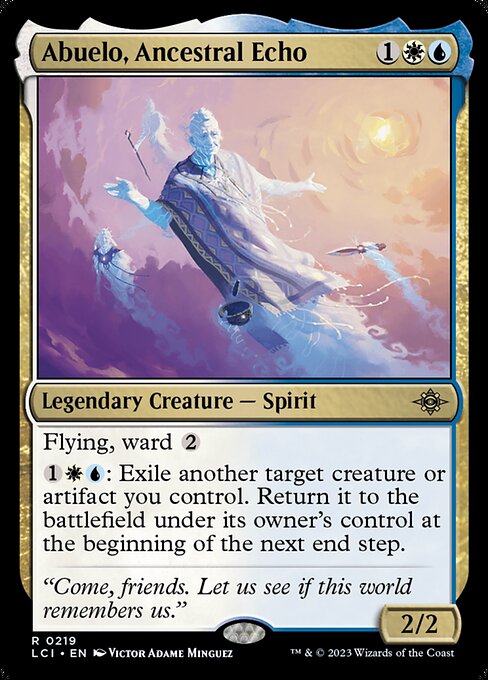
Abuelo, Ancestral Echo costs  , flies, has ward , and for exiles another target creature or artifact you control, returning it at the beginning of the next end step. It is the cheapest Azorius commander on this list, and its blink reaches artifacts, so it protects a mana rock or a Panharmonicon from artifact removal at instant speed the same way it protects a creature.
Three mana per blink is not cheap, so Abuelo suits a deck that blinks mostly on other people's turns, when the mana would otherwise go unused. The ward (an opponent's spell or ability targeting Abuelo is countered unless they pay ) makes the commander a poor removal target, which matters when the commander is the engine.
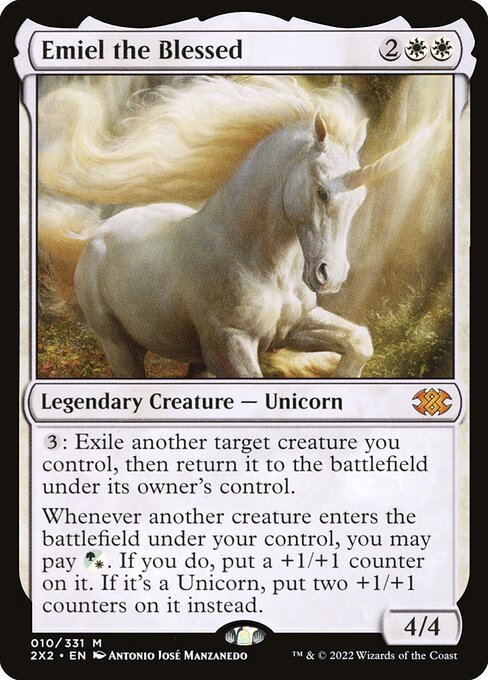

6. Emiel the Blessed
Emiel the Blessed costs and for exiles another target creature you control and returns it at once, as many times a turn as you have mana. The hybrid  in its second ability puts green in its colour identity, which catches people out: an Emiel deck can run Eternal Witness, Knight of Autumn and green ramp. That second ability pays to put a +1/+1 counter on each other creature that enters, two if it is a Unicorn.
Emiel is the only commander here whose own blink goes infinite with Peregrine Drake (the Drake untaps five lands and the blink costs three), and its colours keep the Drake out, so the deck stays honest unless the 99 adds a loop of its own. Every blink is paid for, so keep the first of each turn for a response rather than for value.
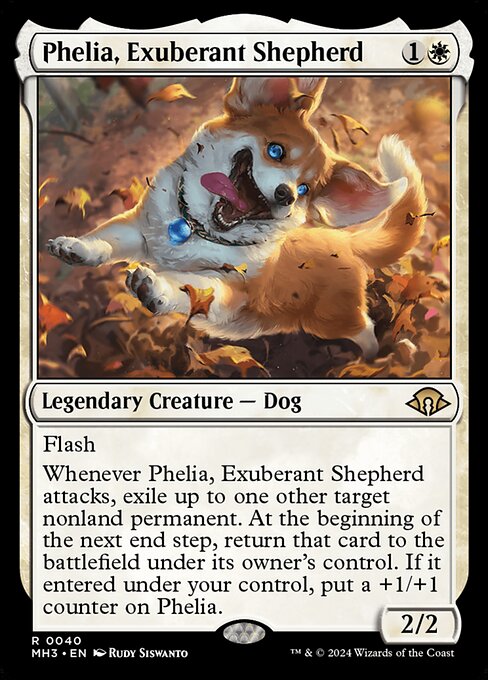
7. Phelia, Exuberant Shepherd
Phelia, Exuberant Shepherd costs , has flash, and whenever it attacks exiles up to one other target nonland permanent, anyone's, returning it at the beginning of the next end step; if the permanent came back under your control, Phelia gets a +1/+1 counter. Pointed at the blocker in front of it, that is removal for the turn, and pointed at a token it is removal for good. On your own Skyclave Apparition, it exiles something new on the way back, at the cost of handing the first card's owner an X/X Illusion when Apparition leaves.
A two-mana commander dies to everything, and attacking every turn with it is the whole plan, so Phelia decks are aggressive white decks with a flicker theme rather than value piles. Her blink has one more use: attack, exile your best creature, cast your own board wipe in the second main phase, and the creature returns at your end step to an empty table.
8. Aminatou, the Fateshifter
Aminatou, the Fateshifter costs  and her -1 exiles another target permanent you own and returns it under your control at once, lands included. Black adds Ravenous Chupacabra (destroys an opponent's creature when it enters) and Gray Merchant of Asphodel (drains each opponent when it enters), and her +1 fixes your draws. The known loop is Aminatou with Felidar Guardian: her -1 blinks Felidar, Felidar's enters trigger blinks Aminatou, and she comes back as a new object with fresh loyalty, able to activate again. That is infinite enters triggers from two cards, so check it in the Combo Finder before you sit down at a casual table.
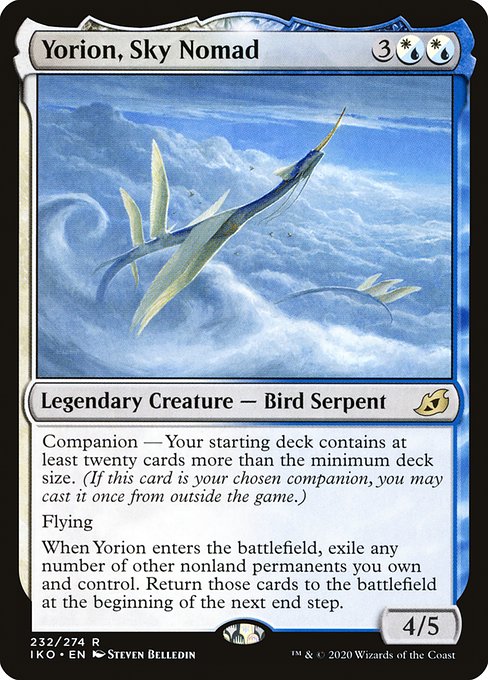
9. Yorion, Sky Nomad
Yorion, Sky Nomad costs  and, when it enters, exiles any number of other nonland permanents you own and control, returning them at the beginning of the next end step. The hybrid mana makes Yorion Azorius (white and blue). It sits this low because it blinks once, when it enters, and everything after that comes from the 99: a Yorion deck is really a "blink Yorion" deck, with Ephemerate, Displacer Kitten, Teleportation Circle and Conjurer's Closet each turning into a full-board flicker. Because the permanents come back at end step rather than at once, it is also the mass blink that dodges a board wipe you can see coming, if you have an instant-speed way to flicker Yorion in response; Eerie Interlude and Ghostway do that job without the commander.
The timing trap is the Circle and the Closet. Both blink at your end step, so when Yorion returns and exiles your board, "the next end step" is the next player's: your permanents are gone through an opponent's entire turn, with no blockers, and come back at their end step. Exile only the enters creatures with those two and keep your blockers home; use Ephemerate or the Kitten in your main phase when you want the whole board back the same turn. Yorion's companion text cannot be satisfied by a 100-card deck, so ignore it.
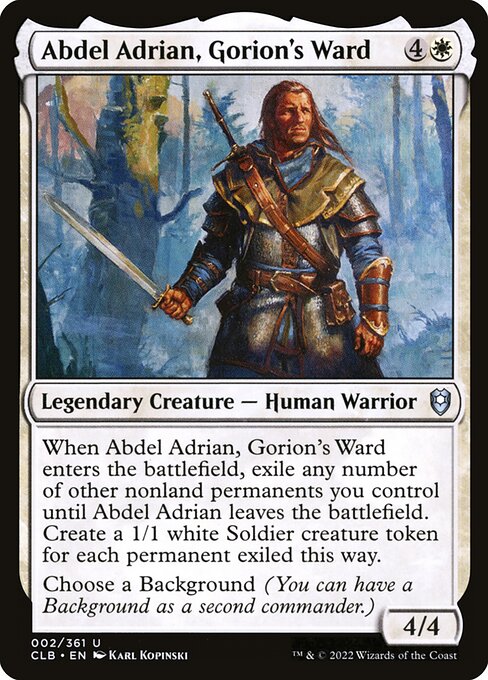
10. Abdel Adrian, Gorion's Ward
Abdel Adrian, Gorion's Ward costs  and, when it enters, exiles any number of other nonland permanents you control until it leaves the battlefield, making a 1/1 Soldier for each. The blink is spread across two events, your permanents leave now and return when Abdel does, which means every way of flickering Abdel is a full-board blink plus a fresh pile of tokens. Candlekeep Sage is the Background (a legendary enchantment that serves as a second commander for a "Choose a Background" commander) that pays you a card every time Abdel enters or leaves.
Abdel with Felidar Guardian and any one blink of Abdel loops as well: Abdel exiles Felidar, the blink releases it, Felidar's trigger blinks Abdel, and around it goes. The order matters: when both enters triggers go on the stack together, put Abdel's on top so it exiles Felidar first, with Felidar's trigger (aimed at the new Abdel) underneath. Know that before you build it for a bracket 2 table.
Payoffs that get mistaken for blink commanders
Four popular helms double or reward enters triggers without blinking anything. Elesh Norn, Mother of Machines makes each of your permanents' enters triggers fire twice and stops your opponents' from firing at all. Yarok, the Desecrated does the doubling in Sultai (black, green and blue). Preston, the Vanisher copies any nontoken creature of yours that enters without being cast, which is exactly what a blinked creature does, as a 0/1 Illusion that still has the enters trigger. Ranar the Ever-Watchful makes a 1/1 flying Spirit whenever a spell or ability you control exiles a permanent from the battlefield, so every blink is a body.
Elesh Norn and Preston belong in the 99 of the white decks above, and Ranar in the white-blue ones, where the commander does the blinking. Yarok's colours fit none of the ten, so it has to lead its own deck and blink with blue and colourless cards: Ghostly Flicker, Deadeye Navigator and Conjurer's Closet. Soulherder, the white-blue Spirit that blinks at your end step, is the card people reach for here, and it is not legendary, so it cannot lead a deck. The commander's job in a blink deck is to be the flicker.
Where a blink deck's bracket comes from
None of these commanders has a bracket. A bracket is a property of the whole list: the commander sets the ceiling and the 99 decide where you land. For blink decks the usual escalators are the Game Changers (the official list of high-impact cards that push a deck up the brackets; the calculator keeps the current list) that white and blue decks lean on anyway, the infinite loops above, and the mana loops that blue blink enables, like Deadeye Navigator paired with Peregrine Drake. Leave those out and most of these lists sit comfortably at a bracket 2 table; put them in and the same list audits as a 3 or a 4.
If you want commanders chosen for a bracket rather than for an archetype, we have those lists: the best commanders for bracket 3 and for bracket 4. Whatever you build, run the finished list through the bracket calculator and quote that number to your pod, not the one you guessed.
Blink habits that lose games
Blinking into a wrath. Only two commanders here blink at instant speed and return the creature at once, Oji (with two spells) and Emiel, so their creature goes straight back into the sweeper. Roon and Abuelo are the ones that dodge a sorcery-speed board wipe, because their creature stays in exile until the end step, and only if you activate before the wipe resolves. Thassa, Brago, Phelia and Aminatou cannot respond at all; their blinks happen on your own turn.
Forgetting what falls off. A blinked creature loses its +1/+1 counters, its Auras go to the graveyard, its Equipment comes unattached, and it comes back summoning sick, so blinking your equipped attacker before combat costs you the attack. Blink after combat damage, or blink the creature that was not going to attack anyway.
End-step blinks on draw creatures. Thassa and the Closet-style effects put the enters trigger at your end step, so Mulldrifter and Cloudblazer draw into the cleanup discard if your hand is already full. Point end-step blinks at steal, tap and removal creatures, and save the card draw for blinks you make in your main phase.
When you settle on one of these, record the games. A blink deck's results are the fastest way to find out whether your table lets Brago connect or kills it on sight, and a deck rating keeps the deck's record separate from yours.


Comments
Join the conversation.