

Mana Rocks in Commander: What Each Color Should Run Beyond Sol Ring

A mana rock is a noncreature artifact whose job is to make mana, and it is the one kind of ramp (extra mana beyond your one land a turn) that every color gets. That is also the problem: because every color gets the same colorless rocks, most lists of the best mana rocks in Commander are the same ten cards in a different order. This one is organized by color because the interesting choices are the ones that differ: what a white deck does for mana when its only white rocks are mediocre, why green should mostly skip rocks, why red's best rock is a one-turn copy of someone else's creature, and which two-color rock to pick. For the lands half of the conversation, our best ramp cards by color post covers it.
The rule we grade by
A rock's value is set by the turn it comes down and by what it gives back. A two-mana rock on turn two means four mana on turn three, a full turn ahead of the table. A three-mana rock on turn three means five mana on turn four, which only matters if your hand has a five-drop in it. So a rock has to pass one of three tests: it costs two or less, it makes two or more mana, or it does something besides make mana. Manalith fails all three. Darksteel Ingot has one honest point in its favor, indestructible, which keeps it alive through Vandalblast and Bane of Progress but not through Farewell, which exiles, and not through Stony Silence, which turns it off without touching it. Commander's Sphere passes on its second job: sacrifice it for a card when you flood (draw more lands and rocks than you can use), and you can do that after tapping it for mana or with removal already pointed at it. Everything below is sorted by that rule.
The other thing to hold in mind is that rocks die together. Vandalblast cast for its overload cost of 
 , which changes "target artifact you don't control" to "each artifact you don't control", takes every rock on the table except the caster's own. Farewell and Bane of Progress take everyone's, and Collector Ouphe, Stony Silence and Null Rod switch every rock off without destroying anything. Lands do not have that problem. Green gets to choose which kind of ramp to run; the other colors mostly do not, which is why the color sections below differ so much. Our removal by color post covers what kills what.
The colorless core every deck starts from
- Sol Ring:
 for
 , the only legal rock that costs one and gives back two every turn. Our Commander Bracket Calculator classifies it as fast mana and classifies Arcane Signet as plain ramp, which is the right way to think about the gap between them. Keep any seven-card hand with Sol Ring and two lands.
- Arcane Signet:
 for one mana of any color in your commander's identity, with no life cost and no activation cost. It is the best colored rock printed, and every other two-drop is measured against it.
- Fellwar Stone: for a color one of your opponents' lands could make. In three or more colors it is a second Arcane Signet. In a mono-color deck, look at what the table is playing before you count on it for your own color.
- Mind Stone: for , and later , a tap and a sacrifice to draw a card, so on any given turn it is a mana or a card, not both. The job is being a rock on turn two and a card on turn nine.
- Thought Vessel: the same for , with no maximum hand size instead of the draw. Only for decks that expect to hold more than seven cards.
- Everflowing Chalice: for on turn two, or for that enters untapped on turn four. It scales to whichever turn you have free.
- Worn Powerstone:
 for , enters tapped. A turn-three Powerstone is six mana on turn four, so it passes the rule on output and fits decks whose curve starts at five.
- Thran Dynamo and Gilded Lotus: for and
 for three mana of any one color. These belong in decks that spend eight or more mana in a turn: big artifact decks, spells with
 in the cost, commanders with expensive activations. Casting one in a deck full of three-drops is how you end up with mana and nothing to do with it.
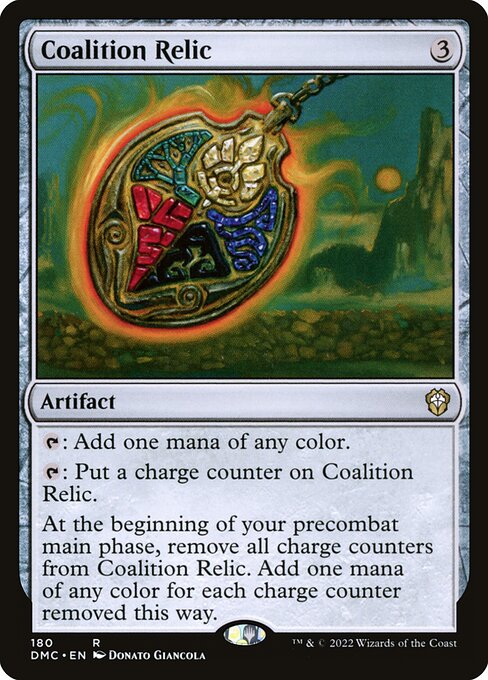
- Coalition Relic: for any color, and the charge counter is its second job. Tap it for a counter during the end step of the opponent right before you; at the beginning of your first main phase the counter becomes a mana and the Relic has untapped, so a mana you did not need on their turn is now spent on yours. A turn-three Relic is six mana on turn four.
- Commander's Sphere: for a color in your identity, plus the free sacrifice to draw described above. Fine in four and five color decks, replaceable everywhere else.
- Chromatic Lantern: , and every land you control taps for any color. It is a five-color staple and a two-color mistake; if your lands already make your colors, it is a Manalith with a reputation.


Fast rocks, and the bracket conversation they start
These are the rocks that make more mana than they cost early in the game, which is one of the things the bracket system (the 1 to 5 power scale Commander uses now) watches. They are good; the question is what table you are bringing them to. Paste your list into the calculator and it names any of your cards that count against your bracket as Game Changers, the list of cards the system singles out. The bracket explainer covers how many each bracket allows.
- Mana Vault: for , once. It does not untap unless you pay during your upkeep, and it deals 1 damage to you at each of your draw steps while it stays tapped. The job is one explosive turn: a four-mana commander on turn two, or a wrath (a spell that clears every creature) on turn three. Treat it as a ritual (a one-shot spell that adds mana) that happens to stay on the battlefield.
- Grim Monolith: for , and to untap it. Same one-shot logic as the Vault, one turn later and without the damage.
- Basalt Monolith: for , and to untap it, so on its own it is a mana battery rather than a profit: a turn-three Basalt is seven mana on turn four, and after that it only breaks even. It is in this section because Power Artifact (which cuts the untap cost to ), Rings of Brighthearth (which copies the untap for ) and Forsaken Monument (which adds an extra every time it taps) each turn it into unlimited colorless mana, which is the combo dedicated decks build around and the reason your pod may raise an eyebrow at it.
- Chrome Mox:
 , exile a nonartifact, nonland card from your hand, and it taps for any of that card's colors. It is a card for a mana. Correct in decks that win by turn five, a mistake in decks that draw their value over ten turns.
- Mox Diamond: , discard a land card as it enters or it goes to the graveyard, and it taps for any color. The same trade as Chrome Mox with a land instead of a spell, which is a better deal in a 36-land deck than in a 32-land one.
- Mox Opal and Mox Amber: free, but conditional. Opal needs three artifacts, counting itself; Amber needs a legendary creature or planeswalker and only makes their colors. Amber in a deck whose commander is on the battlefield most of the game is a free Arcane Signet. In anything else it is a dead card half the time.
- Lotus Petal: one mana of any color, once. It exists to cast a commander a turn early or to finish the turn you go off (win with a combo), and it is a blank card every other time.
- Lion's Eye Diamond: three mana for your whole hand. A combo card rather than a rock; if you have to ask what it is for, it does not belong in your deck.
Mana Crypt and Jeweled Lotus would have led this section, but both have been banned in Commander since September 2024, so they stay in the binder.
White
White has almost no rocks of its own. Marble Diamond is for  and enters tapped, which makes it a slower Arcane Signet that only makes . Pearl Medallion is not a rock at all: it takes off the generic part of each white spell you cast, so a spell that costs exactly gets nothing, and it does nothing for equip costs, activated abilities or your non-white spells. In a mono-white deck it beats a rock; in a two-color deck it loses to one.
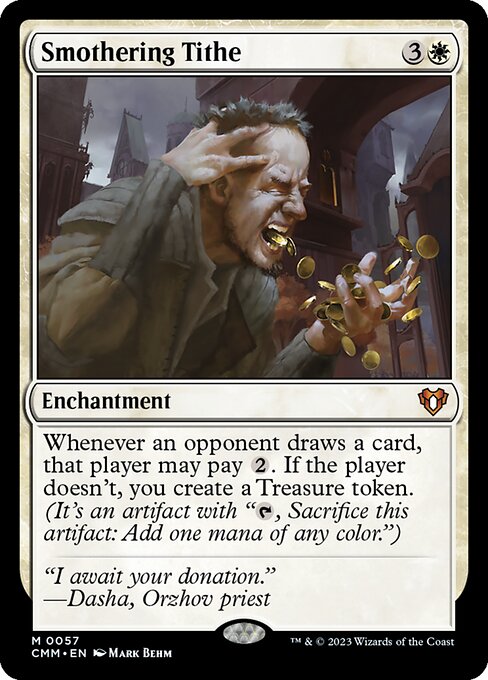
What white does for artifact mana is make other people pay for it. Smothering Tithe gives you a Treasure (an artifact token you sacrifice for one mana of any color) every time an opponent draws a card unless that player pays . Draw steps alone offer up to three Treasures a round, and every opponent who pays instead has spent of their own turn to deny you one. It is the best mana engine in the color, and the table will treat it that way: it is on the Game Changer list, so it counts toward your bracket. Oketra's Monument is the creature-deck option: for a discount on white creature spells plus a 1/1 vigilance Warrior each time you cast a creature spell. Archaeomancer's Map is white's catch-up card: two basic Plains to hand when it enters, and a free land drop from your hand whenever a land enters under an opponent's control while that opponent has more lands than you. Add them on top of the colorless core, not instead of it.
Blue
Blue's own rocks are Sky Diamond ( for  , enters tapped) and Sapphire Medallion (blue spells cost less), with the same limits as their white twins. The blue-flavored choices worth a slot are about hand size and about time.
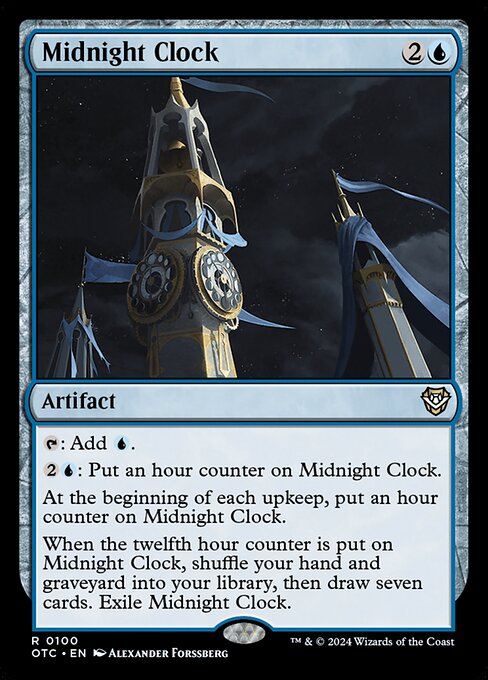
Thought Vessel and Decanter of Endless Water both remove your maximum hand size, which blue needs more than any other color. The Vessel is the two-mana one; the Decanter costs but taps for any color, so it is the pick in three-color blue decks. Midnight Clock is for a rock that taps for and gets an hour counter at the beginning of every upkeep, not just yours. At a four-player table the twelfth counter lands on your third upkeep after you cast it, at which point it shuffles your hand and graveyard into your library, draws you seven, and exiles itself. Cast it the turn after a wrath and that timing is roughly when you have run out of cards, and you can pay for an extra counter whenever you want the refill sooner. Coveted Jewel is the trap: it costs  , draws three when it enters and taps for three mana of one color, and the first opponent whose creatures attack you and go unblocked draws three and takes it.
Black
Charcoal Diamond and Jet Medallion are the black copies of the white pair, and black has the same shortage of real rocks. Bontu's Monument is the creature-deck option: , black creature spells cost less, and each creature spell you cast makes every opponent lose 1 life and gains you 1. The card that does a rock's job in black is an enchantment. Black Market Connections gives you a Treasure at the beginning of each of your first main phases for 1 life, and in any combination you can also take a card for 2 more life or a 3/2 changeling (a creature of every creature type) for 3 more. In a deck that is going to spend life anyway, it is an Arcane Signet that also draws. Nyx Lotus is colorless but belongs here: , enters tapped, and taps for mana equal to your devotion to a color, meaning the number of that color's symbols in the mana costs of permanents you control, which in a mono-black deck full of  costs is six or more by the midgame. The rest of black's ramp lives in rituals and in Swamp-count lands, and the ramp post covers both.
Red
Red's best rock is Cursed Mirror. For it can enter as a copy of any creature on the battlefield, with haste, until end of turn, and then it is a rock that taps for for the rest of the game. On turn three that is often a hasty copy of the best thing an opponent played, including its enters-the-battlefield trigger, with a mana source left behind. Fire Diamond and Ruby Medallion are the color's plain options. Hazoret's Monument adds a rummage (discard a card, then draw a card) to each creature spell for red decks that run twenty creatures. Pyromancer's Goggles is a five-mana rock that copies the red instant or sorcery its mana pays for, which makes it a card for spellslinger decks (built around instants and sorceries) and nothing else. Goldspan Dragon is not a rock, but every Treasure you control taps for two mana while it is out, so in a deck with Treasure makers it is the biggest ramp spell in the color. Dockside Extortionist is banned, so the Treasure deck has to earn them now.


Green
Skip most of them. Moss Diamond and Emerald Medallion exist, but Rampant Growth costs  , the same two mana as the Diamond, the basic land it finds enters tapped just as the Diamond does, and nothing short of land destruction takes it back. Rhonas's Monument earns a slot in a creature deck for the +2/+2 and trample each creature spell hands out. Mana Reflection is the color's real mana artifact in spirit: to double what each permanent you tap for mana produces, which in a deck of twelve mana sources is absurd and in a deck of six is a six-mana do-nothing. Against a blue-heavy pod, Carpet of Flowers makes mana equal to one opponent's Islands once a turn, during one of your main phases, for . Green's artifact slot should go to Sword of the Animist, which fetches a basic every time its wearer attacks and adds to the land count rather than the rock count.
Two colors: Signet or Talisman
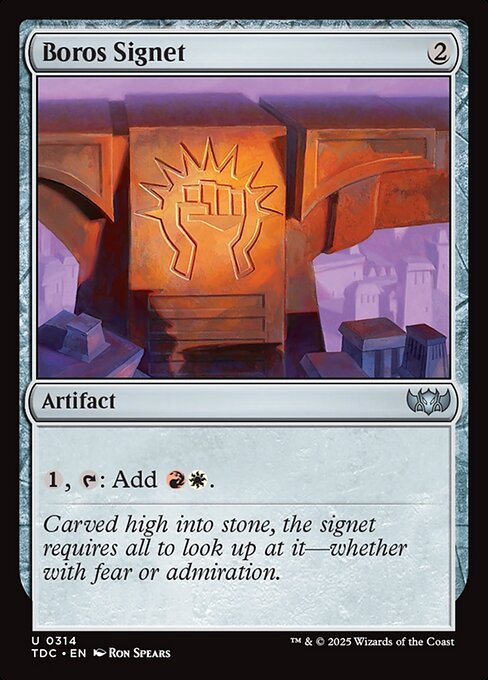
Every two-color pair now has both. A Signet such as Boros Signet costs and needs and a tap to make two colored mana, one of each color. A Talisman such as Talisman of Conviction costs and taps for for free, or for one of its two colors at the cost of 1 damage. The mana count is the same: three lands plus either one is four mana on turn three. The difference shows at the edges. A Signet needs one other mana to start, so two Signets cannot start each other, and a Signet can never be the only mana you leave open for an instant on an opponent's turn. A Talisman works alone, but every colored activation costs 1 life, which adds up in a deck already paying life to its own lands and to Ancient Tomb. Run Signets in decks that need two colored pips (colored mana symbols) by turn three, a or cost on a key card, and Talismans in decks that would rather have the colorless mana and the flexibility. Azorius Locket and Gruul Cluestone cost for one colored mana and a draw you will almost never use; they fail the first two tests, and a draw that costs or four hybrid mana plus a tap is a weak second job next to a two-mana Signet or Talisman.
Three colors and up
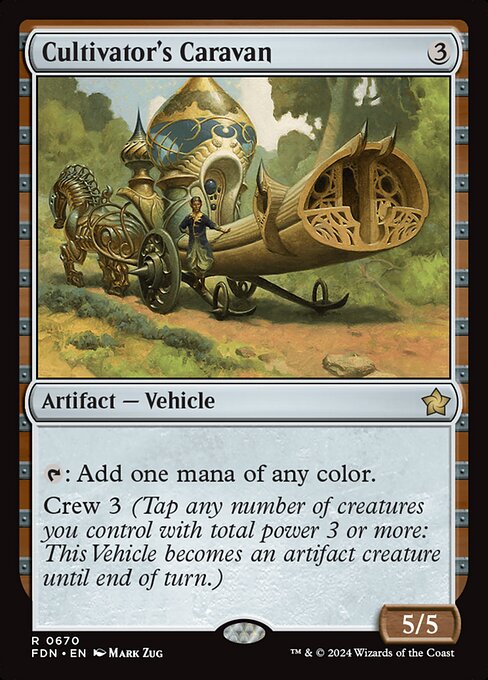
The more colors you run, the more an any-color rock is worth, and the rule still holds. Arcane Signet and Fellwar Stone come first. Prismatic Lens taps for , or turns into one mana of any color, so on a given turn it either ramps you or fixes your colors (makes a color your lands do not), never both. It is the two-mana fixer for the five-color deck that has run out of any-color rocks at two. At three mana, Commander's Sphere, Coalition Relic and Mana Geode (scry 1 when it enters: look at your top card and keep it there or put it on the bottom) are the acceptable fixers, and Chromatic Lantern becomes correct only once you are in four or five colors. Cultivator's Caravan taps for any color, and on a turn you do not need the mana, crew 3 (tap creatures with total power 3 or more) turns it into a creature that can attack or block; it cannot attack and tap for mana in the same turn. In a legends-heavy deck, Relic of Legends lets you tap an untapped legendary creature for a mana, Honor-Worn Shaku taps for and lets you tap an untapped legendary permanent you control to untap it, and Patriar's Seal untaps a legendary creature for and a tap: rocks with an engine bolted on. Liquimetal Torque is the odd one out: for , and it can turn any nonland permanent into an artifact until end of turn, which lets your artifact removal hit a creature or an enchantment.



How many rocks, and what to cut first
A typical bracket 2 or 3 deck wants about ten ramp pieces in total, and how many of those are rocks depends on color. Green decks get there with two or three rocks (Sol Ring, Arcane Signet and one more) and land ramp for the rest. Non-green decks need six to eight artifacts to reach the same place, which is also why they fold to a single overloaded Vandalblast. Artifact decks run more than that on purpose and protect them.
When you are cutting, cut in this order: any three-mana rock that makes one mana and does nothing else, then any rock that enters tapped, then the one you keep casting on a turn when you had a better play. The last test is the one most players skip. A rock is for the turn your hand has nothing else to do at that mana. If your turn three always has a three-drop that draws cards, a three-mana rock is a card you will never cast on time.
One habit saves more rocks than any counterspell. Once a red player at the table can reach five mana, hold the rock you do not need this turn in your hand, where an overloaded Vandalblast cannot reach it, and play it the turn you will spend the mana. Against the wraths that hit everyone you can only spread the risk: a mix of rocks and land ramp loses less to any single card than eight artifacts do. You can browse how other players split rocks against land ramp in the deck explorer, and if you are building the mana base on a budget, our $20 mana base post is where the lands half of that money goes.


Comments
Join the conversation.