

The Best Recursion in Commander, Color by Color

Recursion is any effect that gets a card back after it has gone to your graveyard: to your hand, onto the battlefield, or onto the top of your library. In Commander (EDH) it matters more than in any other format, because your deck runs exactly one copy of your best spell (Commander is singleton), and the first time it gets countered or killed, recursion is the only way it comes back. This is the third post in our color-by-color series, after the best ramp by color and the best removal by color, and it follows the same shape: the cards worth a slot in each color, and the one job each does.
Two things separate a good recursion card from a bad one: where the card comes back to, and whether the effect works once or every turn. Reanimation, which puts a creature card from a graveyard straight onto the battlefield, is the strongest kind, and a one-mana reanimation spell beats a seven-mana spell that returns a card to hand unless the seven-mana one does it every upkeep.
Black: creatures straight back onto the battlefield
Black is the only color that reanimates any creature, of any size, for one or two mana, and its cheapest spells say "a graveyard" rather than "your graveyard". Three other players are filling graveyards for you.
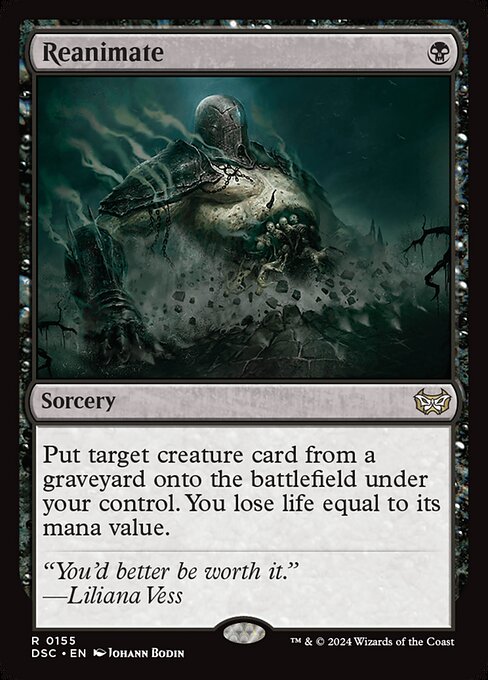
- Reanimate,
 . Any creature card in any graveyard onto the battlefield under your control, and you lose life equal to its mana value. The job: an eight-drop (a card that costs eight mana) on turn two. The cost is real in a 40-life format only when you forget it: Reanimate on an eight-mana creature at 30 life is fine, and at 12 life it hands the Boros Charm player the game.
- Animate Dead,
 . The same job without the life loss, but it is an Aura, so the creature is sacrificed if the Aura leaves. Against a table full of enchantment removal, Reanimate is the safer copy; when your own life total is under pressure, this is.
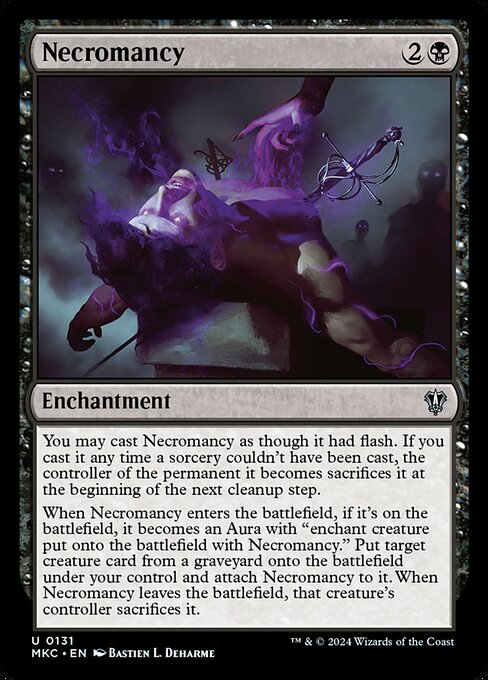
- Necromancy,
 . Reanimation you can cast at instant speed. If you cast it at a time a sorcery could not be cast, the creature is sacrificed at the next cleanup step, so at instant speed it is for a creature with an enter or dies trigger, or for one surprise blocker. Cast in your own main phase with an empty stack, it stays, like Animate Dead.
- Victimize, . Choose two creature cards in your graveyard, then sacrifice a creature as it resolves and return both tapped. The sacrifice is not a cost: the two targets are chosen when you cast it, so the creature you sacrifice can never be one of them, and if your only fodder is killed in response, nothing comes back. Sacrifice a token, or a creature that wants to die anyway.
- Phyrexian Reclamation, . Pay and 2 life: a creature card from your graveyard to your hand, as many times as you can afford. The repeatable one. With a sacrifice outlet (a permanent that lets you sacrifice creatures whenever you like) and a creature with an enter trigger, it is a grind engine that costs , 2 life and the creature's own mana cost per loop.
- Sheoldred, Whispering One,
 . On each of your upkeeps, a creature card from your graveyard onto the battlefield; on each opponent's upkeep, they sacrifice a creature. Seven mana, so she is for decks that can keep her alive until your next turn.
- Living Death,
 . Every player exiles the creature cards in their graveyard, sacrifices every creature they control, then the exiled cards come back. A board wipe and a mass reanimation in one card, and it is symmetric: count every opponent's graveyard before you cast it. The reanimator deck across the table is hoping you do.
- Rise of the Dark Realms,
 . Every creature card in every graveyard onto the battlefield under your control. Nine mana, so it is the finisher for a deck that has been killing creatures all game.
- Agadeem's Awakening,
 or a land. Return any number of creature cards with different mana values X or less. Play it as a land when you need a land and cast it as a mass reanimation when you are behind, which is why it costs no spell slot.



What black teaches you at the table: hold Animate Dead for the best creature that has died this game, not the best one in your own graveyard. When someone's seven-drop eats a removal spell on turn five, it is yours for two mana on your turn, and their deck probably cannot get it back as cheaply as yours can.
Green: anything back to hand, and lands back onto the battlefield
Green does not reanimate. What it does is return any card, not just creatures, and it treats lands in the graveyard as a resource rather than a loss.
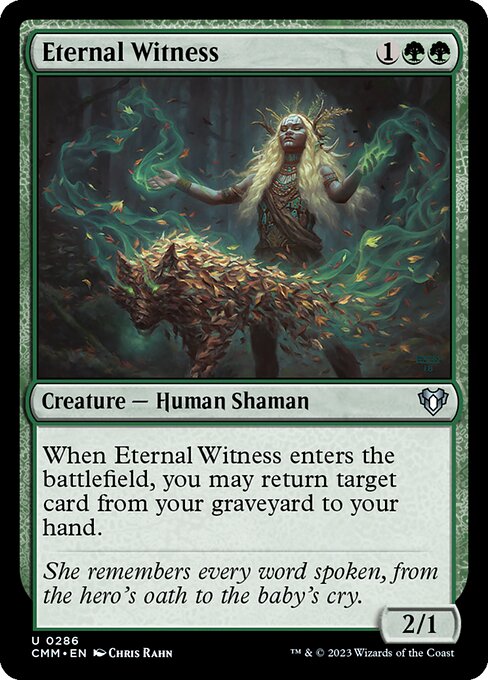
- Eternal Witness,
 . A 2/1 that returns any card from your graveyard to your hand when it enters. The classic, and the most misplayed: casting it on turn three as a 2/1 with nothing worth returning throws the card away. Hold it until the board wipe or the removal spell you want back is in the yard.
- Regrowth, . Eternal Witness without the body, for one mana less.
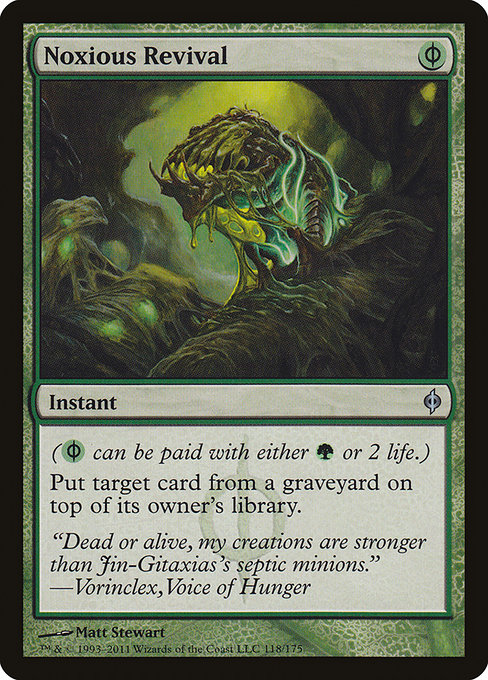
- Noxious Revival,
 . You can pay 2 life instead of , but the Phyrexian symbol still makes it a green card for color identity, so only green decks can run it. It puts any card from any graveyard on top of its owner's library at instant speed. Pointed at your own graveyard, you draw your best spell again next turn. Pointed at an opponent's, the creature they were about to reanimate goes back on top of their library, where it does nothing this turn.
- Bala Ged Recovery, or a land that enters tapped. Regrowth on the front, a land that makes on the back. It is a land early and a recursion spell late, and that flexibility is the whole reason to run it over a second Regrowth.
- Seasons Past,
 . Return any number of cards with different mana values from your graveyard to your hand, then it goes to the bottom of your library. In a deck with a spread of costs that is five or six cards for six mana, and a tutor can find it again later.
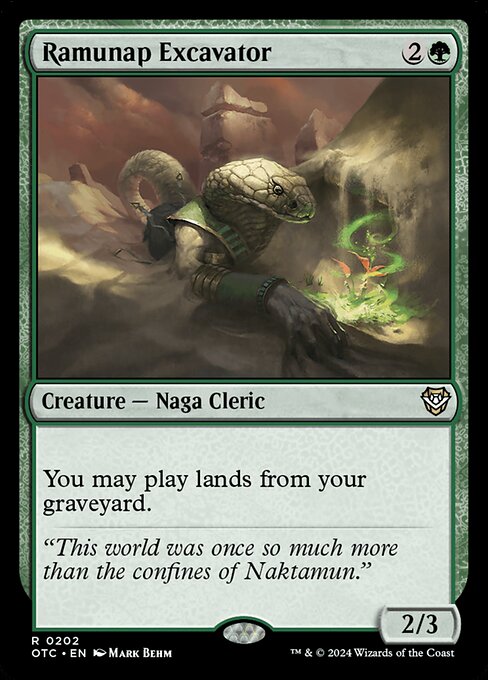
- Ramunap Excavator, . You may play lands from your graveyard. It uses your normal land drop, so it is not extra mana, but with one fetchland (a land you sacrifice to find another land from your library) you never miss a land drop again.
- Splendid Reclamation, . Every land card in your graveyard onto the battlefield tapped. Only for decks that put lands in the graveyard on purpose, through fetchlands, Life from the Loam (dredge lets you mill cards instead of drawing to get it back) or self-mill (putting cards from the top of your own library into your graveyard). In those decks it is four mana for five or more lands.
- Genesis, . It works from the graveyard: at the beginning of your upkeep, if it is in your graveyard, pay to return a creature card to your hand. Discard it, mill it, or let it die in combat. It never has to be cast.


Green's recursion gets better the more lands pass through your graveyard, which is why it pairs with the fetch-and-sacrifice style of acceleration in our ramp list better than any other color does.
White: small permanents, and whole boards the turn they die
Much of white's recursion stops at mana value three, and it hits that ceiling over and over. White also has the best answers to a board wipe, which are recursion that happens the same turn.
- Sun Titan,
 . Whenever it enters or attacks, return a permanent card with mana value 3 or less from your graveyard to the battlefield. Fetchlands have mana value 0, so Sun Titan returning the fetchland you cracked (sacrificed) last turn is a genuine extra land every attack, on top of your land drop. It also returns a dead Sol Ring, a mana dork (a small creature that taps for mana), or an Oblivion Ring.
- Sevinne's Reclamation, , flashback . Flashback means you can cast it from your graveyard for that cost, then exile it. Same job as Sun Titan's trigger as a sorcery, and when you cast it from the graveyard it copies itself, so the flashback returns two permanents.
- Serra Paragon, . Once during each of your turns, play a land from your graveyard or cast a permanent spell with mana value 3 or less from it. A four-mana flyer that turns your land drop into a land from the graveyard, or gives you an extra spell, every turn. Anything it returns is exiled the next time it goes to the graveyard, so a fetchland gets one replay, not a loop.
- Emeria Shepherd, . Landfall (whenever a land enters under your control): return a nonland permanent card from your graveyard to your hand, or onto the battlefield if that land is a Plains. A fetchland gives you both triggers: the fetchland itself returns something to hand, then the Plains it finds puts something onto the battlefield. Any land with the Plains type counts, Godless Shrine included.
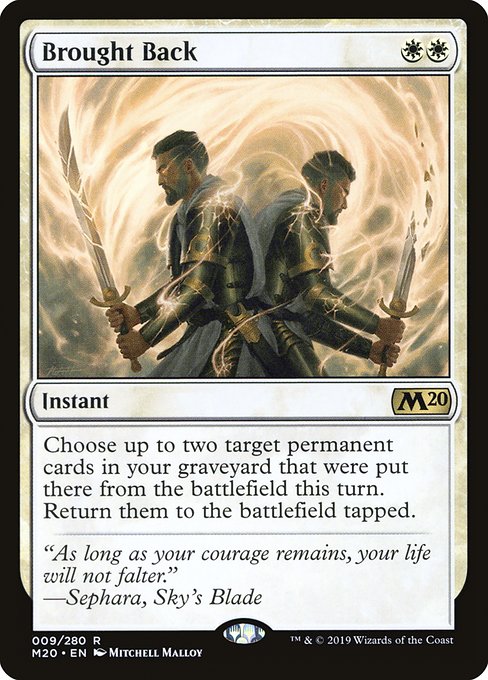
- Brought Back, . Instant: up to two permanent cards that went from the battlefield to your graveyard this turn come back tapped. Your two best creatures after a board wipe, or two fetchlands you cracked this turn, which is two lands for two mana.
- Faith's Reward, . Every permanent card that went from your battlefield to your graveyard this turn comes back, untapped, so everything but tokens. Four mana to undo a board wipe, as long as you left the mana up, which is the hard part.
- Karmic Guide, . When it enters, a creature card from your graveyard onto the battlefield. Pay echo (its cost again on your next upkeep) or let it go. Together with Reveillark, which returns two creatures with power 2 or less when it leaves the battlefield, and a free sacrifice outlet, it loops forever. That is a combo, and your pod will treat it as one.


Red: artifacts, and a second cast for every spell
Red barely recurs creatures: Feldon of the Third Path's one-turn copies and Squee, the Immortal recasting himself are about it. What it has is the best artifact recursion in the game, and spells that let you recast your whole graveyard at once.
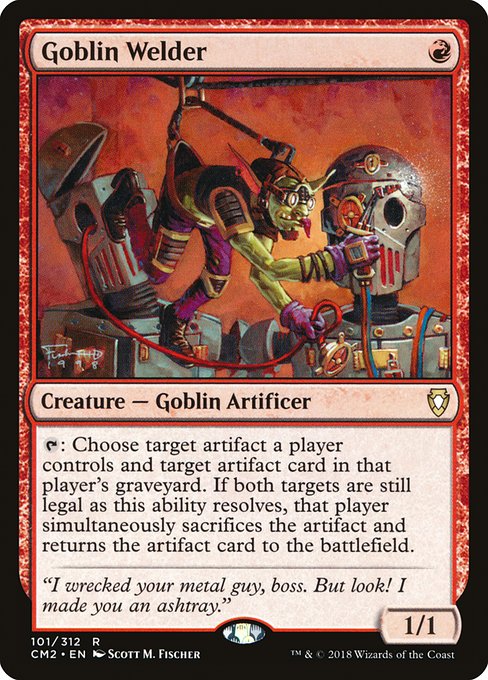
- Goblin Welder,
 .
 : a player sacrifices an artifact they control and returns an artifact card from their graveyard to the battlefield. Both targets belong to the same player, so you can swap your worst artifact for your best dead one, or point it at an opponent and trade their Sol Ring for whatever junk artifact is in their graveyard.
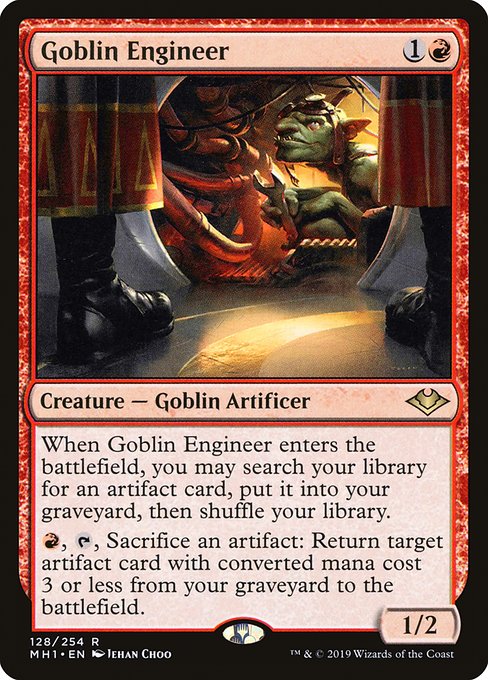
- Goblin Engineer, . When it enters, put an artifact card from your library into your graveyard. Then , and sacrifice an artifact: return an artifact card with mana value 3 or less from your graveyard to the battlefield. A tutor and the recursion for it in one two-drop.
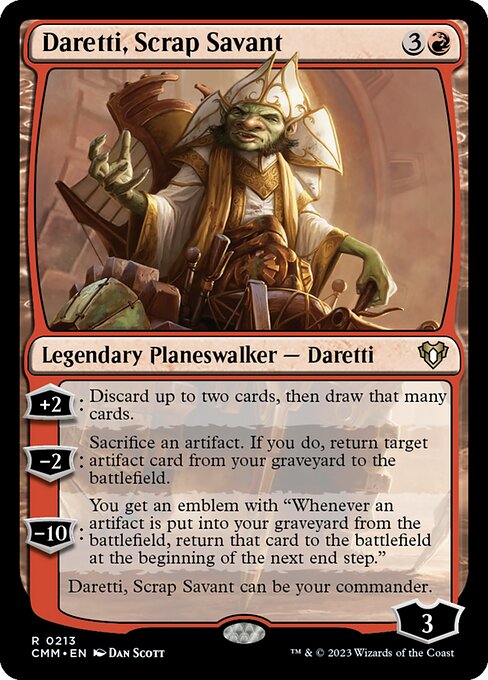
- Daretti, Scrap Savant, . The -2 sacrifices an artifact to return any artifact card from your graveyard to the battlefield, with no size limit. The +2 discards up to two cards and draws that many, which is how the artifact gets into the graveyard in the first place.
- Trash for Treasure, . Sacrifice an artifact as you cast it, return an artifact card from your graveyard to the battlefield. Sorcery speed, any size.
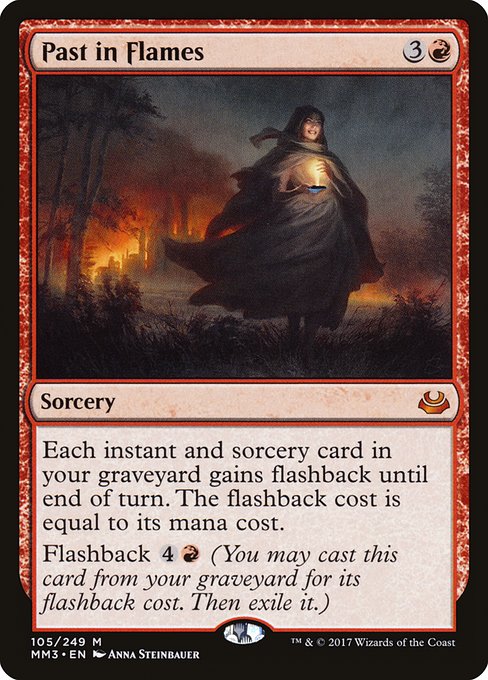
- Past in Flames, . Every instant and sorcery card in your graveyard gains flashback for its own mana cost until end of turn. It has flashback itself (), so it comes back for a second round.
- Mizzix's Mastery, . Exile an instant or sorcery from your graveyard, copy it, and cast the copy free. Overloaded for it does that to every one of them.
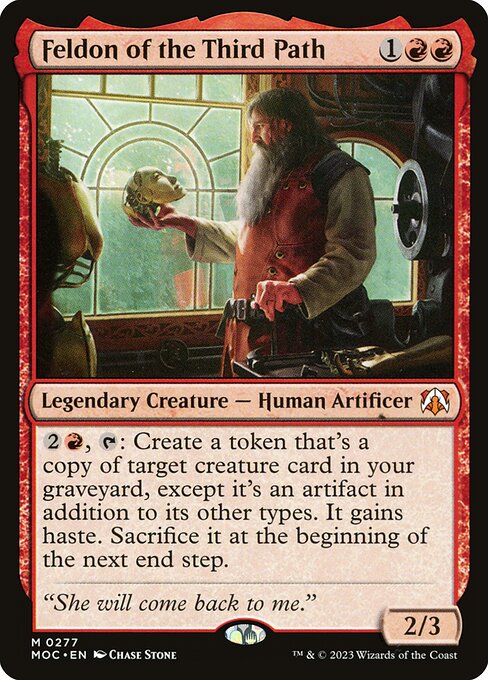
- Feldon of the Third Path, . , : a token copy of a creature card in your graveyard, with haste, sacrificed at the next end step. Aim it at creatures with enter or dies triggers. A dead Solemn Simulacrum becomes a land and a card every turn.
- Squee, the Immortal, . You may cast it from your graveyard or from exile. Sacrifice fodder that never runs out.
- Underworld Breach, . Until your end step, every nonland card in your graveyard gains escape: cast it from the graveyard for its mana cost plus exiling three other cards from your graveyard. It is on the Game Changers list, the cards that WotC's Commander bracket system caps (brackets 1 and 2 allow none, bracket 3 allows up to three), so a single copy puts a deck at bracket 3 or higher. It is also the enchantment in the competitive loop with Lion's Eye Diamond and Brain Freeze, where each Brain Freeze mills you the cards that pay for the next escape.
Blue: spells, not bodies
Blue recursion is almost entirely about instants and sorceries. Its creatures are delivery systems for a spell you already cast once. Blue's way of keeping a creature is to stop the removal in the first place, which is a different post: the best counterspells in Commander.
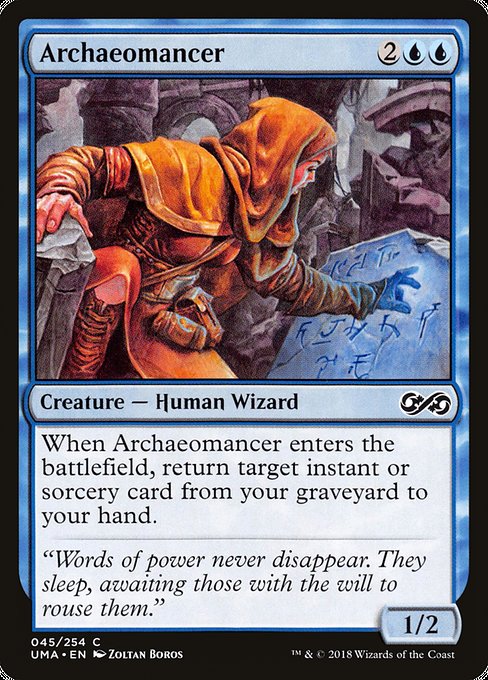
- Archaeomancer,
 . When it enters, an instant or sorcery card from your graveyard to your hand. With Ghostly Flicker targeting Archaeomancer and another artifact, creature or land you control, the Flicker comes back to hand every time, and you have a repeatable blink (exile and return, so enter abilities trigger again) for the rest of the game.
- Mnemonic Wall, . The same trigger on a 0/4 defender. The redundancy copy.
- Snapcaster Mage, , flash. An instant or sorcery card in your graveyard gains flashback for its mana cost until end of turn. One counterspell, twice in a turn cycle (one full round of the table).
- Mission Briefing, . Surveil 2 (look at the top two cards, keep or bin each), then cast an instant or sorcery from your graveyard this turn for its cost. Snapcaster without the body and with a card-quality bonus.
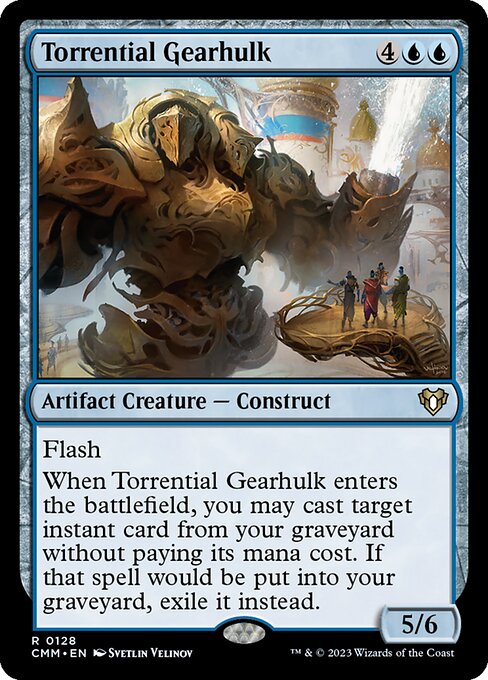
- Torrential Gearhulk, , flash. When it enters, cast an instant card from your graveyard free. Instants only, so a 5/6 that arrives with a free counterspell or a free single-target Cyclonic Rift attached (a spell cast without paying its mana cost cannot be overloaded).
- Mystic Sanctuary. An Island that enters untapped if you control three or more other Islands, and when it does, it puts an instant or sorcery card from your graveyard on top of your library. Fetch it at the end of an opponent's turn and you draw your best spell again. Mono-blue and heavy-blue decks only.
- Body Double, . Enters as a copy of any creature card in any graveyard. The closest blue gets to reanimation, and it copies an opponent's dead creature as happily as yours.
- Scholar of the Ages, . Two instant or sorcery cards back to hand when it enters. Seven mana, so it is a late refuel for spellslinger decks (decks built around casting many instants and sorceries) rather than a staple.



Lands and colorless artifacts
A land that recurs something costs no spell slot, and the artifacts here fit any color identity.
- Lands with a graveyard ability. Volrath's Stronghold (, ) puts a creature card from your graveyard on top of your library, Academy Ruins (, ) does it for an artifact, and Hall of Heliod's Generosity (, ) for an enchantment. Buried Ruin (, , sacrifice it) returns an artifact card to hand in any colors. Takenuma, Abandoned Mire has channel (discard it from your hand for an effect): mill three, then return a creature or planeswalker card from your graveyard to your hand, cheaper for each legendary creature you control. The , and in those activation costs count toward color identity, so Volrath's Stronghold and Takenuma need a black deck, Academy Ruins a blue one and Hall of Heliod's Generosity a white one; Buried Ruin fits any deck. "On top of your library" is a drawback and a feature: you give up a draw, but nobody can respond to a draw the way they can to a spell.
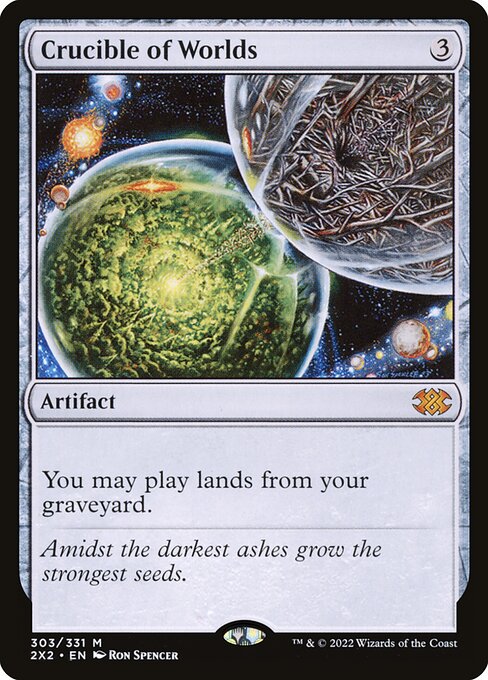
- Crucible of Worlds, . You may play lands from your graveyard. Ramunap Excavator for every color.
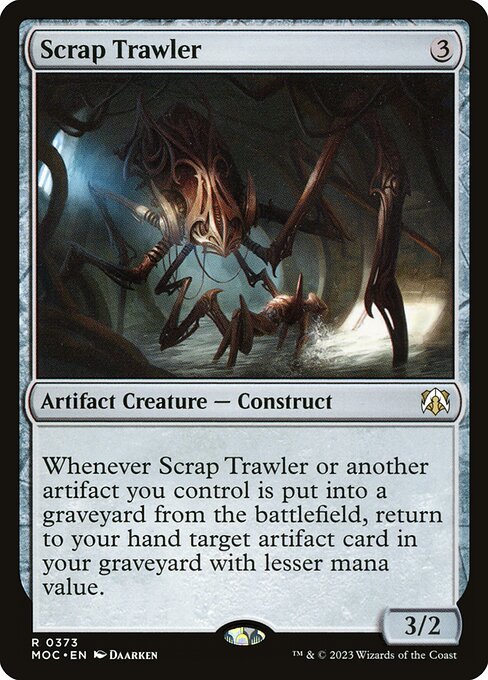
- Scrap Trawler, . When it dies, or another artifact of yours goes from the battlefield to the graveyard, return an artifact card with lesser mana value to your hand. Myr Retriever () and Junk Diver () do the one-shot version when they die.
- Nim Deathmantle, . Whenever a nontoken creature of yours dies, you may pay : it comes back with the Deathmantle attached. Leave four mana up going into a board wipe and your best creature survives it.
- Sword of Light and Shadow, . Combat damage to a player: gain 3 life and return a creature card from your graveyard to your hand. Protection from white and from black dodges targeted removal like Swords to Plowshares, though not those colors' board wipes.
- Mimic Vat, . Exile a nontoken creature as it dies, yours or theirs, then , : a hasty token copy that is exiled at the next end step. Every turn.
- Elixir of Immortality, . , : shuffle it and your graveyard back into your library and gain 5 life. Not recursion in the usual sense, but it is the cheapest insurance against a mill deck and against your own self-mill running your library dry.



Multicolor: when the commander is the recursion
If recursion is the whole plan rather than a few slots, start in the command zone, where it cannot be exiled by a Bojuka Bog.
- Meren of Clan Nel Toth, . At your end step, pick a creature card in your graveyard: onto the battlefield if its mana value is at most your experience counters, otherwise to your hand. Every other creature of yours that dies adds a counter, so the engine grows as the game goes.
- Muldrotha, the Gravetide, . During each of your turns, play a land and cast one permanent spell of each permanent type from your graveyard. With self-mill it is a second hand.
- Karador, Ghost Chieftain, , one less for each creature card in your graveyard. Cast one creature spell from your graveyard during each of your turns.
- Chainer, Nightmare Adept, . Discard a card: cast a creature spell from your graveyard this turn, once each turn. Any nontoken creature that enters without being cast from your hand gets haste, so the reanimated creature attacks the turn it lands.
- Kess, Dissident Mage, . Once during each of your turns, cast an instant or sorcery from your graveyard; it is exiled afterward.
- Alesha, Who Smiles at Death, , and the
 in her text makes her color identity red, white and black. Whenever she attacks, pay : a creature card with power 2 or less from your graveyard enters tapped and attacking.
- Lurrus of the Dream-Den, . Once during each of your turns, cast a permanent spell with mana value 2 or less from your graveyard.
- Debtors' Knell, . Not a commander, but it belongs here: at the beginning of your upkeep, a creature card from any graveyard onto the battlefield under your control, every turn, for as long as it lives.
How much recursion a deck needs, and the trap
A recursion card does nothing on its own. It needs something worth returning in your graveyard, so the right count depends on how many cards your deck puts there on purpose. A deck with a sacrifice outlet and a dozen creatures with enter triggers wants six to eight pieces. A deck that only loses cards to removal wants two or three: one flexible (Eternal Witness, Sun Titan) and one cheap (Regrowth, Animate Dead). More than that and you are drawing cards that wait for something to happen.
The trap is exile. Graveyard hate costs a land slot (Bojuka Bog, Scavenger Grounds) or two mana (Rest in Peace), and the table points the first one at whichever graveyard looked scariest, which is rarely a deck with two or three recursion pieces. Never let a lone reanimation target sit in your graveyard through an opponent's turn: bin it at the end of the turn before yours, or bin it and reanimate it in the same turn.
The fastest way to count your recursion is to tag it in the deck builder (per-deck card tags) and compare the count against other players' graveyard decks in your colors in the public deck explorer. Paste your list into the Combo Finder to see whether the Karmic Guide loop is live in it, and the bracket calculator will count Underworld Breach as a Game Changer before your pod does.
The other half of this exchange is what to do about the creature someone else just brought back, and that is the removal list. For the cards that go in every deck of a color regardless of plan, see automatic includes for each color.



Comments
Join the conversation.