

How Many Counterspells Should You Run in Commander?

Most blue Commander decks want 4-6 counterspells. Casual value decks that just want a safety net can run 2-4, dedicated control decks climb to 8-10, and cEDH lists push well past that — but for the average blue deck at a four-player table, 4-6 is the honest number.
If that feels low, it's because counterspells are the most overrated card type in multiplayer Magic — not because they're weak, but because players port 1v1 instincts into a format where the math is completely different.
Why Counterspells Get Worse at a Four-Player Table
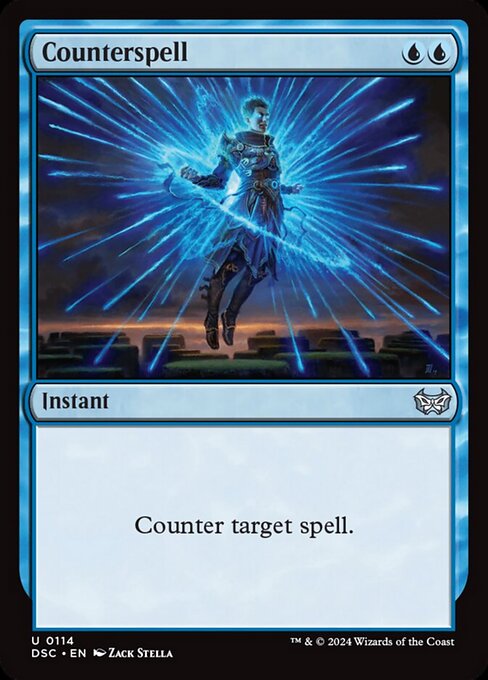
In a duel, Counterspell trades one card for one card against your only opponent. In Commander, you have three opponents casting roughly three times the threats, and your  still only answers one of them. Every counter you spend is a card you didn't spend against the other two players — and they saw you spend it.
There's a second cost that doesn't show up on the card: holding mana. To threaten a counter, you pass the turn with mana up across three opponents' turns, and most of those turns nothing counter-worthy happens. That's real tempo you're paying whether or not the spell ever gets cast — the same trade-off covered in when to hold up interaction versus developing your board.
None of this makes counterspells bad. It makes them a scalpel. You're not countering spells in Commander — you're countering the three or four game-ending moments per game, and you only need enough counters to be holding one when a moment arrives.
The 4-6 Baseline, and What Counts
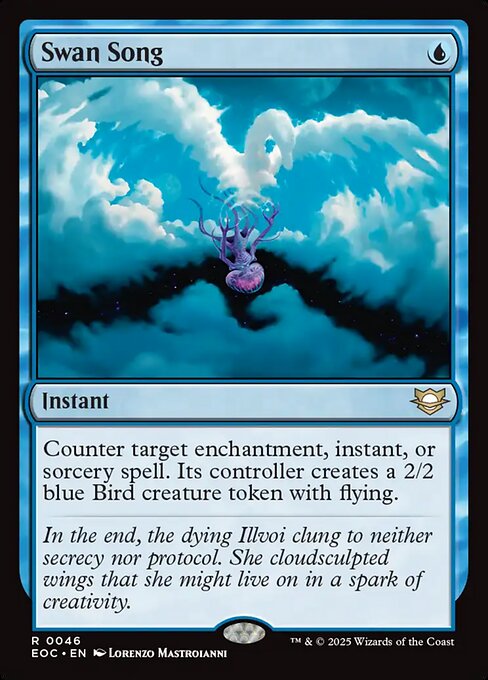
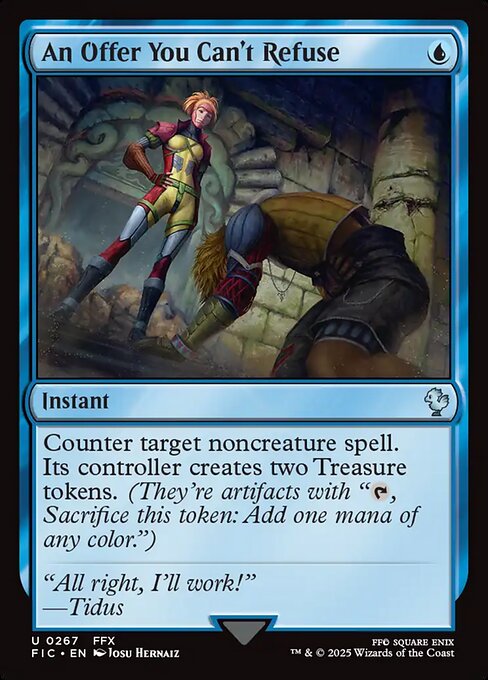
Count the cards whose primary job is stopping a spell on the stack: Counterspell, Negate, Swan Song, An Offer You Can't Refuse, Arcane Denial. Modal cards that counter as one option among several count as half a slot in your mental math — you'll often use the other mode.


And be honest about what counterspells can't do: nothing. Once a threat resolves, every counter in your deck is blank against it. Counters are a supplement to your removal, never a substitute — get your targeted removal count right first, then add counters on top.
Adjusting the Count for Your Archetype
Value and battlecruiser decks: 2-4. You'd rather be advancing your board than holding mana. Keep a few cheap, high-impact counters — Swan Song-style one-mana answers — strictly for board wipes and game-ending spells aimed at you.
Blue midrange and spellslinger: 4-6. The default. Enough that you can represent a counter in the mid-game without warping your deck around passing with mana up.
Control decks: 8-10. If your plan is to drag the game long and win late, counters are load-bearing. Even here, favor variety over volume — three Cancel variants are worse than one hard counter, one cheap conditional counter, and one that generates value.
Combo decks: 4-6, but chosen differently. Your counters exist to protect your own win, not to police the table. One-mana protection like Swan Song and Flusterstorm matters far more than catch-all answers, because you'll be casting them on the turn you're also casting your combo.
The Mistakes That Waste Counter Slots
The biggest one is running counterspells and then tapping out every turn anyway. A counter in a deck that never holds mana is a mulligan you shuffled in on purpose. If your curve wants you tapping out through turn six, cut to the 2-4 range and spend the slots on removal that works at sorcery speed.
The second is loading up on soft counters. "Unless they pay  " reads fine on turn three and does nothing on turn nine — and Commander games are decided on turn nine. Weight your suite toward hard counters and toward cheap counters with a narrow-but-relevant target class, and treat pay-off-the-tax counters as early-game tempo cards you're happy to trade away.
Want a second opinion on your interaction suite? Run your list through the Commander bracket calculator — the deck audit breaks down your interaction, ramp, draw, and curve next to a bracket estimate, which makes an anemic answer package obvious fast. And once you've settled on your number, filling those slots with the right counters is its own decision — that's the subject of our guide to the best counterspells in Commander.



Comments
Join the conversation.