

Jodah, the Unifier Commander Deck: Legends That Cast Legends, Minus the cEDH Arms Race

A Jodah, the Unifier commander deck does two things at once, and both of them scale. Jodah, the Unifier costs 



 and gives your legendary creatures +X/+X, where X is the number of legendary creatures you control. Then, whenever you cast a legendary spell from your hand, you exile cards from the top of your library until you hit a legendary nonland card with a lower mana value and may cast it for free. Every legend you cast from hand is a second legend, and every legendary creature you control makes all of them bigger. (That free cast looks like the cascade keyword but is Jodah's own trigger; in this post "the trigger" always means his.)
This is our bracket 3 build: Jodah, the Unifier Bracket 3, which audits at bracket 3 with two Game Changers, Demonic Tutor and Rhystic Study, no two-card infinite combos, and nothing banned. Game Changers are the cards on Wizards' list that push a deck up a bracket, and bracket 3 allows up to three of them; our brackets guide has the full rules. The list we started from was a five-color legends shell with a cEDH (competitive Commander) counterspell fight grafted on: three Game Changers, free counterspells, one-shot mana, and two sacrifice outlets that only existed for a combo. Fourteen swaps later it is a deck for a normal table that still does the Jodah thing every turn. One honest note before the list: the mana base of original dual lands and fetchlands (lands that sacrifice to search up another land) is the expensive part, and swapping it for cheaper dual lands and basics does not move the bracket.
Read the trigger twice before you build
Three rules decide how the deck plays. The trigger says "from your hand." A legend you find with it is cast from exile, so it does not find a third. The same goes for a legend Sisay, Weatherlight Captain puts straight onto the battlefield, or one Kethis, the Hidden Hand lets you play from the graveyard. One cast from hand, one free card. Plan on two-for-ones, not on a chain.
"Lesser mana value" is checked against the spell while it is on the stack, the zone where a spell waits to resolve, and for an X spell that includes X. Jaya's Immolating Inferno for X equals five is a seven-mana spell while it is being cast, so it digs for a legend costing six or less. Kamahl's Druidic Vow for six is an eight. Cast from hand with a big X, these two are removal and ramp (ramp meaning extra mana or lands ahead of schedule) that set up the deck's deepest digs. The reverse is a trap: if the trigger flips one of them, the free cast has X equal to zero and does nothing.
Legendary sorceries need a legendary creature or planeswalker on your side when you cast them. With Jodah dead and the board swept, Urza's Ruinous Blast, the Inferno and the Vow are all stuck in hand. Keep a legend in hand, or Hajar, Loyal Bodyguard on the battlefield, so you can still cast them after a wrath (a spell that destroys every creature).
On mulligans: a commander with five colored pips (mana symbols) in a 99 (every card except the commander) that plays every color wants a hand that makes at least two colors by turn two. Three lands plus a mana creature or a rock such as Arcane Signet is a keep. Three lands and no mana source beyond them is the hand to think hard about, because Birds of Paradise, Bloom Tender, Faeburrow Elder, Noble Hierarch and Ignoble Hierarch are what make Jodah castable on turn four.
A turn sequence to expect
Turn one is a mana creature or Yoshimaru, Ever Faithful, who gets a counter every time another legendary permanent you control enters and so grows with everything the deck does. Turn two is a cheap legend with a job, either Lotho, Corrupt Shirriff for a Treasure (a token you sacrifice for one mana of any color) off everyone's second spell or Lavinia, Azorius Renegade against the decks that cast spells for free. Turn three is an engine: Reki, the History of Kamigawa so every legendary spell draws, or Esika, God of the Tree // The Prismatic Bridge on her creature side, which turns every other legendary creature you control into a source of any color.
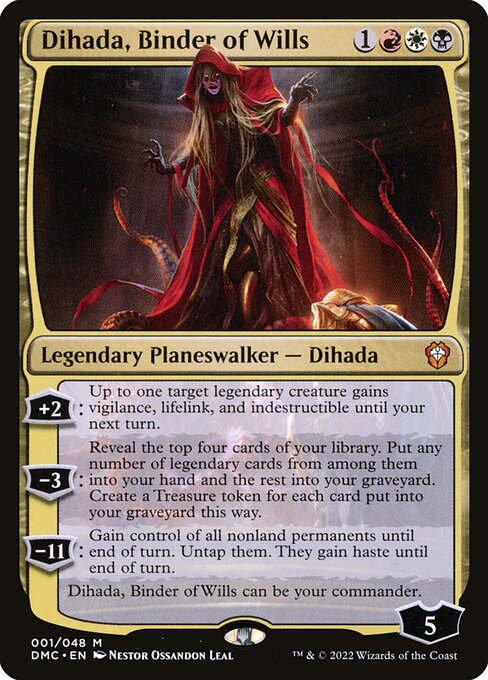
Turn four or five is Jodah, and from then on you cast your most expensive legend from hand each turn. Aragorn, the Uniter at four finds a three-or-less legend and then pays you for every white, blue, red or green spell. Dihada, Binder of Wills at four finds the same range and then either makes Jodah indestructible until your next turn or digs four cards for more legends. The anthem (an effect that pumps a group of your creatures; Jodah's pumps only legendary ones) does the rest: with Jodah and five other legendary creatures out, every one of them is six power bigger than its card says.
Lwaxana Troi, Charming Guest is the pet card, and she is here for one line. Pay  , tap her, and choose Jodah. As long as she stays tapped, each of his triggered abilities triggers an additional time, which means every legendary spell from hand finds two free legends. You may choose not to untap her, so once she is pointed at Jodah she stays pointed. Annie Joins Up does the same thing for every legendary creature you control, and with both out a single legendary spell from hand finds three free cards. Our Star Trek cards for your 99 post has more on where else she fits.
What came out, and why it was in there
The starting list was tuned for a counterspell fight that the rest of a bracket 3 table is not having. Enlightened Tutor was cut first because it was the third Game Changer, and Kinnan, Bonder Prodigy went with it. Kinnan adds one extra mana every time you tap a nonland permanent for mana, which suits a deck of mana creatures more than a deck of legends. Enlightened Tutor finds an artifact or enchantment and puts it on top of your library, so it costs you the next draw, and the two targets that matter here, Annie and The Great Henge, are legendary, which means Captain Sisay already puts them straight into your hand (a tutor is any card that searches your library for another).
The counterspells and Silence went next. Pact of Negation is free when you cast it and costs  on your next upkeep, the kind of card that loses a twelve-turn game on its own. Mindbreak Trap is only free against a player who has cast three spells this turn, which at a bracket 3 table usually means a storm deck (one that wins by casting many spells in one turn). Flusterstorm only counters if they cannot pay
 per copy, and a player casting a wrath late in the game usually can. Force of Negation is free only on another player's turn, only against noncreature spells, and costs you a blue card. Silence stops opponents casting spells for a turn, which protects a one-turn combo that this deck no longer has. Swan Song and An Offer You Can't Refuse stay because each one counters a wrath for a single blue mana. Veil of Summer stays because it stops targeted blue or black removal for one mana, and Deflecting Swat because it redirects any targeted removal for none.
Simian Spirit Guide, Elvish Spirit Guide and Lotus Petal are one-shot mana that buys a turn in a format where a turn is everything. Here a turn is one legend, and a permanent source is worth more than a one-turn head start. Blasting Station and Goblin Bombardment are sacrifice outlets (permanents that let you sacrifice creatures whenever you like), there to finish a combo the cEDH list could assemble and this one cannot. The one card here that would have liked them is Ratadrabik of Urborg, who turns a sacrificed Atraxa, Grand Unifier into a second Atraxa trigger; that is a real loss and a fair price. Skrelv, Defector Mite protected one creature from one color, and Gemstone Caverns is a land that only earns its slot when it starts in your opening hand and you are not going first.
What went in, and the job each one does
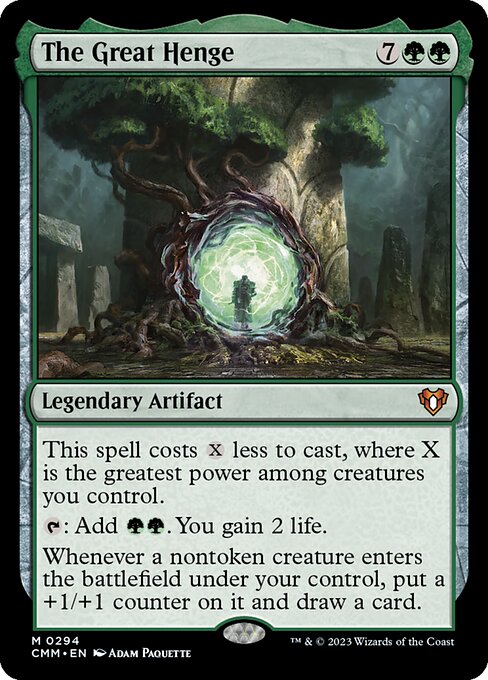
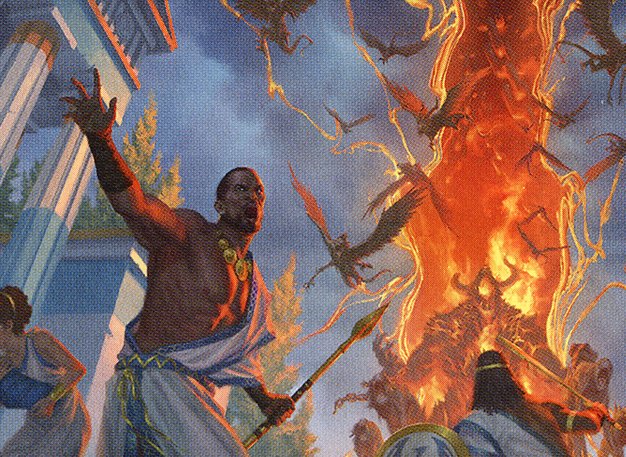
The Great Henge costs  less where X is the greatest power among your creatures, and with the anthem a seven-power legend is routine, so it usually costs . It stays a nine-mana spell while you cast it, so the trigger can find Atraxa or Etali, Primal Conqueror // Etali, Primal Sickness, and from then on every nontoken creature that enters, legend or mana creature, gets a counter and draws you a card.
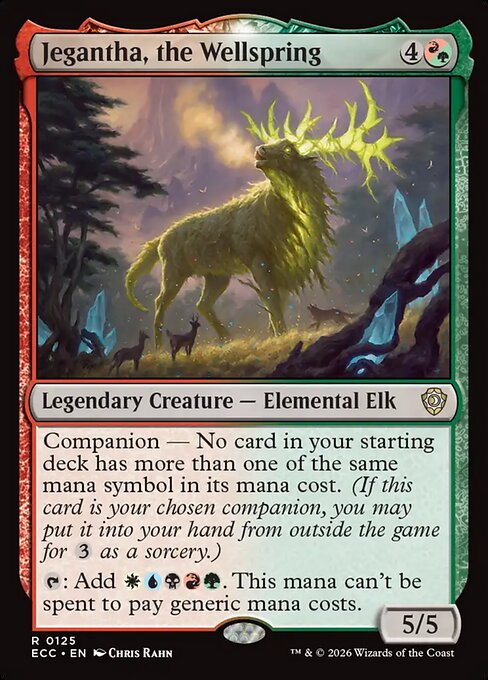
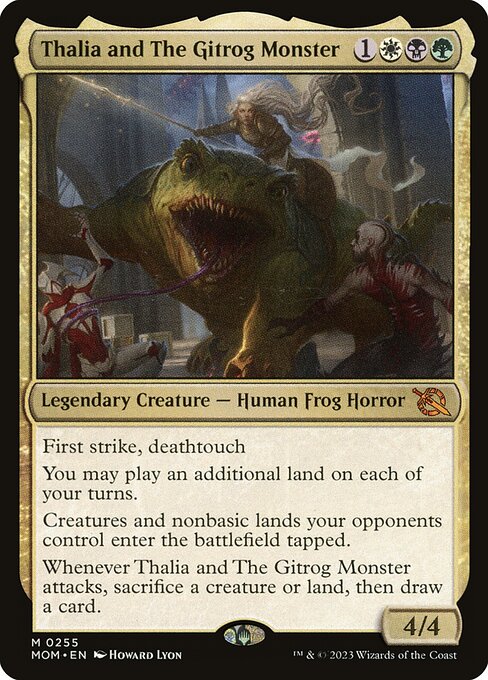
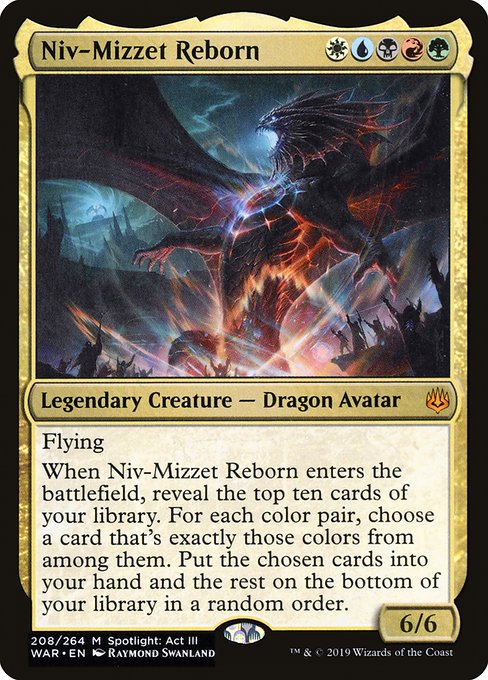
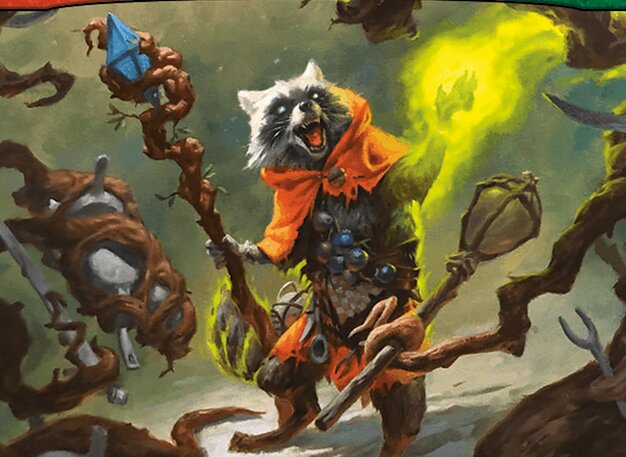
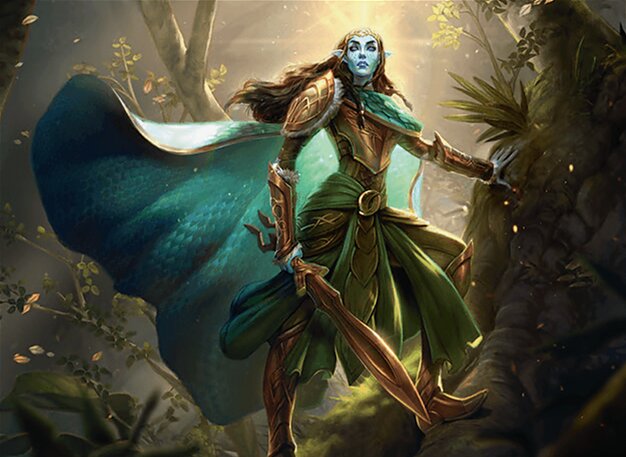
Jegantha, the Wellspring taps for , which is exactly Jodah's cost and exactly what a deck full of three- and four-color legends needs. Niv-Mizzet Reborn reveals ten cards and takes one card for each two-color pair among them, usually one or two cards here; the deck has two-color cards for seven of the ten pairs, Lotho, Hajar, Lavinia, Jhoira, Weatherlight Captain, Captain Sisay, Ratadrabik, Kutzil, Malamet Exemplar, Tyvar, Jubilant Brawler, Eladamri's Call, Abrupt Decay, Anguished Unmaking and Bring to Light among them. Thalia and The Gitrog Monster gives you an extra land drop and makes opposing creatures and nonbasic lands enter tapped; each attack makes you sacrifice a creature or land and then draw, and the extra land drop is what pays for it. Omnath, Locus of Creation draws on entry and adds on the second land each turn.
Kenrith, the Returned King is in for one ability: gives all creatures trample and haste, so a turn where Jodah finds two legends is a turn where both of them attack. His blue ability is the mana sink (somewhere to spend spare mana) when the hand runs dry. Anguished Unmaking and Heroic Intervention replaced two of the counters because the plan is a wide board of legends, and the two things that beat that plan are one permanent you cannot otherwise answer and a wrath.
How the game ends
Expect most wins to be combat under the anthem. Seven legendary creatures make every one of them seven power larger, and Shanid, Sleepers' Scourge gives the others menace, so even a board of 1/1 legends is a lethal attack. Two cards turn that into an explosion. Sisay, Weatherlight Captain searches for a legendary permanent with mana value less than her power and puts it onto the battlefield for . Her power is two, plus one per color among your other legendary permanents, plus Jodah's anthem, so a Sisay at ten power fetches Atraxa or Etali directly. Selvala, Heart of the Wilds adds mana equal to the greatest power among your creatures for and a tap, and your biggest creature is a legend.
Finale of Devastation for X of ten or more puts any creature onto the battlefield and gives the team +X/+X and haste, which with Selvala mana is a live line by turn seven. Kutzil, Malamet Exemplar draws a card each time your pumped creatures hit a player, so an attack into three opponents is three cards. Raffine, Scheming Seer has one attacker connive X, where X is the number of attackers (draw X, discard X, and a counter for each nonland card discarded).
Urza's Ruinous Blast is the one-sided wrath, and it is one-sided only on paper. It exiles every nonlegendary nonland permanent: on your side that is the mana creatures, Sol Ring, Arcane Signet, Fellwar Stone, Relic of Legends, Esper Sentinel, Ranger-Captain, Rhystic Study, Mystic Remora, Lotho's Treasure and any Ratadrabik token, and on theirs it leaves every commander and every legend standing. Cast it when the rocks have done their job and the legends can carry the game alone, which is usually the turn after Jodah has triggered twice. Cast it on turn five to clear a blocker and you will spend the rest of the game short on mana.
Protecting the one card that matters
Jodah is the deck. Without him the legends are a pile of fair creatures, so the list carries more protection than most bracket 3 decks. Ratadrabik is the best of it: when Jodah dies, you get a nonlegendary 2/2 copy with both his abilities, and the real Jodah goes back to the command zone. Recast him and you have two anthems and two triggers. The copy works the same way for a dead Reki, which keeps drawing. Hajar sacrifices himself to make every legend indestructible at instant speed. Plaza of Heroes exiles itself for hexproof and indestructible on one legend, and Heroic Intervention does the same for the whole board. Indestructible does nothing against an exile or -X/-X sweeper (a spell that hits every creature at once), so against those the answers are Swan Song and An Offer You Can't Refuse. Samwise the Stouthearted returns a permanent that died this turn to your hand for two mana at instant speed.
The honest weakness is a counterspell on Jodah himself, and the deck has more answers than it looks. Delighted Halfling makes him uncounterable, and Ranger-Captain of Eos finds the Halfling on entry or, sacrificed, stops noncreature spells for the turn. Cavern of Souls does the same if you name Human: Jodah is a Human Wizard, and Aragorn, both Sisays, Jhoira, Kenrith, Reki, Shanid, Hajar, Lavinia and Sakashima of a Thousand Faces are Humans too. Veil of Summer makes your spells uncounterable for a turn. Kutzil stops opponents casting anything during your turn, and Lavinia counters any opponent's spell cast without spending mana (your own free casts are safe), which covers the free counterspells aimed at five-color commanders. Get one of these out before Jodah against a blue deck rather than running him into open mana on turn four.
The list
The full list is below. Copy it to your account and run it through the Commander Bracket Calculator after any swap. If your pod plays it, record the games: the deck's own rating will show whether the legends plan holds up at your table.
Jodah, the Unifier Bracket 3 (EDH)
- 1 Arcane Signet
- 1 Fellwar Stone
- 1 Relic of Legends
- 1 Sol Ring
- 1 Esper Sentinel
- 1 Birds of Paradise
- 1 Bloom Tender
- 1 Deathrite Shaman
- 1 Ignoble Hierarch
- 1 Delighted Halfling
- 1 Noble Hierarch
- 1 Ranger-Captain of Eos
- 1 Faeburrow Elder
- 1 Mystic Remora
- 1 Rhystic Study
- 1 Abrupt Decay
- 1 An Offer You Can't Refuse
- 1 Anguished Unmaking
- 1 Deflecting Swat
- 1 Eladamri's Call
- 1 Heroic Intervention
- 1 Swan Song
- 1 Swords to Plowshares
- 1 Veil of Summer
- 1 Arid Mesa
- 1 Bloodstained Mire
- 1 Bountiful Promenade
- 1 Cavern of Souls
- 1 City of Brass
- 1 Command Tower
- 1 Exotic Orchard
- 1 Flooded Strand
- 1 Luxury Suite
- 1 Mana Confluence
- 1 Marsh Flats
- 1 Misty Rainforest
- 1 Morphic Pool
- 1 Plaza of Heroes
- 1 Polluted Delta
- 1 Scalding Tarn
- 1 Sea of Clouds
- 1 Spire Garden
- 1 Verdant Catacombs
- 1 Windswept Heath
- 1 Wooded Foothills
- 1 Tropical Island
- 1 Savannah
- 1 Volcanic Island
- 1 Underground Sea
- 1 Taiga
- 1 Plateau
- 1 Tundra
- 1 Scrubland
- 1 Bayou
- 1 Badlands
- 1 Mox Amber
- 1 The Great Henge
- 1 Lwaxana Troi, Charming Guest
- 1 Derevi, Empyrial Tactician
- 1 Kutzil, Malamet Exemplar
- 1 Yoshimaru, Ever Faithful
- 1 Niv-Mizzet Reborn
- 1 Etali, Primal Conqueror // Etali, Primal Sickness
- 1 Omnath, Locus of Creation
- 1 Jegantha, the Wellspring
- 1 Kethis, the Hidden Hand
- 1 Selvala, Heart of the Wilds
- 1 Esika, God of the Tree // The Prismatic Bridge
- 1 Samwise the Stouthearted
- 1 Lotho, Corrupt Shirriff
- 1 Jhoira, Weatherlight Captain
- 1 Thalia and The Gitrog Monster
- 1 Shanid, Sleepers' Scourge
- 1 Aragorn, the Uniter
- 1 Kenrith, the Returned King
- 1 Sakashima of a Thousand Faces
- 1 Reki, the History of Kamigawa
- 1 Captain Sisay
- 1 Hajar, Loyal Bodyguard
- 1 Lavinia, Azorius Renegade
- 1 Sisay, Weatherlight Captain
- 1 Ragavan, Nimble Pilferer
- 1 Atraxa, Grand Unifier
- 1 Raffine, Scheming Seer
- 1 Ratadrabik of Urborg
- 1 Annie Joins Up
- 1 Boseiju, Who Endures
- 1 Otawara, Soaring City
- 1 Dihada, Binder of Wills
- 1 Tyvar, Jubilant Brawler
- 1 Jaya's Immolating Inferno
- 1 Kamahl's Druidic Vow
- 1 Urza's Ruinous Blast
- 1 Bring to Light
- 1 Demonic Tutor
- 1 Finale of Devastation
- 1 Nature's Lore
- 1 Three Visits
- 1 Time of Need
- 1 Jodah, the Unifier
The tutors by color post covers the tutors Captain Sisay and Demonic Tutor compete with, and the Rhystic Study piece explains why it is on the Game Changers list.
Comments
Join the conversation.