

Sixteen Shrines and a Tutor Every Turn: A Bracket 4 Sisay, Weatherlight Captain Commander Deck

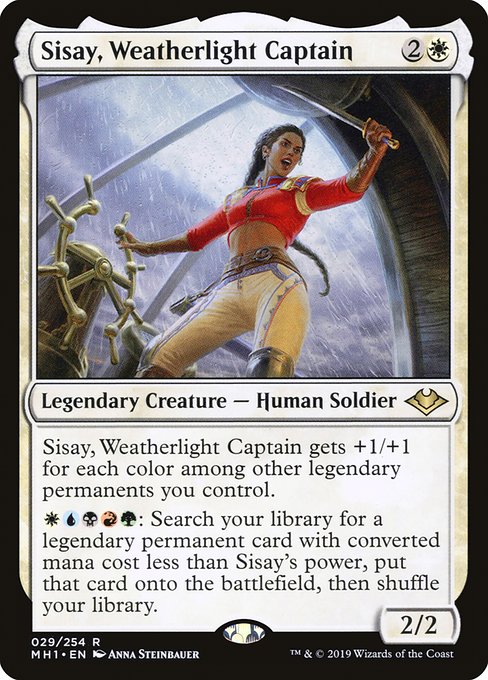
Sisay, Weatherlight Captain is a 2/2 for 
 that counts colors. She gets +1/+1 for each color among the other legendary permanents you control, and for


 she searches your library for a legendary permanent card with mana value less than her power and puts it straight onto the battlefield. There is no tap symbol in that cost. Find five colors of mana twice in a turn and she tutors twice (tutoring is the slang for searching your library for a card). This Sisay, Weatherlight Captain commander deck is built so that she activates every turn from the midgame on, often twice, and so that the things she finds are Shrines: legendary enchantments, nearly all of which get stronger for every other Shrine you control.
This is our bracket 4 build. The list most people arrive at for Sisay already has the Shrines and the cheap multicolor legends. It lacks the mana to activate her twice in a turn and a clean way to end the game. Twelve swaps fix both, and each one is explained below.
How Sisay reads your board
Her power counts colors. Two legends that are both green and white give her +2/+2, because green and white are two colors however many permanents carry them, so the early turns are about getting all five colors represented. Tam, Mindful First-Year is the best turn-two play in the deck for that reason. Tam is green and blue, and Tam's own ability ( : target creature you control becomes all colors until end of turn) can target Tam itself. With Sisay on the battlefield, she then sees five colors from one creature, she is a 7/7, and her tutor reaches mana value 6, which covers every card in the deck she would ever want to find.
The activation costs one mana of each color, so Tam on two and Sisay on three only lead to a turn-four tutor if you have one colored source beyond your four lands. The clean version is a turn-one Sol Ring, then Tam and Arcane Signet on turn two, Sisay on three, and on turn four Tam at itself and for Sanctum of All, with four lands that cover four colors and the Signet for the fifth. Fellwar Stone in the Signet's slot usually does the same job (it makes only colors your opponents' lands could produce). Without the extra source it is a turn-five play, which is still early for a card that fetches a Shrine from your library or graveyard every upkeep from then on. Sanctum of All is itself all five colors, so once it lands Sisay stays a 7/7 whether or not Tam untaps.
One rule to respect: Sisay's power is checked when the ability resolves, not when you pay for it. If an opponent kills the legend carrying your colors in response, she shrinks and the search finds less. Always know what you would take at a lower power, and in this deck the answer is usually a land: Gaea's Cradle and Serra's Sanctum have mana value zero, and she can find either at any power above zero.



The decklist and its audit
Sisay, Weatherlight Captain Bracket 4 (EDH)
- 1 Arcane Signet
- 1 Chromatic Lantern
- 1 Fellwar Stone
- 1 Relic of Legends
- 1 Sol Ring
- 1 Swiftfoot Boots
- 5 Forest
- 3 Island
- 3 Mountain
- 3 Plains
- 3 Swamp
- 1 Faeburrow Elder
- 1 An Offer You Can't Refuse
- 1 Beast Within
- 1 Counterspell
- 1 Negate
- 1 Path to Exile
- 1 Swords to Plowshares
- 1 Arcane Sanctum
- 1 Command Tower
- 1 Exotic Orchard
- 1 Jungle Shrine
- 1 Mana Confluence
- 1 Mystic Monastery
- 1 Nomad Outpost
- 1 Opulent Palace
- 1 Path of Ancestry
- 1 Plaza of Heroes
- 1 Sandsteppe Citadel
- 1 Seaside Citadel
- 1 Canopy Vista
- 1 Sunken Hollow
- 1 Cinder Glade
- 1 Prairie Stream
- 1 Smoldering Marsh
- 1 Heroes' Podium
- 1 The One Ring
- 1 Marvin, Murderous Mimic
- 1 Shalai, Voice of Plenty
- 1 Derevi, Empyrial Tactician
- 1 Kutzil, Malamet Exemplar
- 1 Jegantha, the Wellspring
- 1 Kethis, the Hidden Hand
- 1 Esika, God of the Tree // The Prismatic Bridge
- 1 Tam, Mindful First-Year
- 1 Pippin, Guard of the Citadel
- 1 Ioreth of the Healing House
- 1 Kinnan, Bonder Prodigy
- 1 Shanid, Sleepers' Scourge
- 1 Ruby, Daring Tracker
- 1 Reki, the History of Kamigawa
- 1 Captain Sisay
- 1 Hajar, Loyal Bodyguard
- 1 Lavinia, Azorius Renegade
- 1 Katilda, Dawnhart Prime
- 1 Dynaheir, Invoker Adept
- 1 Jodah, the Unifier
- 1 Raff Capashen, Ship's Mage
- 1 Ertai Resurrected
- 1 Honden of Cleansing Fire
- 1 Honden of Infinite Rage
- 1 Honden of Life's Web
- 1 Honden of Night's Reach
- 1 Honden of Seeing Winds
- 1 Sanctum of All
- 1 Sanctum of Calm Waters
- 1 Sanctum of Fruitful Harvest
- 1 Sanctum of Stone Fangs
- 1 Sanctum of Tranquil Light
- 1 Go-Shintai of Ancient Wars
- 1 Go-Shintai of Boundless Vigor
- 1 Go-Shintai of Hidden Cruelty
- 1 Go-Shintai of Life's Origin
- 1 Go-Shintai of Lost Wisdom
- 1 Go-Shintai of Shared Purpose
- 1 Gaea's Cradle
- 1 Serra's Sanctum
- 1 Aminatou, the Fateshifter
- 1 Ashiok, Dream Render
- 1 Teferi, Time Raveler
- 1 Tyvar, Jubilant Brawler
- 1 Kamahl's Druidic Vow
- 1 Urza's Ruinous Blast
- 1 Coalition Victory
- 1 Cultivate
- 1 Farseek
- 1 Kodama's Reach
- 1 Sisay, Weatherlight Captain
The deck lives at Sisay, Weatherlight Captain Bracket 4, and its bracket audit grades it bracket 4, Optimized. It runs four Game Changers: Coalition Victory, Gaea's Cradle, Serra's Sanctum and The One Ring. Game Changers are the cards on the official list of high-impact staples; a deck with more than three of them is bracket 4 by definition, and our brackets guide walks through the whole system. The audit found no mass land denial, no extra turns and no two-card infinite combos. The deck wins by having more mana and more Shrines than anyone can answer.
Sixteen Shrines, and why they are the right tutor targets
A Shrine is a subtype on three cycles of legendary enchantments: the five Honden from the original Kamigawa block, the six Sanctums from Core Set 2021, and the six Go-Shintai from the Kamigawa: Neon Dynasty Commander decks, which are enchantment creatures as well. This deck runs sixteen of the seventeen. Sanctum of Shattered Heights is the one left out: it asks you to discard a land or a Shrine card to deal damage, and those are the two kinds of card this deck never wants to throw away. Nearly every Shrine scales with the number of Shrines you control, every one is legendary, and every one adds its color to Sisay. A Shrine deck without Sisay is slow because it has to draw its pieces. Sisay turns the whole pile into a toolbox: a set of answers you search for when you need them instead of waiting to draw them.
Sanctum of All is the card to find first. Each upkeep it puts a Shrine from your library or your graveyard onto the battlefield, and once you control six or more Shrines, every other Shrine's triggered ability triggers an additional time. That doubling is where the damage comes from. Sanctum of Stone Fangs makes each opponent lose life equal to your Shrine count at the start of your first main phase, and you gain that much; with nine Shrines and the doubling, that is 18 from each opponent every turn without attacking. Honden of Infinite Rage deals the count to any target at upkeep, Go-Shintai of Ancient Wars does it again at your end step for  , and Honden of Seeing Winds and Sanctum of Calm Waters draw the count. Sanctum of Fruitful Harvest adds that many mana of any one color at the start of your first main phase. One color is the catch, and the mana empties at the end of that main phase: it pays for spells, for the
 on Coalition Victory, and for one pip (one colored mana symbol) of an activation made in the same main phase.
Serra's Sanctum taps for for each enchantment you control, and in this deck that is the Shrine count plus whatever else is on the table. Go-Shintai of Life's Origin makes a 1/1 Shrine enchantment creature token whenever another nontoken Shrine enters, and those tokens count for Serra's Sanctum as enchantments and for Gaea's Cradle as creatures at the same time. Both lands are legendary with mana value zero, so Sisay fetches either with an activation when nothing bigger is needed, and because she puts the land onto the battlefield untapped, it taps the same turn. The mana is all one color, so it covers one pip of the next activation and every generic cost you have, and the other four pips still come from the rest of the board.
Paying for the activation twice a turn
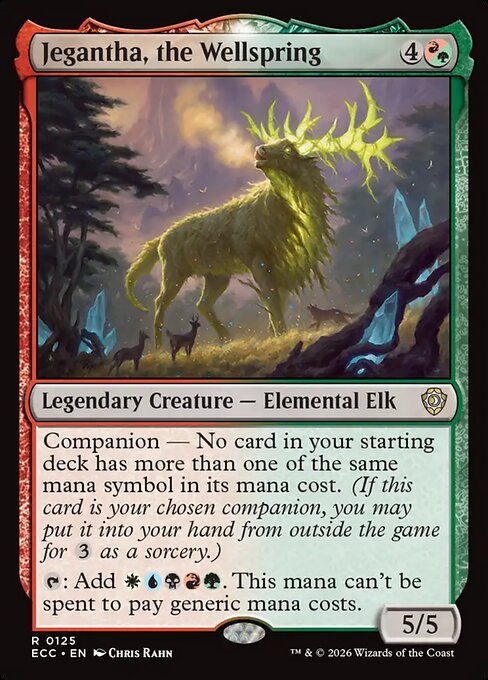
is a hard cost, so the deck has several cards that produce exactly it. Jegantha, the Wellspring taps for that cannot be spent on generic costs, which is no restriction at all for Sisay. Faeburrow Elder taps for one mana of each color among permanents you control, which is the same five once your board has every color. Relic of Legends lets you tap any untapped legendary creature for a mana of any color, and Esika, God of the Tree // The Prismatic Bridge gives every other legendary creature vigilance and that same mana ability, so your creatures attack and still pay for a tutor.
Kinnan, Bonder Prodigy adds one extra mana of a matching type whenever you tap a nonland permanent for mana, whether that is a rock (an artifact that taps for mana), a mana dork (a creature that does) or a legend under Esika, so Jegantha taps for six and a Signet for two. The untappers turn one activation into two. Ioreth of the Healing House untaps Jegantha, or two other legendary creatures. Tyvar, Jubilant Brawler untaps a creature with its +1 and lets your creatures use tap abilities the turn they arrive. Derevi, Empyrial Tactician untaps a permanent whenever one of your creatures deals combat damage to a player. Dynaheir, Invoker Adept does the same job from the other side: tap her, and the next ability you activate that turn by spending four or more mana is copied, so one fetches two legendary permanents.
Marvin, Murderous Mimic is the card people miss. Marvin has every activated ability of the other creatures you control, which means it has Jegantha's five-color tap, Ioreth's untap and Sisay's tutor, using Marvin's own power for the search. Marvin's own power is low, so on its own that search only reaches the cheapest targets, the two legendary lands first; with Jodah, the Unifier or Heroes' Podium pumping every legendary creature, Marvin's copy of the tutor reaches real cards too.
Closing the game
Most games end with the Shrine drain, and the deck protects the turns that get there. Kutzil, Malamet Exemplar stops your opponents casting spells during your turn, and Teferi, Time Raveler holds them to sorcery speed (casting only in their own main phases, with nothing else waiting to resolve). With either on the battlefield, no opponent can cast a counterspell or instant-speed removal during your turn. Abilities of permanents they already control still work, which is why Shalai, Voice of Plenty's hexproof for you and your other creatures is the second layer.
Coalition Victory costs and wins the game if you control a land of each basic land type and a creature of each color. The deck's five tango duals do most of the land work; a tango dual is a two-type land such as Prairie Stream, a Plains Island, that enters untapped if you control two or more basic lands. Prairie Stream and Smoldering Marsh plus any Forest cover all five types, as do Canopy Vista and Sunken Hollow plus any Mountain, and Farseek can fetch any of them. For the creatures, Jodah, the Unifier is all five colors on his own, and failing that, Tam, Mindful First-Year makes any one creature all five colors until end of turn. Point Tam at anything, cast Coalition Victory with Kutzil out, and the game is over. It is a Game Changer for a reason, and at a bracket 4 table an eight-mana sorcery that wins is exactly what everyone signed up for.
Urza's Ruinous Blast exiles every nonland permanent that is not legendary. For your opponents that is most of their board, though their commanders and other legends survive. For you it is the mana rocks, Faeburrow Elder, Swiftfoot Boots, your Spirit tokens, and the colorless Shrine tokens from Go-Shintai of Life's Origin, which are Shrines, so your Shrine count drops with them. Count your nontoken Shrines before you cast it: if the tokens are what has you at six, the Blast turns off Sanctum of All's doubling along with your opponents' boards. Jodah, the Unifier gives your legendary creatures +X/+X where X is how many of them you control, so the same board that is draining the table is also a flying clock (an evasive attack that kills in a few turns) with Derevi, Empyrial Tactician and Shalai, Voice of Plenty.
Twelve swaps from the common list
The cuts first.
- Evolving Wilds and Terramorphic Expanse (cut): each costs you that land's mana on the turn you play it and gives back a tapped basic. The deck wants its second and third turns for Tam and Sisay.
- Crumbling Necropolis and Frontier Bivouac (cut): two of the three tapped tri-lands that make no white, the color Sisay herself needs, and both make red, the color the fewest cards in this deck ask for. Opulent Palace makes blue, black and green instead, and stayed.
- Oath of Teferi (cut): five mana to let four planeswalkers activate twice. Too slow for what it adds.
- Primevals' Glorious Rebirth (cut): seven mana to return every legendary permanent from your graveyard at once. Kethis, the Hidden Hand took the slot: slower per card, but a three-mana legend that discounts every legendary spell as well.
- Nicol Bolas, Dragon-God (cut): is the hardest cost in the deck on a mana base with three Swamps, and his ultimate (the big minus-eight loyalty ability) is several turns away.
- Samut, Voice of Dissent (cut): Sisay's tutor does not tap, so haste for the team is wasted on the commander, and five mana is a lot for a card whose best mode here is untapping Jegantha.
- Commander's Sphere (cut): three mana for one mana a turn and a card when you sacrifice it. Relic of Legends costs the same and also taps your legends, and Chromatic Lantern costs the same and fixes every land.
- Harrow and Rampant Growth (cut): two of the ramp spells that only find basics. Cultivate and Kodama's Reach stay for the extra card, and Farseek stays because it finds the tango duals.
- Arvad the Cursed (cut): a five-mana +2/+2 for legends. Jodah, the Unifier already pumps the team, and the slot became a card-draw engine.
And what went in:
- Gaea's Cradle and Serra's Sanctum (Game Changers): the two legendary lands Sisay fetches for at any power, untapped. Sanctum taps for a mana per enchantment and Cradle for a mana per creature, each in its own color; on a board of eight Shrines and a few legends that is more mana than the activation cost.
- Plaza of Heroes: taps for any color to cast a legendary spell, which is most of your spells, and later exiles itself to give a legendary creature hexproof and indestructible for .
- Mana Confluence: five colors, untapped, for one life a tap. With Plaza, it does the fixing the two tapped tri-lands did, on time.
- The One Ring (Game Changer): a legendary artifact with mana value 4, so Sisay finds it once she has three colors. Note the fine print: the protection from everything only happens if you cast it. A tutored Ring still draws cards and is still indestructible, but there is no turn of immunity. Aminatou, the Fateshifter's minus-one ability can blink it later (exile it and return it) to clear the burden counters.
- Kinnan, Bonder Prodigy: one extra mana from every nonland source you tap, in a deck where Jegantha, Faeburrow Elder and every legend under Esika are mana sources.
- Coalition Victory (Game Changer): the alternative win condition, covered above.
- Esika, God of the Tree // The Prismatic Bridge: the front face makes every legendary creature a mana source; the back face drops a creature or planeswalker onto the battlefield every upkeep if you would rather have a second engine.
- Reki, the History of Kamigawa: draw a card whenever you cast a legendary spell. Forty-six of the 99 cards beside Sisay qualify.
- Kethis, the Hidden Hand: legendary spells cost less, and exiling two legendary cards from your graveyard lets you play the rest of them from there until end of turn, each at its normal cost less the discount. Kethis dies to a wipe (a spell that clears every creature) like everything else, so when you see one coming, hold Kethis in hand, cast it after the wipe, then rebuy the board a card at a time.
- Captain Sisay: : search for any legendary card and put it into your hand. She finds Sanctum of All, Jodah, the Unifier or a legendary land, and Ioreth of the Healing House untaps her.
- Teferi, Time Raveler: opponents cast spells only at sorcery speed, so the tutor and the Victory resolve past any counterspell.
Opening hands and two habits to build
Mulligans. Keep hands with lands in at least two colors and a legend that costs two. Tam, Mindful First-Year, Hajar, Loyal Bodyguard, Ruby, Daring Tracker, Pippin, Guard of the Citadel, Lavinia, Azorius Renegade, Katilda, Dawnhart Prime and Kinnan, Bonder Prodigy each add colors before Sisay arrives, and Ruby and Katilda add mana as well (Marvin, Murderous Mimic is colorless and is there for the copied abilities). A hand of three Shrines and no legendary creatures is a mulligan, however pretty it looks: Shrines are what Sisay finds.
Habit one: activations before Shrines. With Sisay out, your mana is better spent on an activation that puts a Shrine from your library onto the battlefield than on casting the five-mana Honden of Seeing Winds in your hand, which keeps. Cast the cheap legends that add colors, activate, and let Shanid, Sleepers' Scourge and Reki, the History of Kamigawa refill your hand a card per legendary spell. Raff Capashen, Ship's Mage lets you cast historic spells (artifacts, legendaries and Sagas) as though they had flash, so the Shrines you do cast can wait for an opponent's end step.
Habit two: count the generic. Jegantha's mana cannot pay generic costs. It pays Sisay's activation perfectly and the colored half of Coalition Victory, but the in front of the Victory has to come from somewhere else. Count that before you announce the win.
And once you control six Shrines, Sanctum of All doubles the Go-Shintai end-step triggers too, so each of the five Go-Shintai with a pay- trigger asks you twice. Leave open at the end of your turn for each one you control.
If you take it to a league
The Copy to my account button on the decklist above puts this list in your deck builder once you sign in. If your group runs a pod league, register the deck to it and record a few games before you change anything. Ten games give the deck an honest record, and the deck's ELO tells you whether it wins, which is a better guide than how the games felt. If you cut a Game Changer to drop a bracket, run the list through the bracket calculator again; the audit linked above is tied to this exact 99.


Comments
Join the conversation.