

Which Counters Commanders Are Worth Building in EDH? Four Tiers, From Deck-Carrying Engines to Only-If Picks

Ask for the best counters commanders and the answer usually starts and ends with Atraxa. That is right about Atraxa and unhelpful about everyone else, because the green +1/+1 counters decks share one support package (the doublers, the plus-one effects that add an extra counter to every placement, the Hydras, Walking Ballista), so the commander is the decision that shapes the rest of the 99, the ninety-nine cards under it. A counters commander either makes the counters or turns them into something that wins.
So this is a tier list, each tier opened by what its commanders have in common, with no numbers inside a tier. The end covers the shared support cards and what moves a list between brackets (the format's one-to-five power scale), which is a property of the list and never of the commander.
Build around them: the commanders that make or grow the counters
What this tier shares: the commander is the deck's counter engine. It either makes counters itself, from land drops, small creatures, X spells or its own activations (Bristly Bill, Spine Sower, Ezuri, Claw of Progress, Zaxara, the Exemplary, Ghave, Guru of Spores), or grows every counter the deck places (Atraxa, Praetors' Voice, Vorinclex, Monstrous Raider), so the 99's job is to feed it: lands for Bristly Bill, small creatures for Ezuri, X spells for Zaxara, creatures to sacrifice for Ghave and counter sources for Atraxa and Vorinclex.
Atraxa, Praetors' Voice
Atraxa, Praetors' Voice costs 


 for a flying, vigilance, deathtouch, lifelink body that proliferates at the beginning of your end step. Proliferate means you choose any number of permanents and players that already have a counter and give each one more of each kind it has: your creatures grow, and an opponent with a poison counter moves a step toward ten. Four colours means nearly every doubler and plus-one effect is legal. The end-step choice is a real choice: skip your own Saga (an enchantment that advances a chapter each time it gets a lore counter) when you want it around longer, because a proliferated Saga reaches its final chapter and is sacrificed a turn early. And never attack her into a deathtouch blocker; the proliferate does not need her to connect.
Bristly Bill, Spine Sower
Bristly Bill, Spine Sower is  : whenever a land you control enters, put a +1/+1 counter on target creature, and for
 you double the number of +1/+1 counters on each creature you control. That is an engine from turn two in the colour with the extra land drops and the ramp, and the doubling has no timing restriction. Activate it after blockers are declared or in an opponent's end step, and every creature with +1/+1 counters on it gets as many again.
Ezuri, Claw of Progress
Ezuri, Claw of Progress ( ) gives you an experience counter whenever a creature you control with power 2 or less enters, and at the beginning of combat on your turn puts that many +1/+1 counters on another target creature you control. Your experience counters are on you, so a sweeper that kills Ezuri at ten experience leaves you at ten: recast Ezuri from the command zone, and at your next combat any other creature you control gets all ten. The deck is thirty small creatures that draw cards or get through unblocked, and the combat trigger goes on whichever one is connecting this turn.
Ghave, Guru of Spores
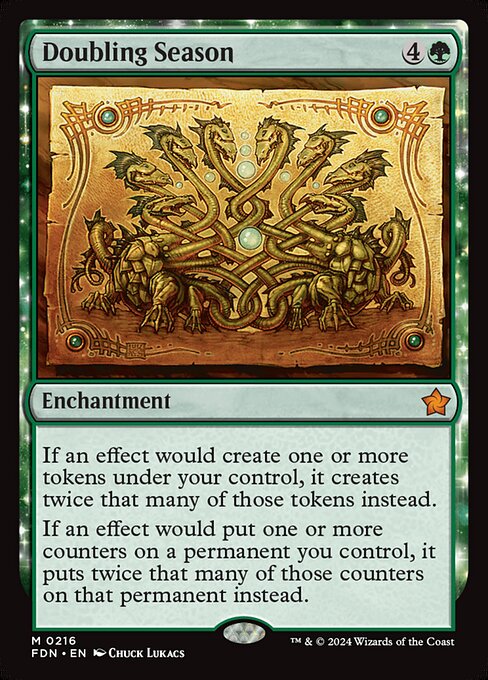
Ghave, Guru of Spores () enters with five +1/+1 counters, turns a counter into a 1/1 Saproling for , and turns a sacrificed creature into a +1/+1 counter for . That is an exchange rate between counters and bodies, and every plus-one effect tilts it: with Hardened Scales out, one sacrificed Saproling comes back as two counters. Two more cards close the loop. With Ashnod's Altar and Doubling Season, removing one counter makes two Saprolings; sacrifice one to the Altar for two mana and the other to Ghave for two counters, and you are up a counter with your mana back. With the Altar and Cathars' Crusade, every Saproling that enters puts a counter on Ghave, which pays for the next one. Decide before you build whether those loops are in, and run the list through the bracket calculator before you call a number.
Vorinclex, Monstrous Raider
Vorinclex, Monstrous Raider is  with trample, haste and two replacement effects: counters you put on anything are doubled, and counters your opponents put are halved, rounded down. The first half makes every other card in the deck better; the second is the quiet weapon, since their planeswalkers enter with half their loyalty and their toxic and infect creatures (the ones that hand out poison counters) give half the poison. The arithmetic people miss is Kalonian Hydra. Entering with four counters counts as you putting them, so it enters with eight, and doubling the counters on a creature means putting that many more, which Vorinclex doubles again: each Hydra attack is a tripling, eight to twenty-four to seventy-two.
Zaxara, the Exemplary
Zaxara, the Exemplary () is a deathtouch Hydra that taps for two mana of one colour and makes a 0/0 Hydra with X +1/+1 counters whenever you cast a spell with  in its mana cost. Unbound Flourishing is the card that makes it an engine: it doubles X on your permanent spells and copies your X instants, sorceries and activated abilities. On a permanent X spell both triggers happen on the cast, so put Zaxara's on the stack first and Flourishing's on top, and the Hydra arrives with the doubled X. On an X instant or sorcery you get the copy, which is not cast, and a Hydra of the original size. Never cast an X spell for one just to get a token.



Strong in the right deck: the commanders that need their 99 built for them
What this tier shares: each is strong only in a 99 built for it, which means counter sources for Shalai and Hallar and Falco Spara, Pactweaver, sacrifice outlets for Reyhan, Last of the Abzan, card draw for Toothy, Imaginary Friend, a stocked graveyard for Kathril, Aspect Warper, evasion for Skullbriar, the Walking Grave and non-Humans with persist for Grumgully, the Generous. Build the 99 first and pick the commander it asks for.
Shalai and Hallar
Shalai and Hallar ( ) deal damage to a target opponent equal to the counters placed whenever one or more +1/+1 counters are put on a creature you control. That is the reach a counters deck otherwise lacks, and the trigger is per creature, so a Kalonian Hydra attack that doubles five creatures is five triggers, each aimed wherever you like. The line: with Hardened Scales and Doubling Season out, one counter placed on one creature becomes four, so every counter you place is four damage, and the deck ends games through blockers it never attacks into.
Falco Spara, Pactweaver
Falco Spara, Pactweaver () lets you look at the top card of your library at any time and cast spells from the top by removing a counter from a creature you control as an additional cost. The plus-one effects mean the counter you spend was free, so every extra counter Hardened Scales adds is a card. Falco arrives with a shield counter (if it would be dealt damage or destroyed, the counter is removed instead), which makes Falco a creature with a counter on it, and the first card off the top will tempt you to spend that one. Don't.
Reyhan, Last of the Abzan and Ishai, Ojutai Dragonspeaker
Reyhan, Last of the Abzan () enters with three counters and, whenever a creature you control with +1/+1 counters dies or is put into the command zone, puts that many counters on a target creature. The word is puts: with a plus-one effect out, every transfer grows the pile by one. Ishai, Ojutai Dragonspeaker () gets a counter whenever an opponent casts a spell, which at a four-player table is three or four counters a turn cycle for doing nothing. Together the counters never leave: Ishai dies, Reyhan passes the pile on; Reyhan dies, back to the command zone and the pile moves again. Your own sacrifice outlets become counter transfers, which is what makes the deck more than a big Ishai.
Pir, Imaginative Rascal and Toothy, Imaginary Friend
Pir, Imaginative Rascal () adds one to every batch of counters, of any kind, put on a permanent your team controls, and Toothy, Imaginary Friend () gets a +1/+1 counter whenever you draw a card and draws a card for each counter on it when it leaves the battlefield. With both out, every draw is two counters on Toothy, and a Toothy with twenty counters that gets bounced or killed is twenty cards. That is the trap as much as the payoff: count your library before you let it die, and keep a way to shuffle the graveyard back in.
Kathril, Aspect Warper
Kathril, Aspect Warper () enters, checks your graveyard for creature cards with each of eleven keywords (flying, first strike, deathtouch and the rest), puts one matching keyword counter on any creature you control for each keyword it finds, then gets a +1/+1 counter for each counter placed. It is a five-mana payoff that needs a stocked graveyard first, so the deck is self-mill and discard with Kathril as the reward, and it is recastable: the counters it hands out stay when it dies, and the next cast reads the graveyard again.
Skullbriar, the Walking Grave
Skullbriar, the Walking Grave () has haste, grows a counter every time it hits a player, and keeps its counters as it moves to any zone other than a player's hand or library. Destroyed or exiled, it comes back from the command zone the same size for two more mana. The answers that work are bounce (back to hand), tuck (into the library), theft and counter removal, so build the protection against those and spend the slots a normal counters deck gives to recursion on evasion instead.
Grumgully, the Generous
Grumgully, the Generous () gives each other non-Human creature you control an extra +1/+1 counter as it enters. The hidden mode is persist: a persist creature returns with a -1/-1 counter, Grumgully adds a +1/+1 counter, the two cancel under the rules, and the creature can persist again. Add a free sacrifice outlet and that is a loop; without one it is a Gruul deck where everything is one size larger, which is fine and nothing more.
Not +1/+1: poison, -1/-1 and vigilance counters
What this tier shares: the counters are a different kind, or they land on the other side of the table. The +1/+1 cards (Hardened Scales, Branching Evolution, Conclave Mentor) do nothing here, and Doubling Season and Winding Constrictor only affect your own permanents, so neither does anything for poison on an opponent or -1/-1 counters on their creatures. Proliferate works on every kind of counter and on every player, so it is the support package.
Hapatra, Vizier of Poisons
Hapatra, Vizier of Poisons () makes a 1/1 deathtouch Snake whenever you put one or more -1/-1 counters on a creature, and puts one on a creature herself when she connects. The trigger is per creature, so Contagion Engine entering and putting a counter on each creature one opponent controls is a Snake for each of them. Shrinking their board is the removal and the Snakes are the army.
Yawgmoth, Thran Physician
Yawgmoth, Thran Physician () pays one life and sacrifices another creature to put a -1/-1 counter on up to one target creature and draw a card, and discards a card for to proliferate. The engine is two undying creatures (they return with a +1/+1 counter if they died without one). Sacrifice Young Wolf with the -1/-1 counter aimed at Geralf's Messenger, which already carries its undying counter: those counters cancel, the Wolf comes back with a counter, and the next activation sacrifices the Messenger and aims at the Wolf. Each activation costs a life and draws a card, so your library sets the limit, but every Messenger return drains an opponent for 2 and Blood Artist adds a point per death while paying the life back. Roughly two points of drain per card drawn, which is a kill.
Ixhel, Scion of Atraxa
Ixhel, Scion of Atraxa () flies with toxic 2 (a player it deals combat damage to also gets two poison counters), and at your end step each opponent with three or more poison counters exiles the top card of their library face down for you to play. This is the poison deck that does not need ten counters to win. It needs three on each opponent, which is two hits or one hit and a proliferate, and from then on every end step is three extra cards.
Tayam, Luminous Enigma
Tayam, Luminous Enigma () gives each other creature you control a vigilance counter as it enters, and for plus three counters removed from among your creatures mills three cards and returns a permanent card with mana value three or less from your graveyard to the battlefield. The counters are currency and the kind does not matter, so this is the counters commander for a recursion deck of cheap creatures with enter-the-battlefield effects. A returned creature brings back one vigilance counter of the three the next activation needs, so the deck wants token makers and a second counter source.
Tekuthal, Inquiry Dominus
Tekuthal, Inquiry Dominus () makes you proliferate twice whenever you would proliferate once, and can buy itself an indestructible counter. It is the proliferate deck for a player who does not want Atraxa's four colours or Atraxa's reputation: mono-blue, built on Inexorable Tide, Flux Channeler and Thrummingbird. The opening is Blighted Agent on two (it can't be blocked and deals its damage as poison counters) and Tekuthal on four, after which every Thrummingbird hit and every cheap noncreature spell through Flux Channeler is two more poison on each poisoned opponent.
Fynn, the Fangbearer
Fynn, the Fangbearer () gives two poison counters to a player hit by any deathtouch creature you control. Two mana, mono-green, and a kill in five hits per opponent. Poison counters are counters, so each proliferate replaces half a hit (four hits and two proliferates is a kill, and one Contagion Engine activation is both). It sits in this tier because its counters land on opponents: the doublers do nothing for it, and proliferate (Evolution Sage, Contagion Engine) is its whole support package.
Only if: the conditional picks
What this tier shares: each does one counters job well and nothing else, so it belongs in the command zone only when the condition attached to it is true for you.
- Marath, Will of the Wild, only if you want a toolbox more than power. It enters with counters equal to the mana spent on it, so the commander tax (two more mana each time you recast it) makes it bigger each time, and the play is to spend counters one at a time on the damage mode against mana creatures.
- Rishkar, Peema Renegade, only on a budget. Its two entry counters go on creatures that are not already mana producers, since every creature you control with a counter gains "
 : Add ", and a turn-three Rishkar is six mana on turn four.
- Vorel of the Hull Clade, only if the board already has something worth doubling, because Vorel makes no counters of its own. Its legal targets are artifacts, creatures and lands, so the best target is a Walking Ballista at instant speed, and an enchantment such as Simic Ascendancy is out of reach.
- Hamza, Guardian of Arashin, only if the deck is thirty creatures. It discounts itself and every creature spell by for each creature you control with a +1/+1 counter, so with three countered creatures out Hamza costs three and every creature spell after it costs up to three less.
- Zegana, Utopian Speaker, only as a cheap Simic entry point. Hold it until you control another creature with a +1/+1 counter so it draws on entry. Every creature you control with a +1/+1 counter has trample while Zegana is out, and adapt 4 (four counters on itself if it has none) on a quiet turn makes Zegana one of them.
- Experiment Kraj, only if you enjoy the puzzle. Kraj has the activated abilities of each other creature with a +1/+1 counter on it, yours or an opponent's, and its own tap ability puts a counter on any creature at instant speed, so tap it at the opposing creature with the best activated ability in the end step before your turn and borrow that ability when you untap.
- Anim Pakal, Thousandth Moon, only if you want Boros. Each attack with non-Gnome creatures puts a counter on Anim Pakal and then makes that many tapped, attacking 1/1 Gnomes, so an Anim Pakal with three counters attacks, gets its fourth and makes four Gnomes, and each combat after that makes one more. Lae'zel, Vlaakith's Champion, a white plus-one effect, makes it two more each combat.
- The Wise Mothman, only if you want mill and counters in one deck: whenever nonland cards are milled, a counter goes on each of up to that many creatures. We built and audited one in our Mothman deck tech.
The support package the +1/+1 decks share
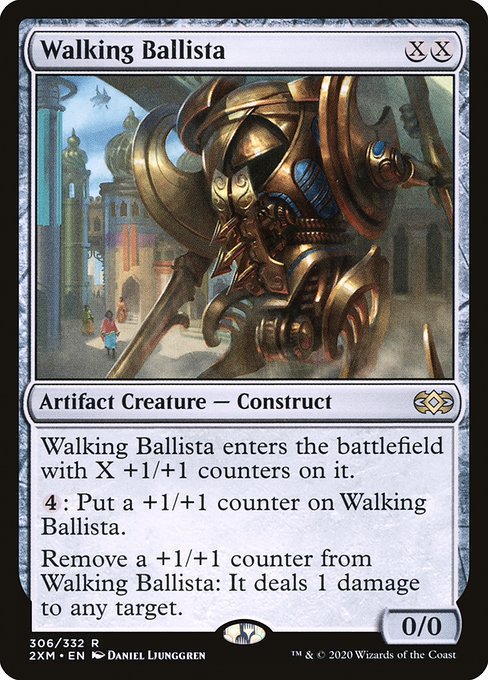
The plus-one effects: Hardened Scales for , Conclave Mentor in Selesnya, Winding Constrictor in Golgari (it works on every kind of counter, including the ones you get), and Ozolith, the Shattered Spire, which for at sorcery speed also puts a counter on something. The doublers: Branching Evolution and Doubling Season. The insurance: The Ozolith catches the counters of any creature you control that leaves and hands them to a creature at your next combat. The reach: Herald of Secret Streams makes your creatures with +1/+1 counters unblockable, and Walking Ballista turns counters into damage at instant speed, which is how a counters deck wins through a board it cannot attack into. And Nesting Grounds, a land that moves a counter from one permanent to another at sorcery speed, which is how a shield counter or a lore counter ends up somewhere useful.
What moves a counters list between brackets
A bracket belongs to the list. Put Ghave on a precon-level 99 (the power of an unmodified preconstructed deck) and the list sits near the bottom of the scale; put the Altar loops in and the deck plays above that, so name the loops to the table whatever number the calculator gives. Our calculator follows the official system: a single Game Changer (a card on the official list of high-impact cards) or a two-card infinite combo it recognises puts a list at Bracket 3 at least, and it takes more than three Game Changers, mass land denial or a lock (a combination that stops opponents playing the game) to read Bracket 4. The counters staples themselves are not what it counts. Run your list through the bracket calculator before you tell the table a number, and if you are choosing a commander to suit a specific table, our Bracket 3 commanders and Bracket 4 commanders lists are built around the table.
Two rules the counters deck learns the hard way
First, you choose the order of your own replacement effects. Hardened Scales adds one, Doubling Season doubles, and because you control the creature receiving the counters, you decide which applies first. Add first, then double: one counter becomes two and then four. Double first and it becomes two and then three. The gap is one counter per placement until a doubler like Kalonian Hydra multiplies the pile, and then it is a big one.
Second, Walking Ballista for X equals zero still dies with Hardened Scales out. Scales and every other plus-one effect only apply when one or more counters would be put, and zero is not one or more. The same goes for Doubling Season, since twice nothing is nothing. If the plan is to grow a Ballista from scratch, cast it for one.
When you have picked a tier and a commander, build the list on Nerd Leagues, where the bracket audit sits next to the decklist and the deck's own rating tells you whether the counters are winning.



Comments
Join the conversation.