

The Best Treasure Commanders in EDH, Ranked by How Much Gold the Commander Makes on Its Own

The best Treasure commanders in EDH do one thing the rest of the format envies: they turn ordinary game actions into mana. A Treasure is an artifact token with " , Sacrifice this token: Add one mana of any color," and a commander that makes them every turn is ramp, color fixing, artifact count and sacrifice fodder in one card. This ranking is by two things: how much Treasure the commander produces on its own, with no help from the other 99 cards, and whether the commander gives you something to do with the pile. A commander that needs ten other cards before the first Treasure appears sits below one that pays you every turn by itself.
One note about brackets before the list. A deck's bracket belongs to the 99, not to the commander, so none of these entries comes with a number stapled to it. The last section covers the Game Changers (cards on the official list that the bracket system treats as a step up in power) that suit the archetype. If you want commanders sorted by bracket rather than by what they do, our bracket 3 commanders and bracket 4 commanders lists do that job.
1. Prosper, Tome-Bound
Prosper, Tome-Bound costs 

 for a 1/4 with deathtouch, and it has never needed a second card to work. At the beginning of your end step it exiles the top card of your library, which you may play until the end of your next turn, and whenever you play a card from exile you create a Treasure. That is a card and a Treasure every turn from a four-mana commander. The window covers your opponents' turns, so an instant exiled at your end step can be cast on someone else's turn and still pays you.
The best habit with Prosper is to play the exiled land instead of the one in your hand. "Play a card from exile" includes lands, so the exiled land is a free Treasure and the land in hand is a spare for later. Red adds more exile-to-play: Light Up the Stage exiles two cards for the same kind of window, Laelia, the Blade Reforged exiles one on each attack, and Wild-Magic Sorcerer gives the first spell you cast from exile each turn cascade (exile cards from the top of your library until you hit a cheaper nonland card, then cast it free). Prosper can't take a Background (a second-commander enchantment) because it lacks the ability that allows one, but Passionate Archaeologist still works from the 99, since it gives every commander creature you own "Whenever you cast a spell from exile, this creature deals damage equal to that spell's mana value to target opponent."
Spending the gold is where black comes in. Marionette Master makes a target opponent lose life equal to its power each time one of your artifacts goes to the graveyard, so cracking five Treasures for mana is also a drain. Mayhem Devil pings for every sacrifice at the table, including opponents cracking their own Treasures. Revel in Riches wins the game at your upkeep with ten Treasures, and the trap with it is counting: it checks for ten as your upkeep begins and again as the trigger resolves, so a single artifact removal spell in response stops the win. Hold one or two above ten before you rely on it. Jeska's Will and Bolas's Citadel are both Game Changers and both at home here, since the Citadel's ", Sacrifice ten nonland permanents: Each opponent loses 10 life" can eat Treasures, so a Prosper list with either is bracket 3 at minimum by definition.
2. Magda, Brazen Outlaw
Magda, Brazen Outlaw is a two-mana 2/1 in mono-red whose first line makes her a Dwarf lord (your other Dwarves get +1/+0) and whose other two lines make her a tutor. Whenever a Dwarf you control becomes tapped, you create a Treasure, and "Sacrifice five Treasures: Search your library for an artifact or Dragon card, put that card onto the battlefield, then shuffle" has no tap symbol and no timing restriction. Five Treasures is any artifact or Dragon in your deck, on the battlefield, at instant speed, and never cast, so nobody counters it.
"Becomes tapped" is the part to build around. Attacking taps Dwarves, but so does crewing a Vehicle (tapping creatures whose total power is at least the crew number so the Vehicle becomes a creature), and you may tap more creatures than the crew number needs. Three Dwarves into Hoard Hauler is three Treasures before it swings, and when the Hauler deals combat damage to a player you get a Treasure for each artifact that player controls. Storm-Kiln Artist is a Dwarf that also makes a Treasure for each instant or sorcery you cast. Seven Dwarves lets you run up to seven copies of a two-mana Dwarf, and with Magda's +1/+0 a single one crews the Hauler, so the question each turn is how many more you want to tap into it for Treasure.
What you fetch decides the game. Hellkite Tyrant takes every artifact a player controls when it connects, and it wins at your upkeep if you control twenty or more artifacts, so stolen rocks and your own Treasures count toward the same twenty. Portal to Phyrexia makes each opponent sacrifice three creatures on arrival and reanimates a creature from any graveyard at each of your upkeeps, and Magda puts it onto the battlefield for five Treasures instead of nine mana. The trap: Magda is a 2/1 that attacks into a table that knows what she does. Make your Treasures by crewing and let her stay home once the first tutor has fired.
3. Tivit, Seller of Secrets
Tivit, Seller of Secrets costs 

 for a 6/6 flyer with ward (a spell or ability an opponent aims at it is countered unless they pay ). Whenever Tivit enters or deals combat damage to a player, every player votes for evidence or bribery, and you vote twice. Each evidence vote has you investigate (create a Clue, an artifact with ", Sacrifice this token: Draw a card"); each bribery vote creates a Treasure for you. Every vote at the table makes a token for you, so one Tivit trigger in a four-player game is five artifacts, and your opponents only get to choose which kind. Your own two votes are the guaranteed Treasures; the rest depends on the table.
That output is why Tivit tables run hotter than the rest of this list. Academy Manufactor turns each Clue or Treasure into one of each (a Clue, a Food, an artifact you can pay , tap and sacrifice to gain 3 life, and a Treasure), so five tokens become fifteen. Time Sieve reads ", Sacrifice five artifacts: Take an extra turn after this one," and a Tivit that connects every turn refills the five every turn. Chaining extra turns like that is bracket 4 territory by the bracket rules themselves, so a Tivit list with Time Sieve has already picked its table. Without the Sieve, Tivit is still the biggest token producer here per trigger, two to five of them Treasures depending on the vote.
4. Jolene, the Plunder Queen
Jolene, the Plunder Queen is a red-green 2/2 for  with three lines of text that pull in different directions. Whenever a player attacks one or more of your opponents, that attacking player creates a Treasure. If you would create any Treasures, you create one more. Sacrifice five Treasures: put five +1/+1 counters on Jolene. The first line pays the whole table to attack anyone but you, the second adds one Treasure to every batch you make, and the third turns the spare gold into a commander that threatens lethal: ten Treasures make her a 12/12, two commander-damage hits, and because the ability has no timing restriction you can sacrifice them after blockers are declared.
Read the first ability carefully before you build around it: the attacker gets the Treasure, not you. When you attack, you make one and Jolene's second ability makes it two. When an opponent attacks a different opponent, they get paid and you get nothing except attacks pointed away from you, which is the whole political engine. Green adds the raw producers. Old Gnawbone makes a Treasure for each point of combat damage your creatures deal to a player, plus one more from Jolene per trigger. Bootleggers' Stash gives every land you control ": Create a Treasure token." Parallel Lives doubles tokens, and because the Treasures are being created for you, you choose the order the two effects apply: add Jolene's extra Treasure first, then double, so a batch of three becomes eight rather than seven. Brass's Bounty with eight lands is nine Treasures for seven mana.
5. Ziatora, the Incinerator
Ziatora, the Incinerator is a six-mana 6/6 flyer in black, red and green. At the beginning of your end step you may sacrifice another creature; when you do, Ziatora deals damage equal to that creature's power to any target and you create three Treasures. Three Treasures every end step is the steadiest big output on this list, and it comes with a removal spell or a face hit attached. The cost is six mana and a creature a turn, so the deck is built from things that want to die.
Rapacious Dragon enters with two Treasures and leaves as three more plus three damage. Old Gnawbone and Ancient Copper Dragon make Treasure when they connect and make fine sacrifices once the table has blockers for them. Pitiless Plunderer adds a fourth Treasure to every Ziatora trigger, since the sacrificed creature is another creature of yours dying. The sequencing point: Ziatora's trigger is at your end step, so you can tap your lands out in your main phase and still have three Treasures up for instant-speed removal on the opponents' turns.
6. Mahadi, Emporium Master
Mahadi, Emporium Master costs  and creates a Treasure at your end step for each creature that died this turn. Not each creature of yours: each creature, including your opponents' and including tokens. That makes Mahadi the Treasure commander for aristocrats decks (decks that sacrifice their own creatures for value), the shell our aristocrats commanders post covers.
Pitiless Plunderer and Mayhem Devil are the usual payoffs, Viscera Seer is the one-mana sacrifice outlet (a card that lets you sacrifice at will), and Deadly Dispute draws two and makes a Treasure for and a creature or artifact you were about to lose anyway. Mahadi only counts deaths on your own turn, so do your killing then, and a sweeper takes Mahadi with it: cast Blasphemous Act in your first main phase, recast Mahadi in your second (its cost plus the commander tax), and the end-step trigger still counts every creature that died this turn, the first Mahadi included. Marionette Master and Disciple of the Vault then turn the pile into life loss when you crack it.
7. Lotho, Corrupt Shirriff
Lotho, Corrupt Shirriff is a two-mana white-black Halfling with one ability: whenever a player casts their second spell in a turn, you lose 1 life and create a Treasure. Every player counts, you included, so at a table of players casting a ramp spell and a creature each turn Lotho pays out three or four times a round for two mana. The life loss is capped at 1 per player per turn, because only the second spell counts, so even a storm deck (one that casts a pile of spells in a single turn) costs you 1 life on its turn.
White-black is the best payoff pair for Treasure. Smothering Tithe (a Game Changer) is a second Lotho that triggers on draws instead of spells. Revel in Riches wins at ten Treasures, and Lotho reaches ten faster than any two-mana commander should. Marionette Master and Disciple of the Vault make the cracking hurt, Academy Manufactor adds a Clue and a Food to every Treasure, and Mondrak, Glory Dominus doubles every batch. The sequencing on your own turn: cast your cheapest spell first, because the Treasure from your second spell arrives in time to pay for a third. Lotho is also a 2/1 nobody bothers to remove, which in this archetype is the whole point.
8. Smaug the Magnificent
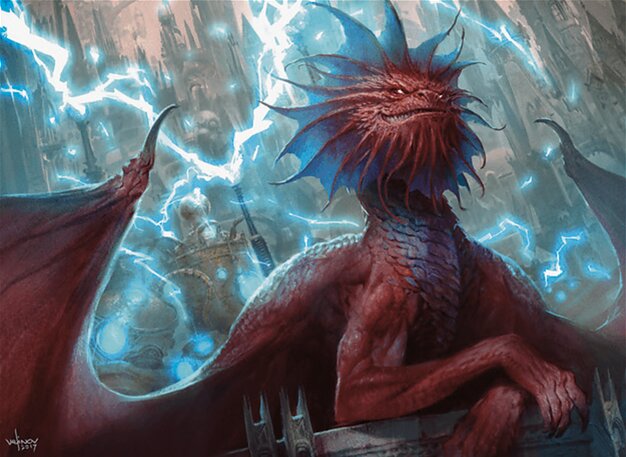
Smaug the Magnificent, from The Hobbit, is a mono-red 4/3 flyer with haste for . At the beginning of your upkeep you create a Treasure, and whenever Smaug attacks, he deals damage equal to the number of Treasures you control to any target. One Treasure a turn with no setup is a modest rate, but the payoff is printed on the same card, and it scales with the one thing a Treasure deck is already doing.
The rule to play by: the Treasures are the ammunition, so crack them after the attack trigger resolves, never before combat. Cast Brass's Bounty in your first main phase and attack the same turn: eight lands are eight more points of damage before anyone can answer the pile. Xorn adds one to every batch, so the upkeep Treasure becomes two. Goldspan Dragon is the other hasty flyer, makes a Treasure whenever it attacks, and lets every Treasure tap for two mana, which means the pile you are holding for Smaug still casts something big when you finally spend it. When the two attack together, put Smaug's trigger on the stack first so Goldspan's Treasure arrives before Smaug counts. Hellkite Tyrant is in color as the alternate win at twenty artifacts.
9. Ognis, the Dragon's Lash
Ognis, the Dragon's Lash costs 
 . Those hybrid symbols put black, red and green in its color identity, so you can cast it for and still build a three-color deck around it. Ognis has haste, and whenever a creature you control with haste attacks, you create a tapped Treasure. Tapped is the catch: the mana arrives on your next turn, not this one, so Ognis decks plan a turn ahead rather than spending as they go.
The build is haste tribal. Fervor gives your creatures haste, Rhythm of the Wild gives your nontoken creatures riot (enter with a +1/+1 counter or haste), and Ogre Battledriver gives each new creature haste and +2/+0 the turn it arrives. Goldspan Dragon already has haste, makes a Treasure when it attacks, and makes every Treasure you control tap for two mana instead of one, which turns Ognis's tapped Treasures into a doubled mana bank for the following turn. Grim Hireling adds two untapped Treasures whenever your creatures connect, which covers the this-turn mana Ognis itself never provides.
10. Vraska, the Silencer
Vraska, the Silencer costs and has deathtouch. Whenever a nontoken creature an opponent controls dies, you may pay ; if you do, that card returns to the battlefield tapped under your control as a Treasure artifact that has lost its other card types. Their dead creature is now your mana, and it stays out of their graveyard only while you keep it: crack it and the card goes back to its owner's graveyard as a creature card, so against a reanimation deck hold the big ones and spend the small ones. Vraska makes Treasure at the speed your opponents' nontoken creatures die, which is slower than anything above her on a quiet table and among the fastest after a sweeper, if you kept up for each body you want.
Revel in Riches is the obvious partner: it creates a Treasure whenever an opponent's creature dies and wins at ten, and each nontoken death now produces two Treasures between the two cards. Tireless Provisioner makes a Treasure on each land drop to keep the count moving on turns when nothing dies, and Bootleggers' Stash does the same from every land. Deadly Dispute turns a claimed card you don't want to keep into two cards and a fresh Treasure. Kill their creatures on their turn where you can: a card claimed then enters tapped but untaps in time for yours.
Seven more worth a look
- Vihaan, Goldwaker makes no Treasure itself, which keeps it out of the ten, but it spends them differently: at the beginning of combat on your turn, your Treasures may become 3/3 Construct Assassin artifact creatures until end of turn. Assassins are outlaws (Assassins, Mercenaries, Pirates, Rogues and Warlocks), and Vihaan gives your other outlaws vigilance and haste, so the Treasures attack the turn they arrive, stay untapped, and can still be sacrificed for mana after combat. A Treasure that dies as a 3/3 is gone, so attack with the ones you were going to crack this turn anyway.
- Gadrak, the Crown-Scourge is a three-mana red Dragon that makes a Treasure at your end step for each nontoken creature that died this turn, anyone's, and can't attack until you control four artifacts. A mono-red Mahadi that counts nontoken deaths only.
- Captain Lannery Storm makes a Treasure whenever she attacks and gets +1/+0 whenever you sacrifice one. Three mana, haste, mono-red, and a fine first Treasure deck.
- Mr. House, President and CEO rolls dice: a 4 or higher makes a 3/3 Robot, a 6 or higher makes the Robot and a Treasure, and his
 ability rolls an extra die for each Treasure mana spent on it. The Treasure feeds the dice and the dice feed the Treasure.
- Vazi, Keen Negotiator gives Treasure to an opponent, then rewards you with a +1/+1 counter and a card every time an opponent spends Treasure mana on a spell or ability. A group-hug commander (one that helps every player) for people who like being paid to be generous; our group hug commanders post has the rest of that family.
- Jan Jansen, Chaos Crafter taps to sacrifice an artifact creature for two Treasures or a noncreature artifact for two 1/1 Constructs. The Constructs are artifact creatures, so the two abilities feed each other one activation at a time.
- Kalain, Reclusive Painter brings one Treasure with her and gives other creatures a +1/+1 counter for each Treasure mana spent to cast them. Better as a card in the 99 of any black-red deck above than as the commander.
The payoffs every Treasure deck shares
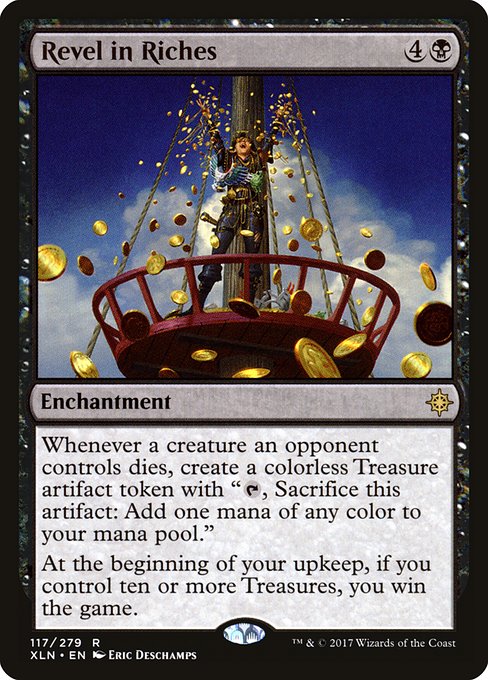
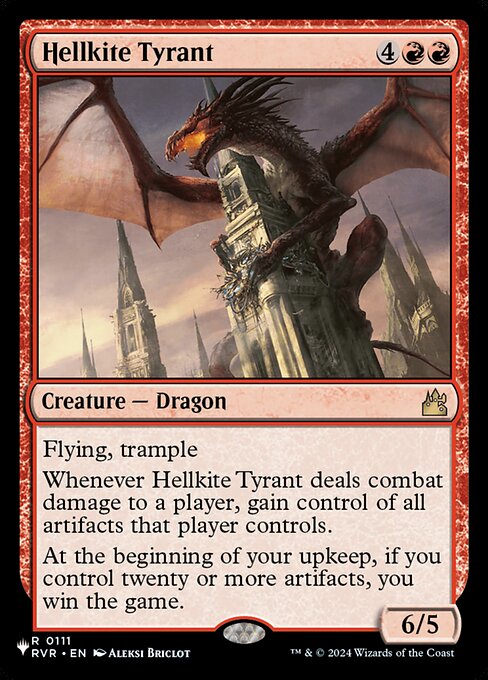
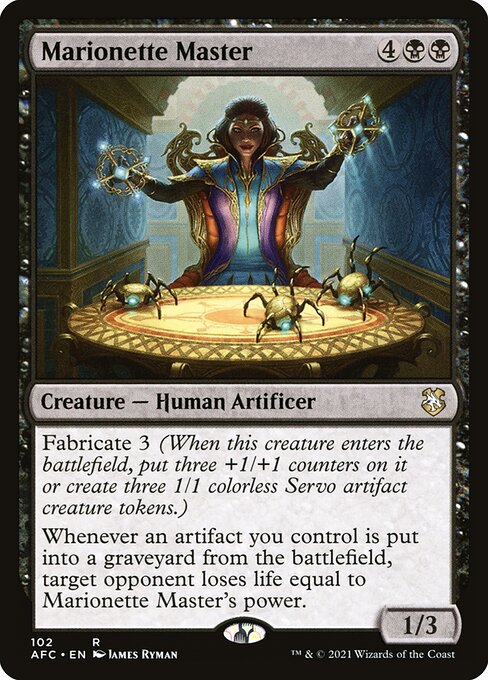


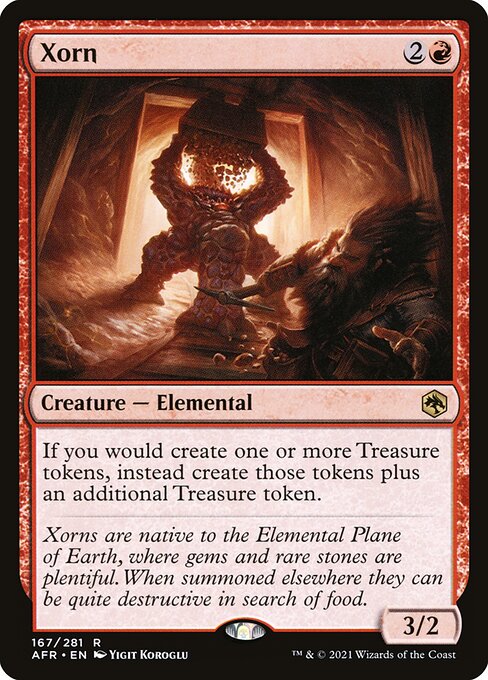
Color identity permitting, the same handful of cards decides whether the Treasure wins or just ramps. Revel in Riches is the alternate win at ten. Hellkite Tyrant is the alternate win at twenty artifacts. Marionette Master and Disciple of the Vault turn cracked Treasure into life loss, Academy Manufactor turns one token into three, Xorn adds one to every batch, and Goldspan Dragon makes each Treasure worth two mana. Treasure Map // Treasure Cove is three Treasures after three scries (scry 1: look at the top card of your library and keep it there or put it on the bottom) and then a land that trades Treasure for cards. One card you will still see in old lists is Dockside Extortionist, which has been banned in Commander since September 2024; leave it out.
Which bracket your Treasure deck is
A deck with any Game Changer is bracket 3 at minimum, and four Game Changers suit a Treasure deck especially well: Smothering Tithe in white, Bolas's Citadel in black, and Jeska's Will and Gamble in red. Chaining extra turns is bracket 4 by the rules, which settles the Tivit and Time Sieve question. Past those lines the number comes from the rest of the 99, so paste the list into the bracket calculator and read the audit, remembering that it counts what is on the list: a loop that depends on Tivit connecting every turn is something you declare to your table, not something a card count shows. Our Negan deck tech shows a finished Treasure sacrifice list from the inside, and the artifact commanders ranking covers the commanders that care about the artifact count rather than the mana.
Once the deck exists, note the Treasure count at the table, record the result, and let the deck's own rating show whether the pile was ever spent on anything.


Comments
Join the conversation.