

What's a Good Win Rate in Commander? Our Pod's Real Numbers

In a four-player pod, 25% is break-even: four decks, one winner, so an average deck wins one game in four. Hold a deck above 30% across twenty-plus games and it's good. Our pod logs its games on Nerd Leagues, so we checked our own records against that line.
Why 25% Is the Break-Even Win Rate in Commander
Every game of Commander has exactly one winner, so your fair share is one divided by the number of players: 33% in a three-player game, 25% at a full table of four, 20% when a fifth friend shows up.
That's why a Commander win rate looks so low next to one-on-one Magic. A deck that wins 40% of its four-player games isn't mediocre. It's taking 60% more than its share.
Our log mixes three-, four- and five-player pods with the odd duel, so treat 25% as a yardstick here, not a law.
What Our Pod's Real Commander Win Rates Look Like
Thirty-one of our decks have at least ten logged games. Here's how they split against the one-in-four line:
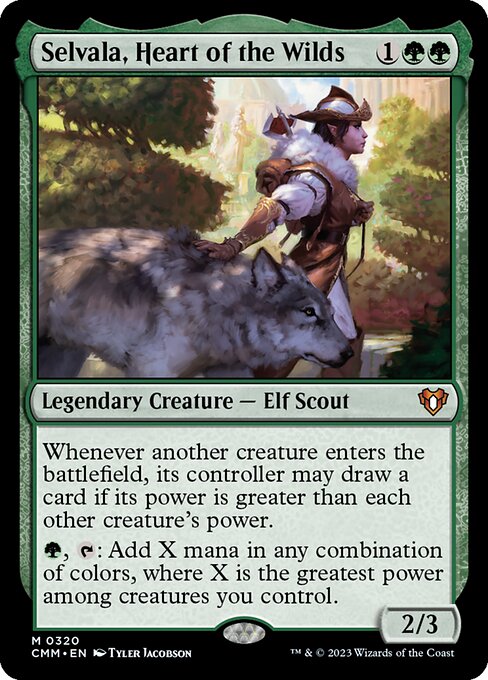
- Five win more than half their games. Grande's Tatyova, Benthic Druid (7-3) and Ygra, Eater of All (7-4), DonSpider's Bruna, Light of Alabaster (15-11), and RuricMo's Atla Palani, Nest Tender (14-12) and Selvala, Heart of the Wilds (7-6).
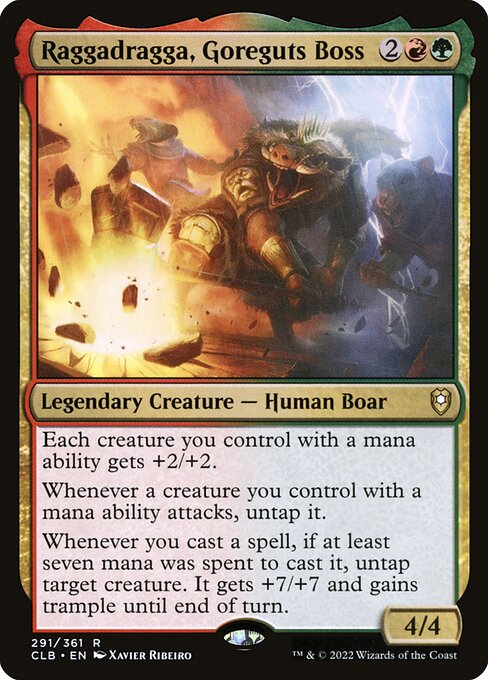
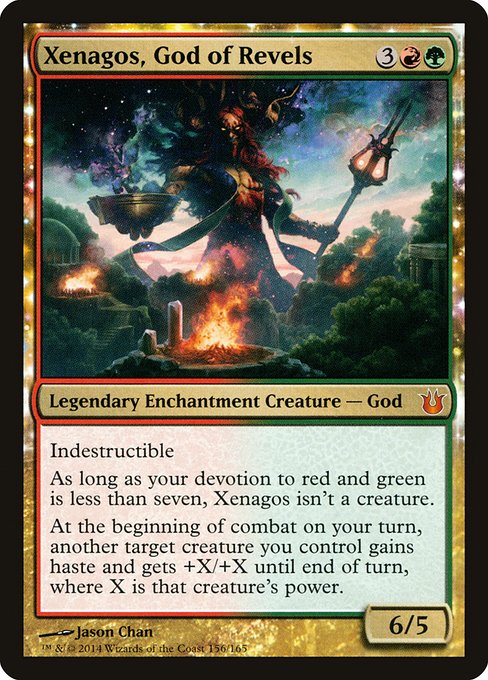
- Thirteen sit between 25% and 50%. Most of the decks we'd call good live here, including my Raggadragga, Goreguts Boss (10-16) and Xenagos, God of Revels (10-20).
- One sits exactly on the line at 4-12.
- Twelve are under water, from 5-18 all the way down to 0-13.
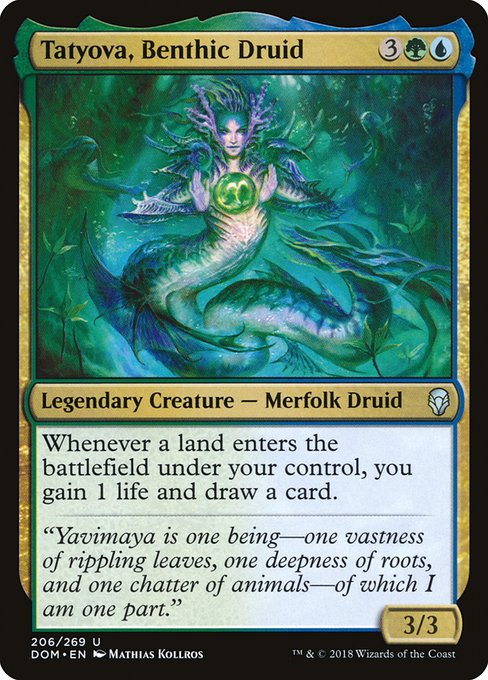
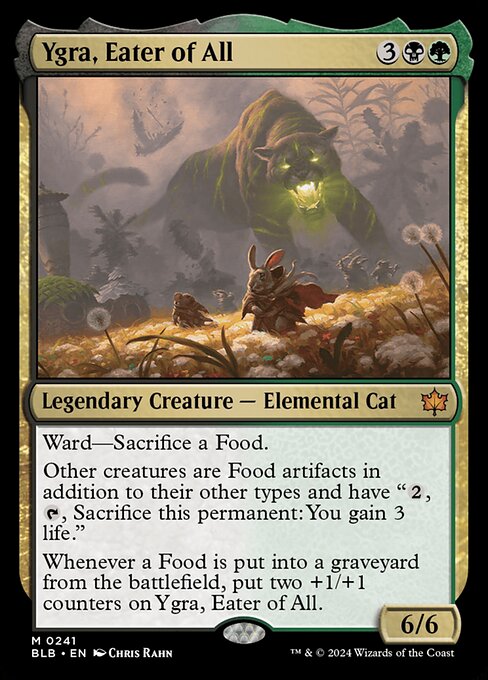
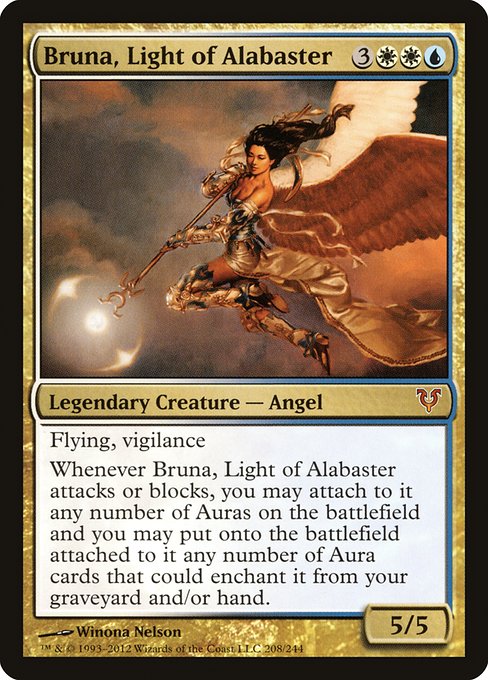
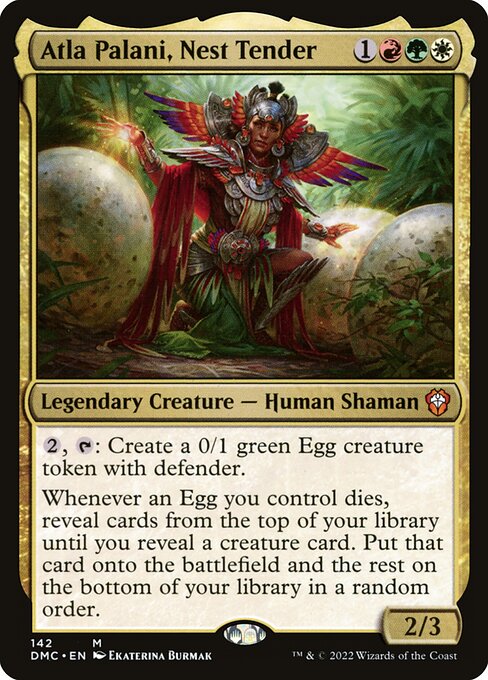
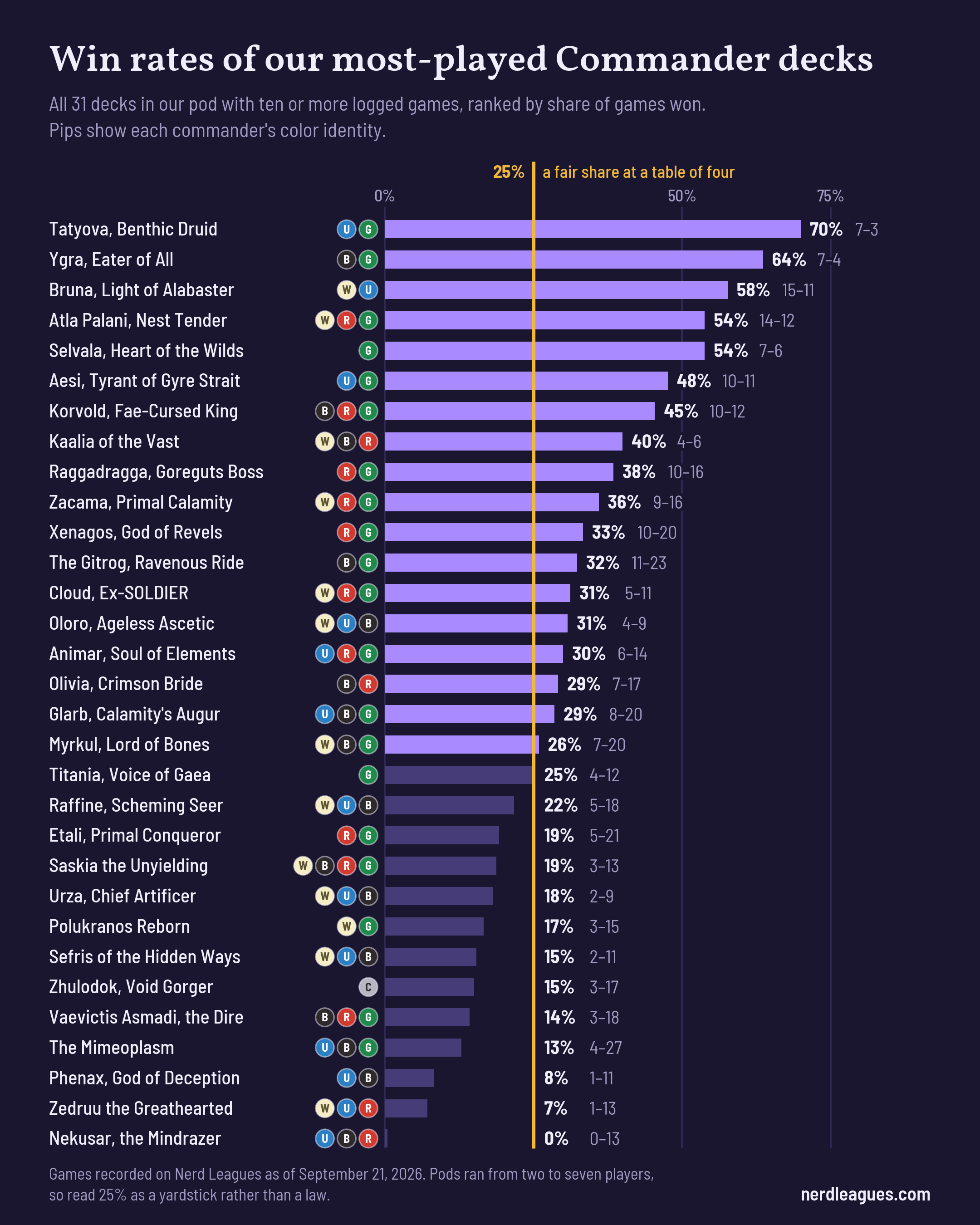
Eighteen of 31 beating their share sounds impossible until you remember that many of those games had three players, where the share is 33%, and that the losses pile up on a few decks at the bottom.
Bruna's 15-11 is the best sustained record we have, and the table knows it. There's a full breakdown of that deck's recent games, target on its back and all.
Why Our Winningest Decks End the Game in One Turn
Look at what those five decks do and a pattern shows up: none of them wins by grinding.
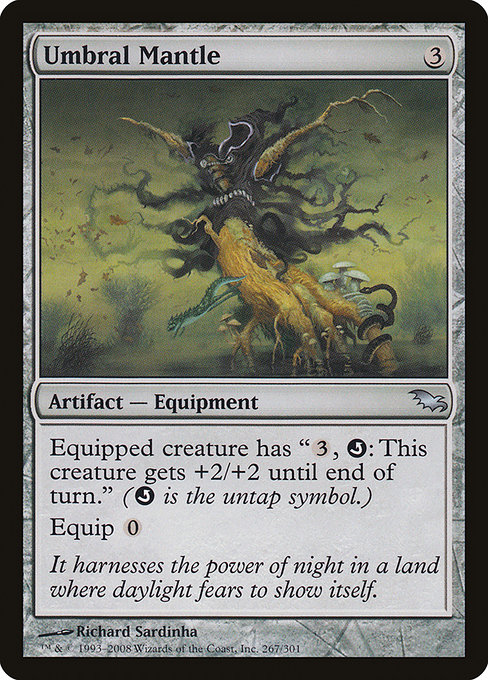
Bruna is voltron, meaning one commander suited up with Auras until it kills a player in a single hit, and her write-ups are full of one-shot kills. Atla Palani's mention a turn-four win and popping off on somebody else's end step. Selvala makes infinite mana with Umbral Mantle. Ygra has a logged turn-four win. Tatyova's recent write-ups are huge all-in attacks plus one Laboratory Maniac combo.
In a duel, a slow deck only has to out-grind one opponent. In a pod it has to survive three players' removal, attackers and attention, every turn cycle, until it gets there. A deck that goes from "fine" to "everyone is dead" inside one turn spends far less time exposed. At our table, that's the trait the winners share.
The Card That Keeps Ending Our Commander Games
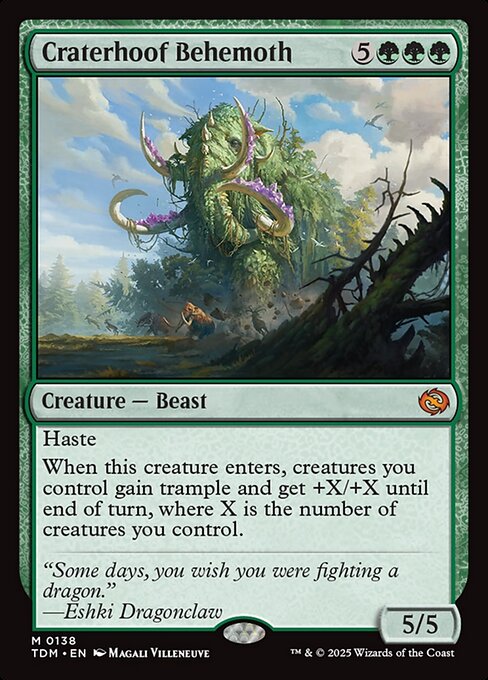
When somebody wins, they usually type a line about how. One card keeps turning up in those lines: Craterhoof Behemoth. Nine winning write-ups this year name it, and five different players have logged one.
It costs 
 , has haste, and when it enters, your creatures gain trample and get +X/+X until end of turn, where X is the number of creatures you control. A harmless-looking board of tokens becomes lethal for the whole table at once. RuricMo logged a Craterhoof attack for 97 damage. Grande pointed a kicked Rite of Replication at one to end this four-player game, and signed off like this:
"Combat damage, good honest magic the way Richard Garfield, PHD, intended."
One caveat: that's a count of write-ups, not wins. Plenty of games get logged with no comment, so read it as "keeps coming up," not as a percentage.
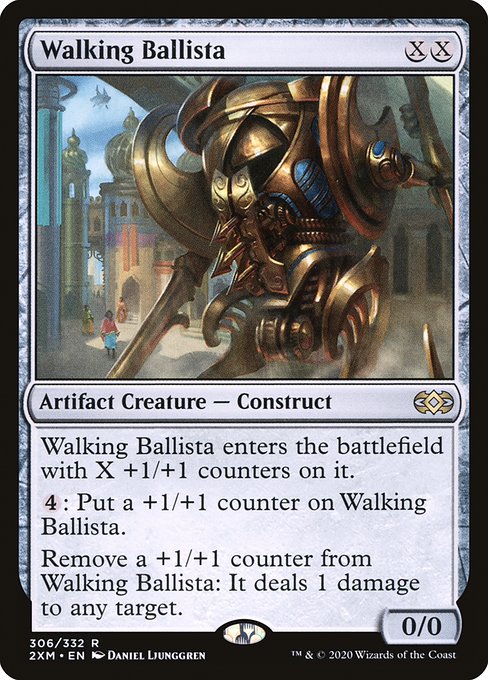
The combo decks have their own version. Walking Ballista shows up in at least seven of my winning write-ups, always as the place infinite mana goes to become infinite damage. Different card, same lesson: winning decks have a specific way to end the game. If yours builds a board and then stalls, start with how to actually close out a game of Commander.
The Commander Strategies That Keep Losing at Our Table
Three of our decks share a theme and a fate:
- DonSpider's Nekusar, the Mindrazer: 0-13
- DonSpider's Zedruu the Greathearted: 1-13
- My Phenax, God of Deception mill deck: 1-11
That's two wins in 39 games. Nekusar hands every player an extra card each turn and pings opponents for every card they draw. Zedruu rewards you for giving your permanents away. Phenax turns your creatures into mill engines, putting cards from a library straight into the graveyard until somebody can't draw.
In a duel those plans work fine. In a pod, extra cards help three opponents find their answers and their own win conditions, and the player who dealt them gets blamed anyway. Mill has to chew through three libraries instead of one. We made the longer case in our honest look at mill in Commander, and the log agrees with it.
That doesn't mean you shouldn't play them. DonSpider's Mimeoplasm deck has the most losses of anything we own at 4-27, and there's a whole post about why that self-mill deck got built anyway. A win rate tells you what to expect, not what to enjoy.
Why a Win Rate Alone Can Mislead You
Two problems with everything above. First, sample size: Tatyova's 70% is ten games, which is a hot streak, not a verdict. Second, a raw win rate treats a win over one opponent exactly like a win over four.
That second gap is what a rating is for. On Nerd Leagues every deck carries its own ELO, a chess-style rating, separate from its pilot's, and how far a result moves it depends on how many players were in the game. The guide to player ELO versus deck ELO explains why your number and your deck's number drift apart.
How to Find Your Own Commander Win Rate
You can't answer this one from memory. Everyone remembers the blowouts and forgets the quiet third-place finishes, which is how a 20% deck becomes "pretty strong" in its owner's head.
So write it down. Anyone at the table can record the result: who played, which deck, who won. Every rating updates right away, and it's free. Setting up a league for your pod takes three fields. Give it twenty games, then look at which of your decks actually beats one in four.



Comments
Join the conversation.