

Six Questions to Answer Before You Build a Ghalta, Primal Hunger Commander Deck
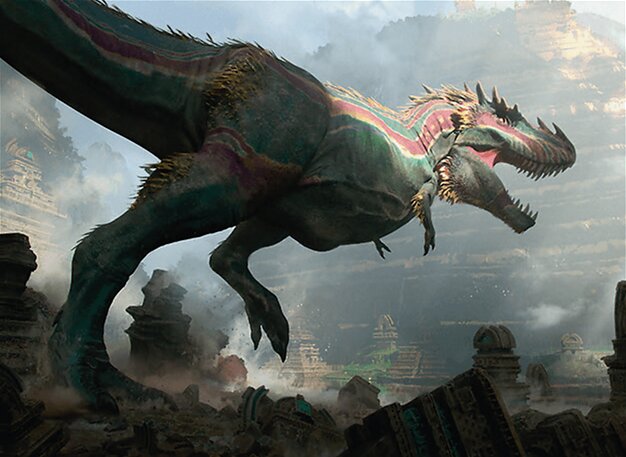
Ghalta, Primal Hunger is a 12/12 with trample (excess combat damage past a blocker carries through to the player) for 
 , and the spell costs
 less where X is the total power of creatures you control. His own reduction only removes generic mana, so it stops at ; Defiler of Vigor can take one more off for 2 life. A Ghalta, Primal Hunger commander deck is therefore an arithmetic problem before it is anything else: how fast can you put ten power on the table, and what do you do with a 12/12 once it is there. This is our Bracket 3 build (the Upgraded tier of the official Commander brackets), and instead of a tour of the list, here are the six questions we had to answer to build it, each with the answer we settled on.
How early can Ghalta actually come down?
Turn four in most games, and turn three when the hand cooperates. The reason is a short list of cheap creatures with outsized power. For three mana: Steel Leaf Champion is a 5/4, Pugnacious Hammerskull a 6/6, Wayward Swordtooth a 5/5, and Slumbering Trudge a 6/6 for  , or for with a catch covered below. Old-Growth Troll and Yorvo, Lord of Garenbrig are 4/4s for , and Yorvo grows with every other green creature we control that enters after it. Two of the five- and six-power ones plus a mana creature is eleven to thirteen power, and Ghalta's is gone.
The standard line: Forest and Elvish Mystic on turn one, Forest and Steel Leaf Champion on turn two, Forest and Hammerskull on turn three for twelve power, then Ghalta for on turn four with three mana left over. The best use of those three is Swiftfoot Boots and its  equip: Ghalta gets haste, and he, the Hammerskull and the Champion attack for twenty-three on the turn he lands.
Turn three follows from Trudge. Its cost is and it enters with three minus X stun counters, tapped if X is 2 or less, so for it is a 6/6 that will not untap for three of our untap steps. Ghalta does not care. He counts power, not availability, so a one-mana elf on turn one, any of the three-drops on turn two and Trudge for on turn three put twelve power down with Ghalta for that same turn and to spare for Snakeskin Veil. One hasty version uses Sol Ring: Forest and Sol Ring on turn one; turn two Forest, Trudge for , and Hammerskull paid with the Sol Ring's  and the other Forest, for twelve power on turn two; turn three Forest, Ghalta for off two Forests, and the Sol Ring plus the third Forest pay for the Boots and the equip, so a 12/12 with haste attacks on turn three. Another needs no Sol Ring at all: an elf on turn one, Trudge for and Lightning Greaves on turn two, then Frenzied Baloth for on turn three (ten power), Ghalta for , and the
 equip, with the Baloth making Ghalta uncounterable on the way. The same logic keeps Swordtooth, which cannot attack or block until you control ten permanents, and Topiary Stomper, which cannot until you control seven lands, in the list: they are Ghalta mana first and bodies later.
Hammerskull has its own catch: it takes a stun counter whenever it attacks while you control no other Dinosaur. Ghalta is an Elder Dinosaur, and Swordtooth, Stomper, Gigantosaurus (a 10/10 for ), Quakestrider Ceratops (a 12/8 for  ), Agonasaur Rex (an 8/8 trampler for ) and Hulking Raptor are Dinosaurs too, so the Hammerskull usually attacks freely from its second turn on. The Raptor is a 5/3 that adds at the start of our first main phase and has ward , meaning an opponent's spell or ability that targets it is countered unless they pay more.
The hand to keep has two or three lands, one of the one-mana accelerants (Elvish Mystic, Fyndhorn Elves, Arbor Elf, Wild Growth or Sol Ring; Delighted Halfling counts too, though its colourless mana pays for a Hammerskull and not for Steel Leaf Champion's ) and one of the three-mana five-power creatures. Seven cards of ramp (cheap cards that add mana) with nothing to ramp into goes back, and so does a hand of four six-mana cards.
Does the commander tax ever matter?
Rarely, and when it does, it is because the board is short of power. The commander tax is the extra added to the cost each time you cast your commander from the command zone. It is generic mana, and Ghalta's reduction removes generic mana after the tax has been added. With fourteen power on the table, a Ghalta that has died twice still costs . The first time you recast a twice-killed Ghalta for two mana, expect the table to do the sums out loud.
On an empty board he costs plus a death, and after a sweeper (a spell that removes every creature) the right play is to rebuild power first and recast Ghalta second, even if that means a turn with him in the command zone: twelve power after the first death, fourteen after the second, and the price is again. Heroic Intervention is in the list to skip that turn entirely: at instant speed, and every permanent we control is hexproof (opponents' spells and abilities cannot target it) and indestructible until end of turn.
Against single-target removal the answers are cheap: Snakeskin Veil is for hexproof and a +1/+1 counter, and Swiftfoot Boots gives hexproof and haste for an equip cost of . Lightning Greaves gives shroud and haste for , and shroud cuts both ways: our own Berserk, Boon of Boseiju, Ram Through, Snakeskin Veil, Soul's Majesty and Hunter's Insight cannot target him either, and Equipment does not move at instant speed. The equip does move the Greaves at sorcery speed, so they go on for a turn when he only needs to land and swing, and the Boots carry him on a turn with a pump spell (one that raises power) planned. Delighted Halfling and Frenzied Baloth make the cast itself uncounterable: the Halfling's second ability makes coloured mana that can only be spent on a legendary spell, which then can't be countered, and the Baloth says creature spells we control can't be countered.
How does a deck of giant creatures with almost no text draw cards?
By reading the power of the biggest one. Green's draw spells in this list all scale with power, so a 12/12 turns every one of them into a full refill. Rishkar's Expertise draws twelve and then casts a spell of mana value five or less from the new hand for free. Soul's Majesty draws twelve for  . Return of the Wildspeaker does it at instant speed, or gives every non-Human creature we control +3/+3 if the attack matters more. Momentous Fall sacrifices a creature to draw its power and gain its toughness in life; Greater Good draws the same for no mana, with no life gain, then discards three. Both are the answer to exile, since a targeted Ghalta can be sacrificed for twelve cards and recast for later. Garruk, Primal Hunter's second ability draws the same twelve with nothing sacrificed, and his first makes 3/3 Beasts while he waits. Hunter's Insight draws a card for each point of combat damage Ghalta deals to a player, and trample damage counts.
The engines fill the gaps between those spells. The Great Henge costs  minus our greatest power, so with Ghalta out and behind a Steel Leaf Champion, and then every nontoken creature that enters under our control, cast or not, draws a card and gets a +1/+1 counter. Garruk's Uprising draws whenever a creature we control with power four or more enters, and gives the team trample. Beast Whisperer draws on every creature spell we cast and Outcaster Trailblazer on every four-power creature after it. Selvala, Heart of the Wilds draws a card for the controller of any creature that enters with more power than everything else on the battlefield, so opponents draw off their own biggest entries too, and her ,
 adds mana equal to our greatest power, twelve with Ghalta out.
Then there is Grothama, All-Devouring, the least obvious card in the list. It is a 10/8 for , so on its own it makes next turn's Ghalta cost . Its text gives every other creature "Whenever this creature attacks, you may have it fight Grothama, All-Devouring", and when Grothama leaves the battlefield each player draws cards equal to the damage their sources dealt to it that turn. Attack with Ghalta, have him fight Grothama, and Ghalta deals 12 to an 8-toughness Wurm while taking 10 himself: Grothama dies and we draw twelve. Two cautions from doing this at the table. A 12/12 with 10 damage marked on it dies to any blocker with power two or more, so fight on a turn you are swinging into an open board or do not mind paying to recast him. And the word "other" covers opponents' creatures too, so they can attack, fight Grothama and draw off it before you do.
How does one 12/12 beat three opponents at once?
Faster than the life totals suggest, because of commander damage: a player who has taken 21 combat damage from the same commander loses, whatever their life total. Two connected hits from a 12/12 kill a player, so a lone Ghalta needs six hits for the table, and every doubler in the list turns one hit into 24, which kills on its own. The list carries six ways to double a swing (Tangleweave Armor is the one not covered below: equipped to Ghalta for , it adds +12/+12, since its X is our commander's mana value), and the other two players die to the team.
The cheapest doublers go on Ghalta himself. Fireshrieker gives double strike (first-strike damage and regular damage in the same combat) for an equip cost of : twenty-four from one attack. Berserk is for +12/+0 and trample, cast before combat damage, and the fine print destroys the creature at the end step if it attacked that turn, so it goes on the swing that kills a player, and if you want him to stay, hold Heroic Intervention for the end step, since indestructible until end of turn beats the destroy. The same card is an instant-speed kill spell for an opponent's attacking creature, at the price of the player it is attacking taking the extra damage. Unnatural Growth doubles the power and toughness of each creature we control at the beginning of each combat, including opponents' combats, where Ghalta blocks as a 24/24. Boon of Boseiju adds +X/+X where X is the greatest mana value among our permanents, twelve with Ghalta out, and untaps the creature, so Ghalta attacks and then stands back up to block.
The team finishers close the other two players. Overwhelming Stampede gives every creature we control +X/+X and trample where X is our greatest power, so with Ghalta out a mana elf attacks as a 13/13 trampler. Craterhoof Behemoth does the same with X equal to our creature count and brings its own haste. Goreclaw, Terror of Qal Sisma takes off every four-power creature we cast, and whenever Goreclaw attacks, each four-power creature we control gets +1/+1 and trample. Majestic Genesis reveals twelve cards, Ghalta's mana value even while he is in the command zone, and puts every permanent among them onto the battlefield.
The habit worth building: aim each doubled swing at one player, the one whose blockers soak the least. Trample sends everything past the blocker's toughness through, and a 24-power hit into a 4/4 is 20 commander damage, one short of the kill. Berserk and Boon are instants that can be cast after blockers are declared, so wait for the blocks and spend them only when the 24 gets through. Our finishers guide covers Stampede, Craterhoof and the rest of green's options.
What kills this deck, and what do you do about it?
Sweepers, by a distance. A deck that spends its first three turns putting twelve power into three creatures loses all three to one card, and the audit's own note that this list runs little interaction is a fair description: it races rather than answers. Heroic Intervention is the answer to sweepers that destroy or deal damage. It does nothing against one that shrinks or exiles instead, such as Toxic Deluge (every creature gets minus X/minus X) or Farewell (exile), and against those the play is Momentous Fall or Greater Good in response, so the dying board becomes cards. Either way the recast is as soon as ten power plus for each earlier cast is back on the table.
Exile and bounce (returning a permanent to its owner's hand) aimed at Ghalta alone are a smaller problem: Snakeskin Veil and the Boots answer the spell, and the recast answers the ones that get through. Fog effects (spells that prevent all combat damage for a turn) are why Frenzied Baloth is in the list: its last line says combat damage can't be prevented while it is on the battlefield.
Chump blockers (small creatures thrown in front of him) are not a problem, because of trample, and Ram Through handles the one blocker that matters: Ghalta deals twelve to it for , and because he has trample, the excess goes to that creature's controller. Fliers racing us over the top are met by Elder Gargaroth, a 6/6 with reach and vigilance that makes a 3/3, gains 3 life or draws a card every time it attacks or blocks, and by Cactus Preserve, a land that becomes a 12/12 Plant with reach for because its X is our commander's mana value.
For everything else there is Beast Within, Kenrith's Transformation (their commander becomes a 3/3 Elk with no abilities, and we draw a card), Song of the Dryads (anything becomes a Forest), Reclamation Sage, Bushwhack and Kogla, the Titan Ape, a 7/6 that fights on entry and destroys an artifact or enchantment every time it attacks.
What puts this at Bracket 3, and what changed from the average list?
One Game Changer, and nothing else that the brackets count. The deck lives at Ghalta, Primal Hunger Bracket 3, and its bracket audit comes back Bracket 3 on the strength of Worldly Tutor, the one card here from Wizards' Game Changers list. The audit finds no two-card combos, no mass land denial and no extra turns. Worldly Tutor is at instant speed to put any creature on top of the library for the next draw: Hammerskull or Trudge for a turn-three Ghalta, Gigantosaurus for a Ghalta the turn after it lands, Kogla when something needs to die, Craterhoof for the last turn. Our tutors guide has the rest of green's options and notes which ones the Bracket Calculator counts.
Ghalta, Primal Hunger Bracket 3 (EDH)
- 1 Sol Ring
- 1 Fireshrieker
- 1 Lightning Greaves
- 1 Swiftfoot Boots
- 1 Tangleweave Armor
- 33 Forest
- 1 Craterhoof Behemoth
- 1 Elder Gargaroth
- 1 Frenzied Baloth
- 1 Agonasaur Rex
- 1 Gigantosaurus
- 1 Hulking Raptor
- 1 Pugnacious Hammerskull
- 1 Quakestrider Ceratops
- 1 Wayward Swordtooth
- 1 Arbor Elf
- 1 Beast Whisperer
- 1 Elvish Mystic
- 1 Fyndhorn Elves
- 1 Llanowar Tribe
- 1 Steel Leaf Champion
- 1 Reclamation Sage
- 1 Delighted Halfling
- 1 Outcaster Trailblazer
- 1 Managorger Hydra
- 1 Defiler of Vigor
- 1 Ilysian Caryatid
- 1 Slumbering Trudge
- 1 Topiary Stomper
- 1 Sakura-Tribe Elder
- 1 Old-Growth Troll
- 1 Garruk's Uprising
- 1 Greater Good
- 1 Unnatural Growth
- 1 Kenrith's Transformation
- 1 Song of the Dryads
- 1 Wild Growth
- 1 Beast Within
- 1 Berserk
- 1 Boon of Boseiju
- 1 Heroic Intervention
- 1 Hunter's Insight
- 1 Momentous Fall
- 1 Ram Through
- 1 Return of the Wildspeaker
- 1 Snakeskin Veil
- 1 Worldly Tutor
- 1 Castle Garenbrig
- 1 Mosswort Bridge
- 1 Cactus Preserve
- 1 The Great Henge
- 1 Kogla, the Titan Ape
- 1 Goreclaw, Terror of Qal Sisma
- 1 Selvala, Heart of the Wilds
- 1 Yorvo, Lord of Garenbrig
- 1 Surrak, the Hunt Caller
- 1 Grothama, All-Devouring
- 1 Nykthos, Shrine to Nyx
- 1 Garruk, Primal Hunter
- 1 Bushwhack
- 1 Cultivate
- 1 Majestic Genesis
- 1 Overwhelming Stampede
- 1 Rampant Growth
- 1 Rishkar's Expertise
- 1 Soul's Majesty
- 1 Kodama's Reach
- 1 Ghalta, Primal Hunger
Thirteen cards changed from the average Ghalta list, every one for a reason we can state. What came out:
- Scavenging Ooze: cut. A 2/2 that grows one counter at a time is never Ghalta mana.
- Myriad Landscape and Rogue's Passage: cut for Castle Garenbrig and Nykthos, Shrine to Nyx. The Landscape enters tapped and charges more for two Forests; the Passage pays to make unblockable a creature that already tramples. Castle Garenbrig pays and a tap for six that creature spells and creature abilities can use, one more mana than tapping it for . Nykthos pays and a tap for mana equal to our devotion to green (the number of green mana symbols in the costs of permanents we control), and with Gigantosaurus, Steel Leaf Champion, Llanowar Tribe, Old-Growth Troll, Yorvo and Unnatural Growth all paid in green symbols, that is routinely eight or more.
- Disciple of Freyalise: cut. Six mana for the draw mode, and Momentous Fall and Greater Good draw the same cards for less.
- Renata, Called to the Hunt: cut. Her power is our devotion to green, so she is usually a 5/3 or 6/3 for four mana with no trample, and one extra counter on each later creature is small next to the Henge's counter and card.
- Garruk's Packleader: cut. Five mana for a 4/4 that draws on three-power entries; the Henge draws on every entry for less.
- Thrashing Brontodon: cut. Reclamation Sage and Kogla already cover artifacts and enchantments, and the slot went to Kenrith's Transformation, an answer to a creature.
- Colossal Majesty: cut. One card per upkeep for three mana, in a list that draws twelve at a time.
- Arcane Signet: cut. A mana rock (an artifact that taps for mana) adds one mana and no power; for one more mana, Old-Growth Troll adds four power and comes back as a mana source when it dies.
- Traverse the Outlands: cut. At five mana it is either a slow ramp spell early or twelve lands we no longer need late.
- Khalni Ambush: cut. A three-mana fight, which deals damage both ways; Ram Through does it for two without our creature taking damage back, and with trample the excess hits the controller.
- Terastodon: cut. Eight mana, and Craterhoof wanted the slot; its three noncreature destroys are covered by Beast Within and Kogla.
- The third one-mana Elf of the average list: cut for Delighted Halfling. Same cost, but it taps for , or for any colour toward a legendary spell, which then can't be countered; the legendary spell that matters is Ghalta.
What came in, and the question above that explains it: Worldly Tutor (this one), Craterhoof Behemoth and Berserk (the three-opponents question), The Great Henge and Grothama, All-Devouring (card draw), Heroic Intervention, Elder Gargaroth, Kenrith's Transformation and Song of the Dryads (what kills the deck), Castle Garenbrig, Nykthos, Old-Growth Troll and Delighted Halfling (above). Thirteen in, thirteen out, and the land count stays at thirty-seven.
The decklist block above puts the list in your account. The Commander Bracket Calculator will give your own version a number, and the brackets explainer says what that number means at the table.
Keep Reading
Three Life Before Combat: The Frodo, Adventurous Hobbit Commander Deck Plan
November 20, 2026
Betor, Ancestor's Voice Commander Deck: A Bracket 3 Abzan Build That Pays Life on Purpose
November 10, 2026
Comments
Join the conversation.